9-Bit Armies: A Bit Too Far
Learn the build order over lunch, then spend forty hours sharpening it. Ideal for lapsed RTS players; anyone hunting 4X-grade systems depth should look somewhere else.
GamerScout Verdict
Best for lapsed Command and Conquer players who want quick skirmishes and co-op, not deep economic systems.
Compare Prices(4 stores)
Every store in this table quotes us in euros, so the EUR figure is the price the seller actually set, not our arithmetic — which is why EUR is also the currency we rank in. We only list an offer here when the store gives us its price in euros, so nothing in this table is a number we invented.
Pick USD, PLN, GBP, CAD or AUD in the header and we convert from EUR at the European Central Bank reference rate — converted amounts are prefixed with ~. Your bank or the store may apply a different rate at checkout. We never hide offers based on where you are: everyone sees this whole table.
We may earn a commission when you buy games through links on this page — at no extra cost to you. It never affects our rankings or verdicts.
Price History
Screenshots & Media
About 9-Bit Armies: A Bit Too Far
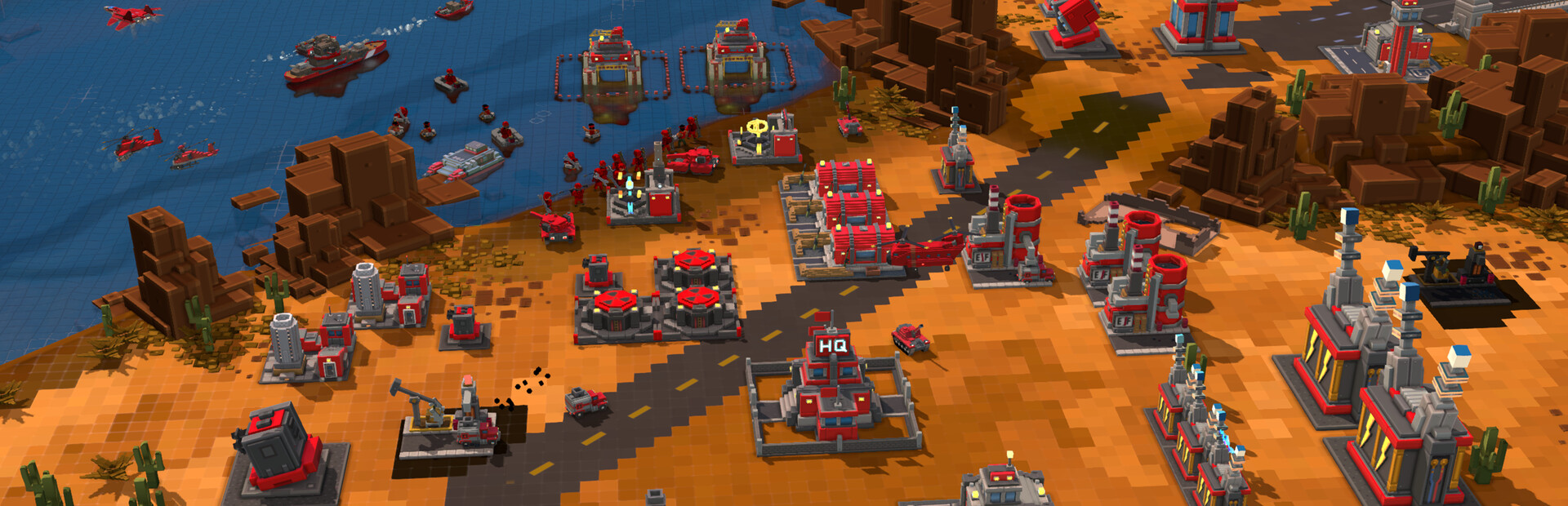
Buy this if Command and Conquer taught you to count production buildings before you count units, and walk away from it if your idea of strategy involves a twelve-page spreadsheet of trade nodes and population modifiers. That one sentence covers most of the audience question, because Petroglyph has spent its whole existence making this exact kind of RTS and the 2024 release is not trying to widen the definition. It is a fast, legible skirmish game wearing voxel armor, and the interesting decisions land at minute six rather than hour six. Mechanically, the loop is the one your hands already know. You claim ground, stack up production, and the whole match hinges on whether you committed to expansion one cycle earlier than your opponent. Land, sea and air all matter, which sounds obvious until you play a map where naval control decides who gets the second expansion and you realize you have been treating water as decoration. My honest read after enough skirmishes to have opinions: the skill ceiling here is macro, not micro. There is no unit in this game that rewards forty actions per minute the way a Protoss blink stalker ball does. What it rewards is knowing, cold, how many seconds behind you are and whether you can afford the tech detour. That is a narrower game than StarCraft II, and it is also a much friendlier one, because a losing position is visible on the minimap instead of hidden inside a mechanics gap you cannot close. The package around it is genuinely well stocked for a game this size. Co-op campaign means the tutorial content is playable with a friend who has never touched an RTS, which is the single best on-ramp this genre has and one almost nobody ships anymore. LAN support for both PvP and co-op is here, not as a checkbox but as a working feature, so a local event does not depend on anyone's connection. There is a level editor and Workshop integration, and that combination is what determines whether an RTS is alive in year three or a ghost lobby. Skirmish AI fills the gap when the lobby is thin, and it is competent enough for practice runs, though I would not call it clever. Higher difficulty settings mostly hand the computer more aggression and better reaction timing rather than better judgment, so once you learn what it opens with, you learn how to punish it, permanently. Where it disappoints depends entirely on what you wanted. If you came from grand strategy or 4X, the decision tree is shallow. There is no diplomacy layer, no research web with meaningful opportunity cost, no economy you can break in three different directions. Your fortieth hour is spent refining execution of a plan you already understand, not discovering a new plan. Unit rosters lean familiar rather than surprising, and the voxel presentation, charming as it is, occasionally costs you readability in a large late-game engagement where everything is the same three colors. Roughly four in five Steam reviewers land positive, and reading between the lines of that split, the unhappy fifth are almost always people who wanted more systems than a self-described throwback was ever going to give them. Here is the case for buying it anyway, especially if you are the person who keeps bouncing off strategy games. Most modern RTS releases ask you to absorb three hundred hours of accumulated meta before you can have a fair match. This one asks for an evening. You can go from your first base to holding your own against a friend inside a weekend, and every concept you pick up here transfers directly upward: expansion timing, army composition against air, when to stop building economy and commit. Treat it as the strategy game that teaches you how to enjoy strategy games, and it earns its place on the drive. Treat it as your next thousand-hour obsession and you will hit the ceiling somewhere around hour fifty, wondering where the rest of it went. I know which of those two players I am recommending it to, and if it is you, you already know.

Strategy & simulation
Tags
System Requirements
Minimum
- OS
- Windows 10
- Processor
- 2.6 GHz Dual Core Processor
- Memory
- 4 GB RAM
- Graphics
- Nvidia Geforce GTX 560 or ATI Radeon RX 550
- DirectX
- Version 9.0
- Storage
- 3 GB available…
Recommended
- OS
- Windows 10 / 11
- Processor
- 2.6 GHz+ Quad Core Processor
- Memory
- 6 GB RAM
- Graphics
- Nvidia GeForce 960 or AMD Radeon HD 6800 Series
- DirectX
- Version…
Keep exploring
Community Discussion
Be the first to comment on 9-Bit Armies: A Bit Too Far.
Reviews & Ratings
Game Info
- Developer
- Petroglyph
- Publisher
- Petroglyph
- Release Date
- Aug 26, 2024