8-Bit Invaders!
Command and Conquer veterans built this lean sci-fi RTS as an on-ramp for genre newcomers, and it mostly delivers, though deep-strategy regulars will hit the ceiling fast.
GamerScout Verdict
Best for lapsed C&C fans and RTS newcomers who want a no-nonsense base-builder; veterans will outgrow it before the credits roll.
Compare Prices(0 stores)
Loading prices...
We may earn a commission when you buy games through links on this page — at no extra cost to you. It never affects our rankings or verdicts.
Price History
Screenshots & Media
About 8-Bit Invaders!
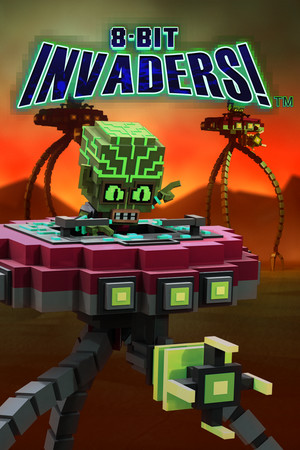
My first read on 8-Bit Invaders was skepticism: a third entry on the same engine from the same studio in the same calendar year feels like franchise fatigue on paper. But Petroglyph has serious pedigree here. Many of the studio's founders worked on the original Command and Conquer at Westwood, and that institutional muscle shows in how cleanly the core loop is assembled. Mine resources, raise buildings, build units, push your opponent off the map. It is a formula that defined a genre in the 1990s, and Petroglyph runs it with genuine competence. The two playable factions are more distinct than they first appear. The Galactic Marine Corps leans on energy management: every structure draws power, and letting your grid go red slows production across the board, so you are constantly weighing expansion against supply discipline. The Cranioids play differently, relying on Motivators to raise a population cap of up to 100 units, and their roster leans into aggressive forward pressure, including acid-pooling xenomorph-style units that punish clustering. Stealth options and special abilities (teleportation for the Cranioids, speed bonuses and stealth for the Marines) add small tactical wrinkles that prevent the two sides from feeling like reskins. The factions are expensive and slower than their counterparts in the sibling titles 8-Bit Armies and 8-Bit Hordes, but they hit harder, which gives matches a distinct tempo. Content volume is the game's clearest selling point. There is a 24-mission solo campaign for each faction that doubles as a structured tutorial, unlocking buildings and units progressively rather than front-loading the tech tree. Secondary objectives carry over as a light progression system: complete them and you carry extra starting units into subsequent missions. The 10-mission co-op campaign is noticeably harder, with the AI enjoying what feels like a resource advantage that forces two human players to coordinate properly. Skirmish maps support 2, 4, 6, and 8-player configurations, and the "Conquer the Multiverse" mode adds a hex-tile metagame layer where you manage tech and economy across multiple locales before dropping into standard RTS battles. It is a nice structural idea, though reviewers and community members generally find it less gripping than the main campaigns. The bigger long-term play is cross-compatibility: if you own any of the three 8-Bit titles, all six factions and all pooled maps become available in multiplayer, which can produce genuinely chaotic six-player skirmishes mixing space marines, fantasy orcs, and medieval pikemen on the same map. The weaknesses are real and consistent across reviews. Unit pathfinding is the loudest complaint: squads will route themselves through hazards, and the medical drone will charge melee range with zero offensive capability because the attack-move command does not discriminate. The AI in skirmish is adequate warm-up practice but rarely provides a serious challenge for anyone who has logged time in classic RTSes. The campaign narrative is a paragraph of exposition per faction and nothing more, so players seeking story context will need to bring their own imagination. And anyone already comfortable with 8-Bit Armies or 8-Bit Hordes will recognize immediately that the engine, interface, and mission structure are essentially identical, with the sci-fi skin and faction mechanics being the primary differentiators. For RTS newcomers, though, the picture is genuinely positive. The single-player campaign respects pacing, the difficulty curve is forgiving without being toothless, and nothing about the base-building logic requires outside reading. Steam users sitting at roughly 82% positive point to approachability and the cross-play system as the consistent highlights. If you are buying into the full 8-Bit trilogy, Invaders is arguably the best standalone of the three given its stronger faction asymmetry. Solo strategy veterans will find the ceiling low, but as an accessible, unpretentious RTS that does what it promises without wasting your time, it earns its place.

Strategy & simulation
Tags
System Requirements
Minimum
- OS
- Windows Vista SP2
- Memory
- 4 GB RAM
- DirectX
- Version 11
- Storage
- 2 GB available space
- Graphics
- Nvidia Geforce GTS 250 or ATI Radeon HD 3870
- Processor
- 2.6 GHz Dual Core Processor
Recommended
- OS
- Windows 7 or newer
- Memory
- 6 GB RAM
- DirectX
- Version 11
- Storage
- 2 GB available space
- Graphics
- Nvidia GeForce 550 Ti or AMD Radeon HD 6800 Series
- Processor
- 2.6 GHz+ Quad Core Processor
Keep exploring
Community Discussion
Be the first to comment on 8-Bit Invaders!.
Reviews & Ratings
No ratings available
Game Info
- Developer
- Petroglyph
- Publisher
- Petroglyph
- Release Date
- Dec 16, 2016