
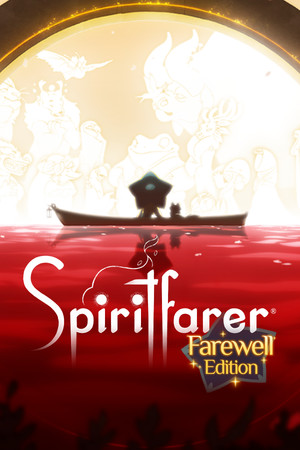
Spiritfarer: Farewell Edition
A management sim with no fail state, a tight resource loop, and goodbyes that actually land. Come for the crafting chains, stay for the schedule you build around other people's needs.
GamerScout Verdict
Best for sim fans who want logistics without pressure and will trade late-game fetch quests for a payoff that lands.
Compare Prices(2 stores)
Every store in this table quotes us in euros, so the EUR figure is the price the seller actually set, not our arithmetic — which is why EUR is also the currency we rank in. We only list an offer here when the store gives us its price in euros, so nothing in this table is a number we invented.
Pick USD, PLN, GBP, CAD or AUD in the header and we convert from EUR at the European Central Bank reference rate — converted amounts are prefixed with ~. Your bank or the store may apply a different rate at checkout. We never hide offers based on where you are: everyone sees this whole table.
We may earn a commission when you buy games through links on this page — at no extra cost to you. It never affects our rankings or verdicts.
Screenshots & Media
About Spiritfarer: Farewell Edition
Around hour fourteen I caught myself running an honest build order. Dump ore into the foundry, set the loom going on linen thread, plant two rows before the in-game day rolled over, then sprint back to the kitchen so Gwen got her favourite dish before her mood dipped and took my production bonus with it. That was the moment this stopped being the sad indie game everyone told me about and turned into a logistics problem with grief attached. I did not expect to be optimising anything here. I optimised constantly. Mechanically, you are running a boat. The hull is a grid, and every building you unlock (sawmill, foundry, loom, kitchen, windmill, garden, orchard, crusher, guest houses for each spirit) competes for deck space and has to be reachable on foot, so you are laying out a factory floor with vertical platforming as the transit layer. Raw inputs come from the world map: ore from mines, cloth and thread from grown flax, fish from a light rod minigame, plus timed events like lightning strikes, jellyfish blooms, and meteor showers you catch by sailing to a coordinate and standing in the right place. Traversal upgrades gate progress in the usual metroidvania way, double jump into glide into zipline into bounce, and each one quietly compresses your lap time around the deck, which is the real economy here. Spirit mood is the closest thing to a stat sheet: fed and housed spirits work faster and open up their story beats, neglected ones sulk and stall your throughput. Here is where I have to be careful with my own biases, because the decision depth is not what strategy players usually mean by depth. There is no fail state. Nothing attacks you, no timer runs out, no run gets lost. Every optimisation you make is against wall-clock time and your own patience, not against an opponent or a collapse condition. If you come in wanting an AI to outplay, you will bounce off this in ninety minutes. What it does offer is scheduling, which is a genuinely underrated sim pleasure: batching your crafting queues before a long sail, chaining a smelt into a forge job into a delivery, learning which recipes double as mood repair. Newcomers to the genre are well served, because the tutorial is patient and nothing punishes a bad first layout, though the crafting trees do go quiet on you around the mid-game and a wiki tab is not a bad idea for the rarer alloys and dishes. What drags, and it drags noticeably, is the back half. Sailing is dead time by design, and once the map opens up you spend a lot of it crossing water you have already crossed, ferrying one seed or one bolt of cloth to a spirit who wants a specific thing at a specific island. Quest prompts are often vague about where to go, so the fetch loop gets padded with searching on top of travelling. Inventory management is fiddly, with chest juggling that a sort button would solve. Co-op is local only and thin: the second player controls Daffodil the cat, who can help gather and hug but has no real production role, so it is a companion mode rather than a division of labour. And there is effectively no mod scene to patch the friction out, which for a 2020 sim is a real gap. The Farewell Edition at least folds in the later spirits and the boat and quality of life updates, so you are getting the fullest version rather than the launch build. The numbers back up the sentiment, for once. Ninety five percent positive across more than fifty three thousand Steam reviews, with critics landing lower at eighty four, and that gap tells you exactly what is happening: the systems are merely competent, and the writing is what people are actually scoring. Every spirit eventually asks to be taken to the Everdoor, and the game makes you steer the boat there yourself. I have played a lot of management games that ask me to grow a number. This one asks me to build an efficient little economy whose entire purpose is to let people leave it comfortably, and then it removes them from my production chain one by one until the deck is quiet. Go in for the resource loop. Stay for the part where your optimised routine gets shorter every time.

Strategy & simulation
Tags
System Requirements
Minimum
- Processor
- Dual Core 3.0 GHz Processor
- Memory
- 4 GB RAM
- Graphics
- DirectX 10-compatible graphics card with at least 1GB of vi…
Recommended
Requires a 64-bit processor and operating system
Keep exploring
Community Discussion
Be the first to comment on Spiritfarer: Farewell Edition.
Reviews & Ratings
Game Info
- Developer
- Thunder Lotus
- Publisher
- Thunder Lotus
- Release Date
- Aug 18, 2020