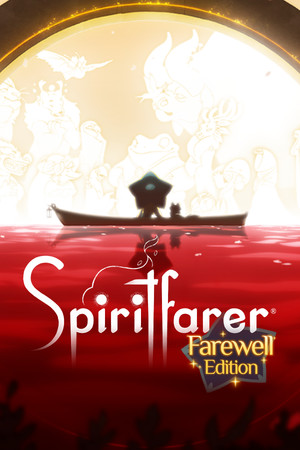
Spiritfarer Farewell Edition
A cozy boat-management sim where you shepherd spirits to the afterlife. Gentle, emotional, and surprisingly deep in its resource loop.
GamerScout Verdict
Worth it for players who want a management sim with genuine emotional weight and a complete, no-DLC-withheld package.
Compare Prices(4 stores)
Every store in this table quotes us in euros, so the EUR figure is the price the seller actually set, not our arithmetic — which is why EUR is also the currency we rank in. We only list an offer here when the store gives us its price in euros, so nothing in this table is a number we invented.
Pick USD, PLN, GBP, CAD or AUD in the header and we convert from EUR at the European Central Bank reference rate — converted amounts are prefixed with ~. Your bank or the store may apply a different rate at checkout. We never hide offers based on where you are: everyone sees this whole table.
We may earn a commission when you buy games through links on this page — at no extra cost to you. It never affects our rankings or verdicts.
Price History
Screenshots & Media
About Spiritfarer Farewell Edition
Spiritfarer: Farewell Edition is a management-and-exploration sim built around a premise you don't see often: you run a ferryboat for the recently deceased, keeping your spirit passengers comfortable until each one is ready to move on. The core loop involves harvesting resources, constructing and upgrading buildings on your ever-expanding boat, cooking meals, and tending to the personal needs of each spirit character. It sounds low-stakes, but the systems layer up quietly. By mid-game you are juggling crop rotations, a cooking station queue, ore smelting, weaving, and a travel map that opens new biomes gated by boat upgrades. It is a gentler version of the resource chain you'd find in a production-line sim, but the chain is real and it matters. Where the game earns its reputation is in the writing. Each spirit passenger is modeled on a real person from the lead developer's life, and their storylines deal directly with illness, regret, estrangement, and acceptance. The emotional beats are not telegraphed with swelling orchestral cues every five minutes. They arrive quietly, sometimes mid-cooking-errand, and hit harder for it. If you have lost someone, specific arcs will likely stop you cold. That is a design achievement worth noting, not as a marketing point but as a practical content warning and a mark of craft. From a systems perspective, the Farewell Edition bundles the base game with three content updates that added three new spirit characters, new locations, and additional building types. The boat customization is more expressive than the screenshots suggest. You place buildings as physical tiles on deck, rearranging them to optimize foot-traffic efficiency (yes, pathfinding your character across a cluttered deck is a micro-optimization problem, and yes, some of us rearranged the layout three times). The upgrade tree is not complex by grand-strategy standards, but every unlock feels purposeful. There is no dead tech. The tutorial is generous and paced well. It surfaces mechanics gradually enough that a player with zero simulation background will not feel buried in the first hour. The weaker areas are worth naming. Combat, built around a platformer-style dodge-and-strike system, is minimal and the weakest part of the design. It exists mainly to gate certain resources and never develops into anything interesting. The late-game pacing slows noticeably once you have most characters' storylines well underway; there are stretches where you are grinding materials for an upgrade and the emotional momentum pauses for several in-game days at a time. The AI for spirit passengers moving around the boat is occasionally chaotic. These are real friction points, not dealbreakers, but if you come from tighter simulation titles you will notice the looseness. Spritfarer is not trying to be a deep-systems sim, and judging it only on systemic depth would miss the point. It uses management mechanics as an emotional delivery device, and that combination is executed with unusual care. The Farewell Edition is the definitive way to play it, with all content included from the start.

Strategy & simulation
Tags
System Requirements
Minimum
- Processor
- Dual Core 3.0 GHz Processor
- Memory
- 4 GB RAM
- Graphics
- DirectX 10-compatible graphics card with at least 1GB of vi…
Recommended
Requires a 64-bit processor and operating system
Keep exploring
Community Discussion
Be the first to comment on Spiritfarer Farewell Edition.
Reviews & Ratings
Game Info
- Developer
- Thunder Lotus
- Publisher
- Thunder Lotus
- Release Date
- Aug 18, 2020