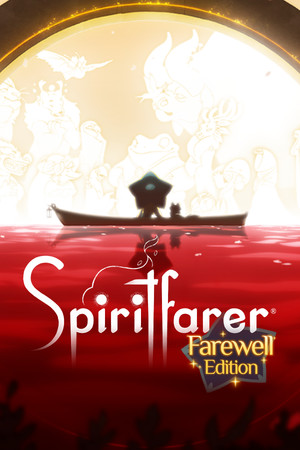
Spiritfarer
A cozy boat-management game where you ferry the dead to their afterlife, and somehow end up crying about it. Grief has never had better building mechanics.
GamerScout Verdict
Best for sim-curious players who want production loops wrapped around a story that will actually make them feel something.
Compare Prices(5 stores)
Every store in this table quotes us in euros, so the EUR figure is the price the seller actually set, not our arithmetic — which is why EUR is also the currency we rank in. We only list an offer here when the store gives us its price in euros, so nothing in this table is a number we invented.
Pick USD, PLN, GBP, CAD or AUD in the header and we convert from EUR at the European Central Bank reference rate — converted amounts are prefixed with ~. Your bank or the store may apply a different rate at checkout. We never hide offers based on where you are: everyone sees this whole table.
We may earn a commission when you buy games through links on this page — at no extra cost to you. It never affects our rankings or verdicts.
Price History
Screenshots & Media
About Spiritfarer
Spiritfarer is a management-and-exploration game built around one of the most unusual premises in the genre: you are running a boat for the recently deceased, keeping them comfortable, fed, and emotionally at peace until they are ready to move on. You play Stella, appointed Spiritfarer after a handoff from Charon himself, and from that point the game hands you a growing vessel, a set of production chains, and a cast of spirit passengers who each carry their own history, personality, and emotional baggage. It is classified as a sim, and the classification holds up. You are juggling cooking, farming, weaving, smelting, and building upgrades across a side-scrolling open world that expands as you unlock new abilities. From a mechanical standpoint, the depth is modest compared to a Factorio or a Stardew Valley at full stretch. The production loops are straightforward once you understand input-output ratios, and the building system rewards players who think about layout efficiency on a boat that has limited deck space. Gathering resources means sailing to specific regions, reading the map for ore nodes or fishing spots, and timing trips around what your passengers currently need. None of this is punishing, but it does have texture. The game does not hold your hand aggressively after the opening hours, which I respect. It trusts you to read the environment and figure out what each spirit wants without a quest tracker screaming at you. Where Spiritfarer earns its 95% Steam score is in the writing and the character work. Each spirit companion is a thinly veiled human archetype dealing with something real: guilt, regret, unfinished relationships, the slow decline of old age. Thunder Lotus does not oversell the sentimentality. The moments land because the game has spent five or ten hours making you cook a specific dish for a specific character before asking you to say goodbye to them. The loop of caregiving feeding into eventual release is the core design loop, and it works structurally as well as emotionally. If you are someone who wants mechanical complexity above all else, the back half of the game will feel light. The challenge ceiling is low. But if you treat the decision-making as social and logistical rather than purely numerical, the game holds its weight. For players coming from strategy and simulation backgrounds, the honest framing is this: Spiritfarer is a light sim with a heavy emotional payload. The resource management and building give you enough to optimize if optimization is your instinct, but the game is not structured around it. Think of it as a game where the "win condition" is qualitative rather than quantitative. The mod ecosystem on PC is limited, and there is no late-game complexity spike. What you see in the first three hours is essentially what you get, scaled up. That is not a criticism so much as a calibration. The game knows what it is, and it executes that identity with unusual consistency across its full runtime.

Strategy & simulation
Tags
System Requirements
Minimum
- OS
- Microsoft® Windows® 7 SP1
- Processor
- Dual Core 3.0 GHz Processor
- Memory
- 4 GB RAM
- Graphics
- DirectX 10-compatible graphics card with at least 1GB of video memory Dire…
Recommended
Requires a 64-bit processor and operating system
DLC & Add-ons for Spiritfarer1
Expansions, DLC packs and add-on content for this game. Click any item to see store offers.
Keep exploring
Community Discussion
Be the first to comment on Spiritfarer.
Reviews & Ratings
Game Info
- Developer
- Thunder Lotus
- Publisher
- Thunder Lotus
- Release Date
- Aug 18, 2020