Train Valley 2 - Japanese Trails
Twenty-minute rail puzzles that bill you for every wrong instinct. Built for logistics brains who want the optimization itch without a 200-hour campaign attached.
GamerScout Verdict
Best for optimizer types who want a tight logistics puzzle in 20-minute doses, not a timetable sim with quarterly reports.
Compare Prices(4 stores)
Every store in this table quotes us in euros, so the EUR figure is the price the seller actually set, not our arithmetic — which is why EUR is also the currency we rank in. We only list an offer here when the store gives us its price in euros, so nothing in this table is a number we invented.
Pick USD, PLN, GBP, CAD or AUD in the header and we convert from EUR at the European Central Bank reference rate — converted amounts are prefixed with ~. Your bank or the store may apply a different rate at checkout. We never hide offers based on where you are: everyone sees this whole table.
We may earn a commission when you buy games through links on this page — at no extra cost to you. It never affects our rankings or verdicts.
Price History
Screenshots & Media
About Train Valley 2 - Japanese Trails
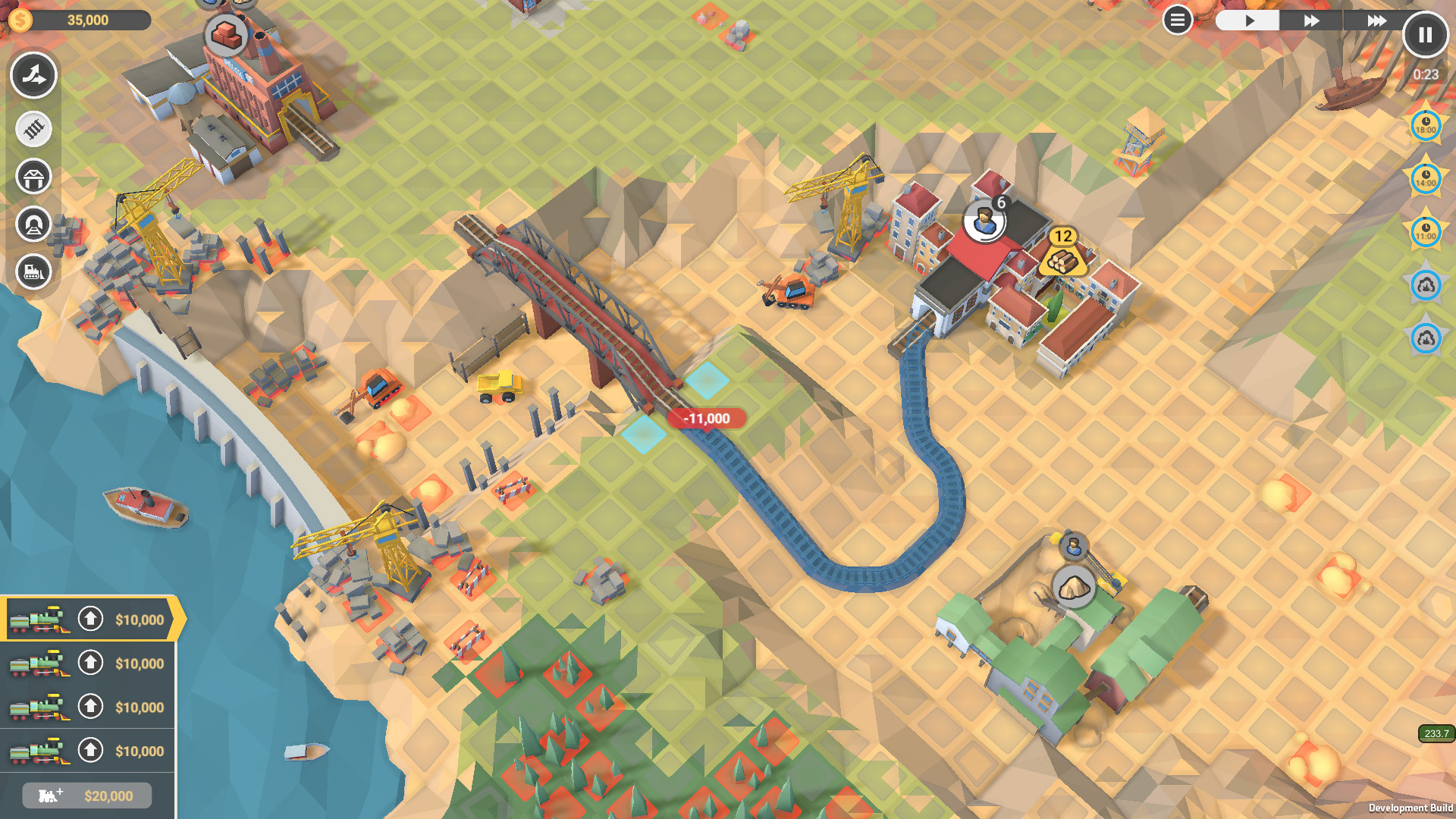
Before it gave me anything, this one made me admit my first plan was wrong and pay to tear it up. Every tile of track costs money, every station link costs money, and demolishing your mistake refunds you a fraction of nothing. I lost my first hour to that lesson, drawing elegant lines across the map like I was sketching a subway diagram, then watching the budget bleed out three deliveries short of the goal. Once that clicked, the loop had me. This is an optimization puzzle wearing a model railway costume, and the version I keep going back to is the tight, pre-planned one, not the sprawling one. The structure is simple enough to explain in a paragraph, which is exactly why the tutorial works on people who bounce off the genre. Each map is a grid with resource nodes around the edges and factories that want specific inputs. Raw goods go one way, refined goods come back, and your job is to lay the rail that makes those chains meet. Trains depart on a rhythm you do not fully control, junctions flip when you click them, and two trains sharing a tile ends the run. So the real skill is not finding the shortest route. It is finding the layout where three separate chains can share a corridor without ever occupying the same square at the same second. The Japan-set maps are the ones I would hand a newcomer last, because the ground gets stingy. Fewer open squares means fewer places to hide a spare loop, and the parallel siding I leaned on earlier stops being affordable. Where it earns its strategy tags is the scoring. Clearing a level is one bar. Clearing it inside the time-attack thresholds is a different game, and it is the one worth playing. My routine settled into three passes: one to learn the resource chain, one to cut the two junctions that turned out to be decoration, and one where I actually build in the correct order. Spine first, then spurs, then nothing. Build order matters more than total track length here, because rail you lay early is rail you pay for while it sits idle. That is a genuine decision with a number attached, repeated across every map, and it is my favourite kind of puzzle. Now the disappointments. There is no opponent AI to blame, which is honest design and also means every loss traces back to a click you were half a second late on. Several later levels ask for dexterity rather than planning, and the gap between a clear and a top-tier score can come down to reflex switching rather than a smarter layout. That is a genre mismatch for anyone who showed up for the spreadsheet and not the twitch. Failure feedback is thin too. A collision tells you two trains met, not which of your six routing choices made it inevitable, so diagnosis is mostly restart and observe. And the mod story is smaller than the Workshop tag implies. The included level editor is genuinely capable and the community output is plentiful, but there is almost no curation, so budget time to sift half-finished maps before you find the two or three that beat the campaign. Who it is for: anyone who wants logistics in twenty-minute portions instead of 200-hour campaigns, and anyone the genre has previously scared off with a wall of tooltips. The systems are legible on sight, the difficulty curve actually teaches, and full controller support plus Remote Play on TV means this works from a couch, which almost nothing in this space manages. Ninety percent positive across roughly three thousand Steam reviews is not an accident, and I would credit most of it to how fast the game communicates its one big idea. If you want a rail sim with timetables, freight contracts and shareholder pressure, look elsewhere. If you want a clean optimization problem you can actually finish, and then finish better, this is one of the good ones.

Strategy & simulation
Tags
System Requirements
Minimum
- OS
- Windows® 10/Windows® 11
- Processor
- Intel i3 Processor
- Memory
- 4 GB RAM
- Graphics
- AMD RX 570 or Nvidia GTX 1050 Ti
- Storage
- 10 MB available space
Recommended
- OS
- Windows 11
- Processor
- Core i5 or better
- Memory
- 16 GB RAM
- Graphics
- NVIDIA GeForce GTX1050 Ti or higher
- Storage
- 10 MB available space
Keep exploring
Community Discussion
Be the first to comment on Train Valley 2 - Japanese Trails.
Reviews & Ratings
Game Info
- Developer
- Alexey Davydov, Sergey Dvoynikov, Timofey Shargorodskiy, Flazm
- Publisher
- Flazm, META Publishing
- Release Date
- Apr 15, 2019