
Tropico 5 - Supervillain
A city-builder wearing a grand-strategy costume: faction balancing, era progression, and a Swiss bank account worth siphoning, but its multiplayer is more promise than payoff.
GamerScout Verdict
Best for solo players who want city-building wrapped in genuine political strategy; skip if multiplayer co-op is the main draw.
Compare Prices(4 stores)
Every store in this table quotes us in euros, so the EUR figure is the price the seller actually set, not our arithmetic — which is why EUR is also the currency we rank in. We only list an offer here when the store gives us its price in euros, so nothing in this table is a number we invented.
Pick USD, PLN, GBP, CAD or AUD in the header and we convert from EUR at the European Central Bank reference rate — converted amounts are prefixed with ~. Your bank or the store may apply a different rate at checkout. We never hide offers based on where you are: everyone sees this whole table.
We may earn a commission when you buy games through links on this page — at no extra cost to you. It never affects our rankings or verdicts.
Price History
Screenshots & Media
About Tropico 5 - Supervillain
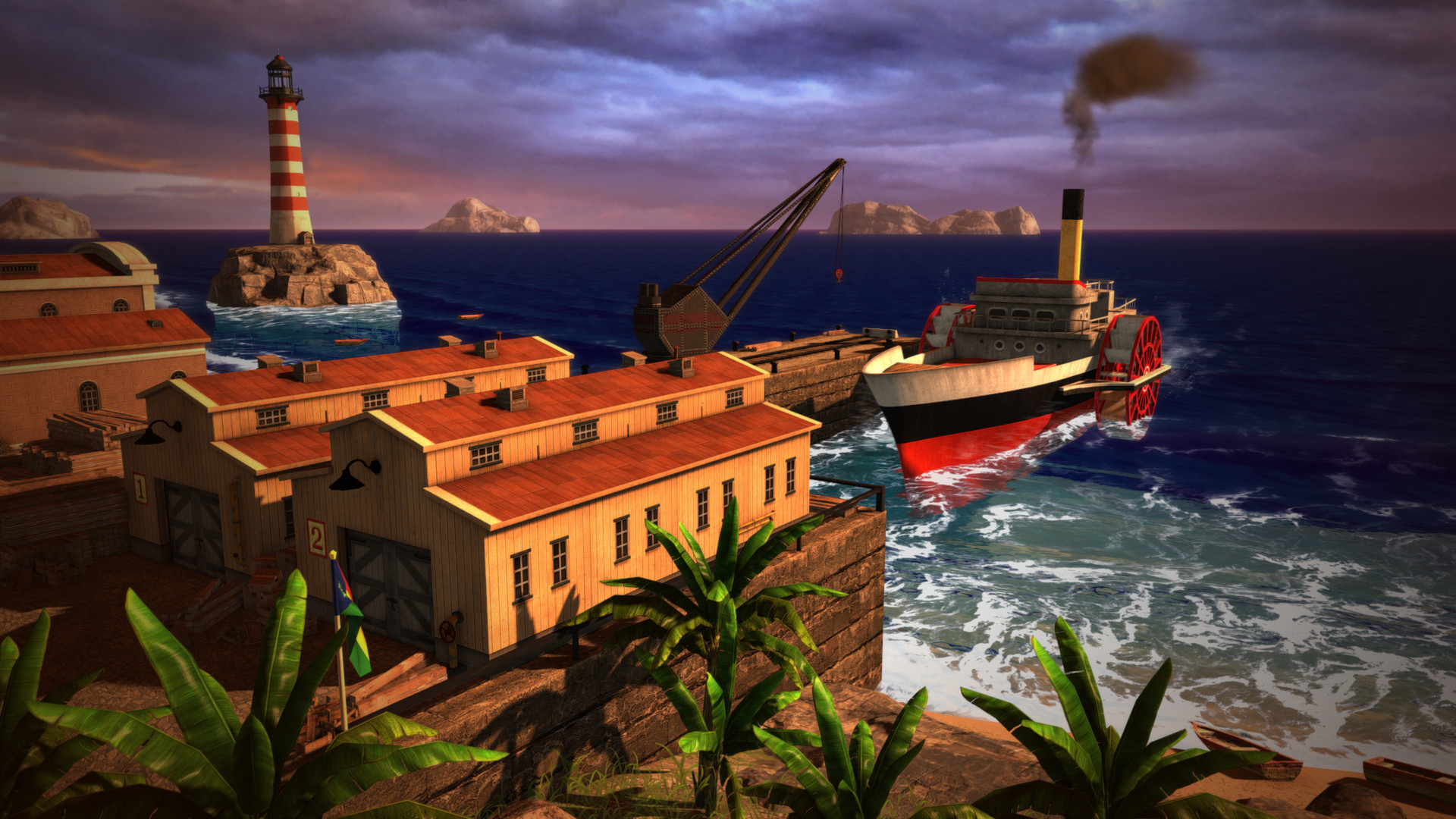
I've spent enough time color-coding Paradox spreadsheets to recognize when a city-builder is quietly doing something more interesting underneath, and Tropico 5 is exactly that kind of game. You are El Presidente, dictator of a small Caribbean island, and the core loop is not about placing roads optimally, it is about reading a room full of factions who all want incompatible things. The Crown wants loyalty during the colonial period. Revolutionaries want independence. Cold War superpowers want allegiance. Keeping all of them just dissatisfied enough to avoid open revolt is the actual game, and that tension is where Tropico 5 earns its strategy credentials. The era system is the headline addition here. You start in the colonial period, survive both World Wars, navigate the Cold War, and push into the modern age, each era reshuffing which buildings, constitutions, and trade routes are available. The constitution editor deserves a special mention: choosing individual liberties, economic policies, and political rights creates a governing framework that meaningfully shapes how your population behaves, what factions strengthen, and which foreign powers tolerate you. That is genuine systems depth, not cosmetic flavour. Alongside it, the dynasty mechanic lets you assign family members as ambassadors, commanding generals, or building managers, each contributing percentage bonuses to your treasury through a Swiss bank account that makes embezzlement feel like legitimate fiscal policy. On paper, compelling. In practice, reviewers and players alike have noted that the dynasty assignments lack enough investment to feel consequential, most experienced players end up treating the mechanic as a background bonus rather than a real decision layer. The trading system adds another node to the economy graph. You assign trade ships to import raw materials or export finished goods, and in theory you can build an island economy entirely on trade arbitrage. In practice, because trade routes resolve off-screen with no visual feedback, this system ends up feeling more like a spreadsheet entry than an active decision. The faction balancing and constitution editing are where decision-making actually lives. The campaign missions teach the surface mechanics adequately, though advanced concepts around era transitions and trade optimization are left entirely to trial and error, something newcomers should factor in before assuming the tutorial is complete coverage. Multiplayer supports up to four players with both co-op and competitive modes. Co-op puts multiple players on the same island map, allowing shared resources, trade routes between players, and citizen transfers. The structural problem is that each player still manages a separate city, so the collaboration feels loosely coupled rather than genuinely cooperative. There is no ability to save a multiplayer session mid-game, the game speed is hardlocked to its fastest setting in online play, and the public lobby population has always been thin. If you are buying Tropico 5 specifically for online co-op sessions with strangers, the infrastructure will disappoint. With a dedicated friend group who can complete a session in one sitting and use the Steam Workshop to tune the experience, it holds together better, but go in clear-eyed. For single-player, the verdict is warmer. The faction management, the era-by-era strategic recalibration, the sandbox mode, and the Steam Workshop mod support give the game real legs. Tropico 5 is not a dramatic reinvention of Tropico 4, critics and longtime fans have made that point repeatedly, but for someone arriving fresh to the series or picking it up at a discount, the depth of the faction and constitution systems alone justifies the time investment. Strategy players who enjoy building economic engines under political pressure, and who can tolerate a campaign pace that slows considerably in the middle eras, will find a game worth the spreadsheet.

Strategy & simulation
Tags
System Requirements
Minimum
- Processor
- 2 GHz Dual Core CPU
- Memory
- 4 GB RAM
- Graphics
- GeForce 400 or higher, AMD Radeon HD 4000 or higher, Intel HD 4000 or higher (DirectX 11 hardware suppo…
Recommended
- Processor
- 2.5 GHz Quad Core CPU
- Memory
- 8 GB RAM
- Graphics
- GeForce 500 or higher, AMD Radeon HD 5000 or higher
Keep exploring
Community Discussion
Be the first to comment on Tropico 5 - Supervillain.
Reviews & Ratings
Game Info
- Developer
- Haemimont Games
- Publisher
- Kalypso Media Digital
- Release Date
- May 23, 2014