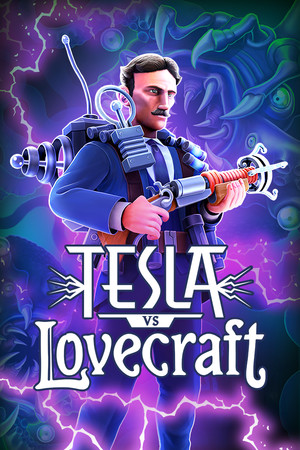
Tesla vs Lovecraft
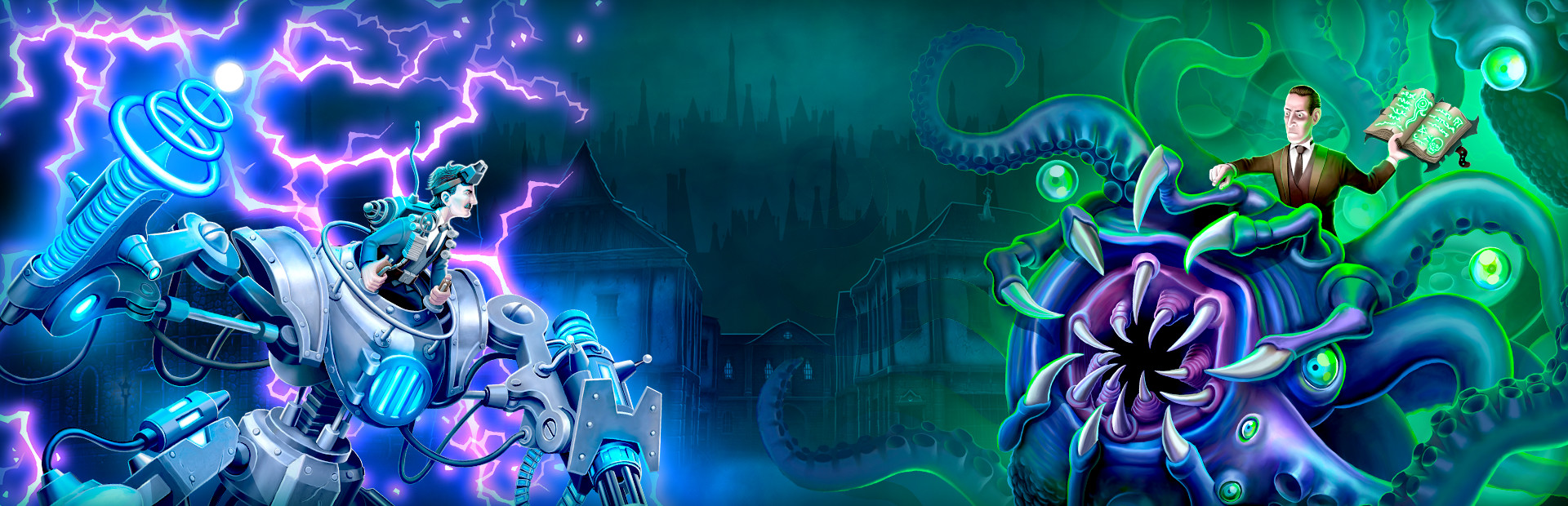
Piloting a giant Tesla Mech into a screaming horde of Lovecraftian cultists is exactly as good as it sounds, but the narrative ambition stops right there.
GamerScout Verdict
Grab it if you want a sharp, session-friendly twin-stick shooter; skip it if you need narrative depth to go the distance.
Compare Prices(4 stores)
Every store in this table quotes us in euros, so the EUR figure is the price the seller actually set, not our arithmetic — which is why EUR is also the currency we rank in. We only list an offer here when the store gives us its price in euros, so nothing in this table is a number we invented.
Pick USD, PLN, GBP, CAD or AUD in the header and we convert from EUR at the European Central Bank reference rate — converted amounts are prefixed with ~. Your bank or the store may apply a different rate at checkout. We never hide offers based on where you are: everyone sees this whole table.
We may earn a commission when you buy games through links on this page — at no extra cost to you. It never affects our rankings or verdicts.
Price History
Screenshots & Media
About Tesla vs Lovecraft
I'll be honest: the premise alone almost carried me through the whole thing. Nikola Tesla versus H.P. Lovecraft, rendered as a frenetic twin-stick arena shooter, is the kind of elevator pitch that makes you click "buy" before the trailer finishes. The setup is delivered in a breezy opening cutscene, Lovecraft summons eldritch nightmares to burn down Tesla's lab, and then you spend the rest of the game making them regret it. If you walked in hoping for Disco Elysium levels of narrative payoff, the game will absolutely not meet you there. The story is a paper-thin scaffold for the shooting, and the cutscenes wrap up the lore in the first five minutes. That is your warning. What the game actually delivers, and does well, is a tight, escalating loop of chaos management. You start each level inside a mech bristling with Gatling guns, which is immediately satisfying right up until the mech's health drains and it detonates in a satisfying explosion. From that point on you are on foot, working with whatever weapons have spawned on the arena floor: revolvers, shotguns, tommy guns, and gadgets themed around Tesla's electrical experiments. The teleport dodge is the mechanical backbone of the whole thing, letting you blink out of corners when the Lovecraftian hordes try to box you in. A short-range teleport that leaves a clone behind (the Theseus Paradox epic perk) and an infinite teleport option (Superconductor) represent the kind of wild-swing moments that make the perk system genuinely entertaining, even if that system leans on RNG more than I would like. Each level-up presents two randomly drawn perks: stackable buffs like Faster Shooting, Extra Barrel, and Extra Speed, plus the rarer epic perks. Combining Extra Barrel with bullet-ricocheting weapons and a shotgun produces the kind of absurd screen-clearing carnage that keeps you coming back. The catch is that perks reset between levels, so every stage is a fresh build-from-scratch, which dampens any sense of meaningful long-term progression within a single run. The permanent progression layer runs through aether crystals, earned by killing specific enemy types in volume. These unlock persistent upgrades, including extended mech duration, but the crystal economy feels deliberately sluggish. Reviewers and players broadly flag this as padding, and it is hard to argue otherwise: finishing all three difficulty tiers (Wardenclyffe, Dreamland, and Eldritch plane) still leaves the upgrade tree looking barely scratched. On the plus side, the three difficulty tiers do meaningfully shift how the game feels. Eldritch difficulty throws elite monster variants at you in dense enough numbers that build luck genuinely swings outcomes, which is either thrilling or infuriating depending on your tolerance for RNG-dependent power spikes. Co-op, both local split screen and via Remote Play Together, is where the game arguably performs best: a second player halves the panic and doubles the carnage, and the framerate holds up impressively even with hundreds of enemies flooding the arena simultaneously. The enemy roster is the game's quietest disappointment. For source material as rich as the Lovecraft mythos, the actual creature variety is thin, and most enemies share the same rush-and-hit behavior pattern regardless of their visual design. Anyone who has read At the Mountains of Madness knows these horrors should feel more unpredictable. They do not. The arena-only structure also means the level design never really surprises you: spawn points, pickup placement, repeat. That repetition is tolerable in short sessions and becomes genuinely wearing in longer ones. For twin-stick shooter fans who want something polished, competent, and flavored with a concept weird enough to stay interesting past the tutorial, this delivers reliably. For RPG-brained players chasing character depth, faction choices, or a story that rewards a second read, the well runs dry embarrassingly fast. Think of it less as a game to sink forty hours into and more as the best possible version of a Saturday afternoon arcade session with a killer premise.

RPGs
Tags
System Requirements
Minimum
- Processor
- 2 GHz
- Memory
- 2048 MB RAM
- Graphics
- SM 3.0+
- DirectX
- Version 9.0c
- Storage
- 150 MB available space
Keep exploring
Community Discussion
Be the first to comment on Tesla vs Lovecraft.
Reviews & Ratings
Game Info
- Developer
- 10tons Ltd
- Publisher
- 10tons Ltd
- Release Date
- Jan 26, 2018