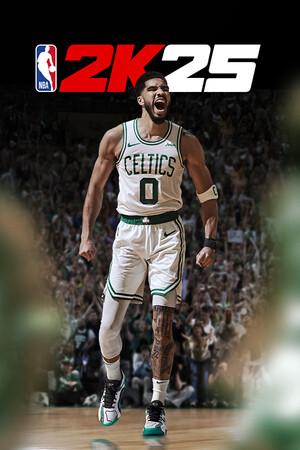
NBA 2K25 Tournament Edition
The deepest front-office basketball sim on PC, welded to a card-shop economy that never stops asking for your wallet. Great if MyNBA is your endgame, rough if you just want pickup games.
GamerScout Verdict
Buy it for MyNBA's cap-sheet depth and multi-decade rebuilds; skip it if the VC economy and Park grind are what you're here for.
Compare Prices(1 stores)
Every store in this table quotes us in euros, so the EUR figure is the price the seller actually set, not our arithmetic — which is why EUR is also the currency we rank in. We only list an offer here when the store gives us its price in euros, so nothing in this table is a number we invented.
Pick USD, PLN, GBP, CAD or AUD in the header and we convert from EUR at the European Central Bank reference rate — converted amounts are prefixed with ~. Your bank or the store may apply a different rate at checkout. We never hide offers based on where you are: everyone sees this whole table.
We may earn a commission when you buy games through links on this page — at no extra cost to you. It never affects our rankings or verdicts.
Screenshots & Media
About NBA 2K25 Tournament Edition
The front office is the best thing in this box, and it isn't close. MyNBA hands you a franchise down to the level of cap holds, contract structures, staff hiring, G League assignments and multi-decade rebuilds, and the trade logic actually pushes back. I have had CPU general managers reject packages my own asset spreadsheet called a clear win for them, then counter with something that made me re-rank half my roster. That is rare in a licensed sports sim, where "depth" usually means one more slider labelled Realism. So let's be precise about what this is. It is three or four different games sharing a court. There is the franchise layer, which is a genuine management sim with salary cap strategy, draft classes and long-horizon roster construction. There is the career layer, where you build a single player through an archetype and badge system, then take that build into Park and City multiplayer against other people's builds. There is the card-collecting mode, a lineup-assembly meta with its own economy. And there is plain exhibition basketball, five on five, playable in split screen locally or online co-op, with a gamepad strongly recommended because keyboard play is a losing proposition. Those layers barely talk to each other, and your enjoyment depends almost entirely on which one you pick. The build math is where I lost most of my hours. Your created player has a hard attribute budget, and every point you spend raises the cost of the next one, so the interesting decisions happen at the margins. A 6'5" guard with maxed three-point rating and no strength gets bullied off the ball in Park; the same build with fifteen points reallocated to interior defense survives. Badges compound on top of that, tiering up as you use the associated skills, which means your effective ceiling is a function of how you actually play rather than what the character sheet says on creation day. Two builds with identical ratings can perform very differently once badge tiers diverge. That's real depth, and it's the reason the online scene stays competitive across a season rather than converging on one meta build in three weeks. Now the part that explains a Mixed rating across more than forty thousand reviews. The currency economy touches everything. Attribute upgrades, cosmetics and card packs all draw from the same purchasable pool, so progression speed is negotiable in a way that makes the grind feel designed rather than earned. The card mode leans hardest into this and is the weakest value proposition in the package if you refuse to spend. Onboarding is the other real failure: the tutorial teaches you the shot timing basics and then abandons you, leaving cap mechanics, badge progression tiers, defensive assignments and the difference between the various offensive systems as things you learn by losing. For a game this systems-heavy, that is a self-inflicted wound, and it's the single most common complaint I see from lapsed players trying to come back. Here is my actual recommendation, and it is narrower than the marketing wants. Ignore the online modes on day one. Start in franchise on a mid-tier team, turn the simulation sliders toward realism, and spend your first ten hours doing nothing but roster evaluation and one trade per week. The management layer is where the AI is smartest and where the monetization has the least grip on you, and it is genuinely approachable if you treat it as a two-hundred-hour campaign instead of a checklist. Once you understand why a contract is bad, the career and online layers make more sense, and you can decide whether the currency treadmill is a price you're willing to pay in time. If you're here for arcade basketball with friends on one couch, the split-screen play still works fine and you can safely ignore ninety percent of the systems I just described. If you're here to run a front office, this is the best tool on PC for the job, and I'd budget a full season of real time before you see the bottom of it.

Strategy & simulation
Tags
System Requirements
Minimum
- OS
- Windows 10 64-Bit (latest update)
- Processor
- Intel® Core™ i3-9100 or AMD Ryzen™ 3 1200
- Memory
- 8 GB RAM
- Graphics
- NVIDIA® GeForce® GTX 960 4 GB or AMD Ra…
Recommended
- OS
- Windows 10 64-Bit (latest update)
- Processor
- Intel® Core™ i5-10600 or AMD Ryzen™ 5 3600X
- Memory
- 16 GB RAM
- Graphics
- NVIDIA® GeForce® RTX 2070 8 GB o…
Keep exploring
Community Discussion
Be the first to comment on NBA 2K25 Tournament Edition.
Reviews & Ratings
Game Info
- Developer
- Visual Concepts
- Publisher
- 2K
- Release Date
- Oct 28, 2024