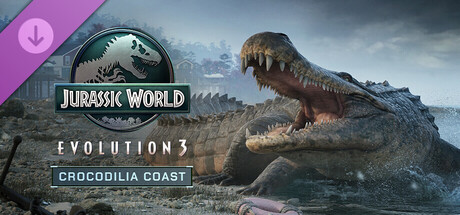
Jurassic World Evolution 3: Crocodilia Coast
A park builder that plays like real strategy for its first stretch and a decorating sandbox after that. Genuinely good first management sim if you start in sandbox and learn one enclosure properly.
GamerScout Verdict
Best for Planet Zoo veterans and sim newcomers who want containment risk with teeth, not for anyone chasing a demanding late game.
Compare Prices(4 stores)
Every store in this table quotes us in euros, so the EUR figure is the price the seller actually set, not our arithmetic — which is why EUR is also the currency we rank in. We only list an offer here when the store gives us its price in euros, so nothing in this table is a number we invented.
Pick USD, PLN, GBP, CAD or AUD in the header and we convert from EUR at the European Central Bank reference rate — converted amounts are prefixed with ~. Your bank or the store may apply a different rate at checkout. We never hide offers based on where you are: everyone sees this whole table.
We may earn a commission when you buy games through links on this page — at no extra cost to you. It never affects our rankings or verdicts.
Price History
Screenshots & Media
About Jurassic World Evolution 3: Crocodilia Coast
Planet Zoo is the obvious comparison point, and if you have ever laid out a habitat there, the muscle memory transfers in about ten minutes. The difference that matters is the failure state. In Frontier's zoo sim, a bad fence costs you a welfare rating. Here it costs you a guest count. This is a park builder where a solid third of your decision space is risk management, and I mean that in the spreadsheet sense: every enclosure you place is a bet on containment strength versus the animal you intend to put inside it, and every bet has a payout curve attached to it in ticket sales. The core loop is the one the series has run since the first game, tightened. You fund expeditions, come back with fossils, extract incomplete genomes, patch the gaps, and end up with an animal that carries a specific set of comfort requirements: forest cover, open ground, water access, and a tolerance for how many of its own kind it will share space with. The headline change in this entry is that your animals arrive as family units rather than as fully grown adults dropped out of a hatchery. Juveniles grow, groups have internal structure, and the space you budgeted for four adults is not the space you need later. That one change does more to the underlying math than it sounds like it should. My first coastal park did not fail because something got loose. It failed because I sized the waterline habitat for the population I incubated instead of the population I was always going to have. Here is the part I write for every sim like this, and I mean it every time: this is a fine first management game, provided you do not start where the game points you. Skip campaign pressure on your opening run and go straight to sandbox. You can pause anything, save anywhere, and nothing runs a timer on your decisions. Pick three or four species you actually like the look of, build one enclosure properly, and read the comfort panel until you can identify which single variable is failing rather than throwing terrain at the problem. Learning one animal's needs teaches you most of the system. The tutorial is competent at teaching buttons and vague about teaching economics, so the honest build order is one habitat, one viewing gallery, one food outlet, then expand only once monthly income clears monthly upkeep with room to spare. Newcomers who wreck their first park almost always do it by opening three habitats at once and drowning in operating costs. What holds up less well is the far end of the curve. Once your park clears its ratings thresholds and income goes vertical, there is not much left to solve. Money stops being a binding constraint, and a management sim without a binding constraint quietly becomes a decorating tool. That is fine if you like decorating, and the scenery kit is generous, particularly the coastal set with its piers, boardwalks and rock work for waterside builds. It is less fine if you came for the strategy half of the genre listing. Guest behaviour is closer to set dressing than simulation: they path, they queue, they spend, and they never hand you a problem worth optimising against. There is no Steam Workshop hookup in the feature list either, so mods are not going to extend the late game the way they routinely do in Paradox titles. Consider the add-on cadence too. A pack that amounts to five family units and a stack of props tells you roughly what the next couple of years will look like. Steam sits at mostly positive on a small review sample, and that matches my experience. The fundamentals are solid, the presentation is sharp, and the complaints cluster around late-game emptiness rather than anything broken. Buy it for the stretch where you are still solving genuine problems, and treat everything past that as a sandbox you happen to own. If you want an AI that pushes back, this is not it. If you want a system you can learn in one evening and keep tuning for a month, it earns the time.

Strategy & simulation
Tags
System Requirements
Minimum
Requires a 64-bit processor and operating system
Recommended
Requires a 64-bit processor and operating system
Keep exploring
Community Discussion
Be the first to comment on Jurassic World Evolution 3: Crocodilia Coast.
Reviews & Ratings
Game Info
- Developer
- Frontier Developments
- Publisher
- Frontier Developments
- Release Date
- Aug 11, 2026