Compare Unity of Command: Stalingrad Campaign prices across trusted key stores and find the best deal. Developed by 2x2 Games. Published by 2x2 Games. Released on 10/17/2012. Available on PC. Genres: Indie, Strategy. Metacritic score: 84/100.

The supply model will humiliate you inside the first hour, then become the reason you replay every map. Probably the most teachable operational wargame on PC, if you survive the opening defeat.

My first hour ended with a full panzer corps frozen solid, sixty miles from anything worth capturing, because one Soviet cavalry squadron had sat down on the rail line behind me. Nothing dramatic happened. No counterattack, no cinematic disaster. My beautiful arrows simply stopped working and my units started bleeding steps every turn until the scenario timer ran out. That is the wall every newcomer hits, and it is worth naming immediately, because it is the whole design in miniature: you win by owning the railhead, not by owning the front line. Push through that first humbling loss and the supply system stops reading as a gotcha and starts reading as the smartest idea an operational wargame has committed to. Released in 2012 by 2x2 Games, this is an operational-level Eastern Front wargame on a hex grid, covering the 1942 to 1943 fighting around Stalingrad from both sides. Units are divisions and corps rather than individual tanks, each with a small number of steps standing in for combat strength, and you attach specialist support (engineers, anti-tank, air, artillery) to shore up whatever a given formation is bad at. Supply traces back along rail hexes to a source, so every advance is a question about whether your logistics tail can keep pace, and every defensive move is a question about whether you can reach around and sever theirs. Scenarios are timed. Finishing ahead of the clock earns the top grade and the prestige that buys reinforcements for the next mission, and the campaign branches according to how cleanly you performed. Here is where I push back on the assumption that wargames demand a weekend of manual reading first. This is the most teachable entry point in the genre I can name. A scenario runs thirty to fifty minutes. The interface shows supply status, projected combat odds, and the exact hexes that will be cut before you commit to a move, which means the information you need for a good decision is visible rather than buried in a modifier stack. There are no production queues, no research trees, no political sliders. Compare that to the twelve-hour on-ramp of a Paradox grand campaign and it is obvious which one actually teaches you to think in terms of encirclement, tempo, and supply. My advice: run the German scenarios first. They front-load mobility, which is the friendlier way to learn what a rail hex is really doing for you. The limits are real, and the 78 percent Steam rating is honest about them. Puzzle strategy is the accurate label: most scenarios have a narrow band of near-optimal solutions, and once you find the line, the replay value of that map collapses. You will save-scum, because the turn limit punishes exploration and the game does little to disguise that its maps were tuned rather than simulated. The AI defends competently along scripted lines, but it will not surprise you or improvise a counter-encirclement the way a person would. Multiplayer runs on hotseat and play-by-email, a reasonable answer in 2012 and a thin one now given how few opponents are still circulating. The custom-scenario and mod scene never grew into anything resembling what the Panzer Corps or Paradox communities sustain, so what ships is broadly what you get. Presentation is functional at best: clean counters, readable map, zero personality. None of that changes the recommendation. The 84 Metacritic score has aged well because the core loop, encircle, cut supply, watch a defensive line evaporate without a single wasted assault, still delivers a specific satisfaction that bigger and prettier wargames keep failing to replicate. Get it if you want to learn operational thinking in bites that fit around a workday, or if you are a lapsed grognard who wants competence over complexity. Skip it if you need emergent sandbox chaos, an AI that schemes back, or hundreds of hours of build variety. This is a tight, finite, well-built thing, and the honesty of that is worth more than another sprawling hex map nobody finishes. Diego, Scout Team

Unity of Command: Stalingrad Campaign

Unity of Command: Stalingrad Campaign

Oct 17, 20122x2 Games
GamerScout Says

The supply model will humiliate you inside the first hour, then become the reason you replay every map. Probably the most teachable operational wargame on PC, if you survive the opening defeat.

PC
Best Price Available
€0.39
at Gamivo
Track this price

GamerScout Verdict

Best for strategy newcomers and lapsed grognards who want an operational WW2 puzzle they can finish in 40-minute sittings.

Compare Prices(4 stores)

GamivoBest price
StandardGlobalSteam KeyKey
€0.39
Priced in EUR by the store
Buy
StandardGlobalSteam KeyKey
€0.66-92%
Priced in EUR by the store
Buy
StandardEurope (EU)Steam KeyKey
€1.95-80%
Priced in EUR by the store
Buy
StandardGlobalSteam KeyKey
€8.67-11%
Priced in EUR by the store
Buy

Every store in this table quotes us in euros, so the EUR figure is the price the seller actually set, not our arithmetic — which is why EUR is also the currency we rank in. We only list an offer here when the store gives us its price in euros, so nothing in this table is a number we invented.

Pick USD, PLN, GBP, CAD or AUD in the header and we convert from EUR at the European Central Bank reference rate — converted amounts are prefixed with ~. Your bank or the store may apply a different rate at checkout. We never hide offers based on where you are: everyone sees this whole table.

We may earn a commission when you buy games through links on this page — at no extra cost to you. It never affects our rankings or verdicts.

Screenshots & Media
Screenshot

About Unity of Command: Stalingrad Campaign

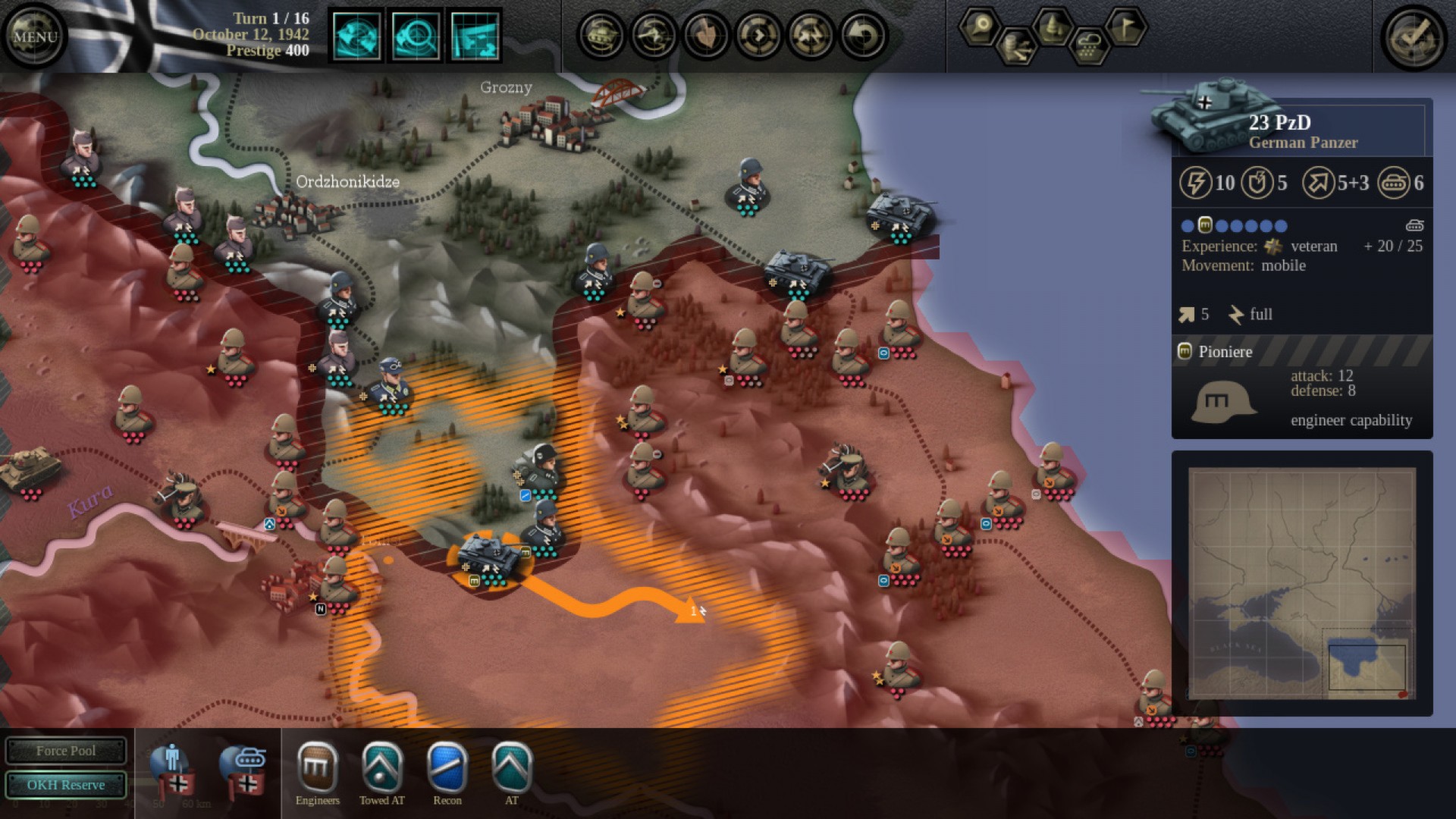
My first hour ended with a full panzer corps frozen solid, sixty miles from anything worth capturing, because one Soviet cavalry squadron had sat down on the rail line behind me. Nothing dramatic happened. No counterattack, no cinematic disaster. My beautiful arrows simply stopped working and my units started bleeding steps every turn until the scenario timer ran out. That is the wall every newcomer hits, and it is worth naming immediately, because it is the whole design in miniature: you win by owning the railhead, not by owning the front line. Push through that first humbling loss and the supply system stops reading as a gotcha and starts reading as the smartest idea an operational wargame has committed to. Released in 2012 by 2x2 Games, this is an operational-level Eastern Front wargame on a hex grid, covering the 1942 to 1943 fighting around Stalingrad from both sides. Units are divisions and corps rather than individual tanks, each with a small number of steps standing in for combat strength, and you attach specialist support (engineers, anti-tank, air, artillery) to shore up whatever a given formation is bad at. Supply traces back along rail hexes to a source, so every advance is a question about whether your logistics tail can keep pace, and every defensive move is a question about whether you can reach around and sever theirs. Scenarios are timed. Finishing ahead of the clock earns the top grade and the prestige that buys reinforcements for the next mission, and the campaign branches according to how cleanly you performed. Here is where I push back on the assumption that wargames demand a weekend of manual reading first. This is the most teachable entry point in the genre I can name. A scenario runs thirty to fifty minutes. The interface shows supply status, projected combat odds, and the exact hexes that will be cut before you commit to a move, which means the information you need for a good decision is visible rather than buried in a modifier stack. There are no production queues, no research trees, no political sliders. Compare that to the twelve-hour on-ramp of a Paradox grand campaign and it is obvious which one actually teaches you to think in terms of encirclement, tempo, and supply. My advice: run the German scenarios first. They front-load mobility, which is the friendlier way to learn what a rail hex is really doing for you. The limits are real, and the 78 percent Steam rating is honest about them. Puzzle strategy is the accurate label: most scenarios have a narrow band of near-optimal solutions, and once you find the line, the replay value of that map collapses. You will save-scum, because the turn limit punishes exploration and the game does little to disguise that its maps were tuned rather than simulated. The AI defends competently along scripted lines, but it will not surprise you or improvise a counter-encirclement the way a person would. Multiplayer runs on hotseat and play-by-email, a reasonable answer in 2012 and a thin one now given how few opponents are still circulating. The custom-scenario and mod scene never grew into anything resembling what the Panzer Corps or Paradox communities sustain, so what ships is broadly what you get. Presentation is functional at best: clean counters, readable map, zero personality. None of that changes the recommendation. The 84 Metacritic score has aged well because the core loop, encircle, cut supply, watch a defensive line evaporate without a single wasted assault, still delivers a specific satisfaction that bigger and prettier wargames keep failing to replicate. Get it if you want to learn operational thinking in bites that fit around a workday, or if you are a lapsed grognard who wants competence over complexity. Skip it if you need emergent sandbox chaos, an AI that schemes back, or hundreds of hours of build variety. This is a tight, finite, well-built thing, and the honesty of that is worth more than another sprawling hex map nobody finishes.

Diego
Diego · Scout Team

Strategy & simulation

Tags

auto-admittedOperational WargameHex GridSupply LinesEastern FrontWW2Scenario CampaignPuzzle StrategyShort SessionsPlay-by-EmailEncirclement TacticsLogistics ManagementTurn Limit ScoringBranching CampaignWargame Entry PointOptimization PuzzleLunch Break StrategyLow Unit CountHistorical Scenarios

System Requirements

Minimum

Processor
1.6 GHz
Memory
1 GB RAM Hard Drive:150 MB HD space

Recommended

Processor
2.0 GHz
Memory
2 GB RAM

Keep exploring

Community Discussion

Be the first to comment on Unity of Command: Stalingrad Campaign.

Reviews & Ratings

Metacritic
84
Steam
78%(1,019)

Game Info

Developer
2x2 Games
Publisher
2x2 Games
Release Date
Oct 17, 2012

Features

Single-playerMultiplayerFamily Sharing

Price Alert

Get notified when the price drops below your target!

Create Alert
Best price€0.39
See offer

Across the 24,365 games we track, a verified key was cheaper than the official store 90% of the time. See the method and the full numbers in our game price report.

No card? Pay another way

Top up your Steam Wallet or buy crypto with any card — instant delivery, no bank account needed.

More from 2x2 Games

Buy smarter: helpful guides

Looking for more? See games like Unity of Command: Stalingrad Campaign →

Frequently asked questions about Unity of Command: Stalingrad Campaign

How much does Unity of Command: Stalingrad Campaign cost?

As of 7 September 2026, the cheapest in-stock offer for Unity of Command: Stalingrad Campaign is €0.39 at Gamivo, out of 4 live offers we track across verified key stores. Prices change daily — the table on this page is refreshed continuously.

Where can I buy Unity of Command: Stalingrad Campaign cheapest?

The lowest in-stock price we track for Unity of Command: Stalingrad Campaign is €0.39 at Gamivo (7 September 2026). We compare 4 live offers from verified key stores — the full table with every store and its trust score is on this page.

What platforms is Unity of Command: Stalingrad Campaign available on?

Unity of Command: Stalingrad Campaign is available on PC.

When was Unity of Command: Stalingrad Campaign released?

Unity of Command: Stalingrad Campaign was released on 17 October 2012.

Who developed Unity of Command: Stalingrad Campaign?

Unity of Command: Stalingrad Campaign was developed by 2x2 Games.

Is Unity of Command: Stalingrad Campaign worth buying?

Unity of Command: Stalingrad Campaign holds a Metacritic score of 84/100, making it one of the standout Indie titles. See the full reviews, ratings and how-long-to-beat times on this page to decide.