Star Wars: Battlefront
The best-sounding Star Wars shooter ever built, wrapped around a loadout system you can exhaust in a weekend. Superb in 40-minute bursts, thin if you want a campaign.
GamerScout Verdict
Worth it for the spectacle, map-control token game and co-op waves; skip it if you need a campaign or deep progression.
Compare Prices(5 stores)
Every store in this table quotes us in euros, so the EUR figure is the price the seller actually set, not our arithmetic — which is why EUR is also the currency we rank in. We only list an offer here when the store gives us its price in euros, so nothing in this table is a number we invented.
Pick USD, PLN, GBP, CAD or AUD in the header and we convert from EUR at the European Central Bank reference rate — converted amounts are prefixed with ~. Your bank or the store may apply a different rate at checkout. We never hide offers based on where you are: everyone sees this whole table.
We may earn a commission when you buy games through links on this page — at no extra cost to you. It never affects our rankings or verdicts.
Price History
Screenshots & Media
About Star Wars: Battlefront
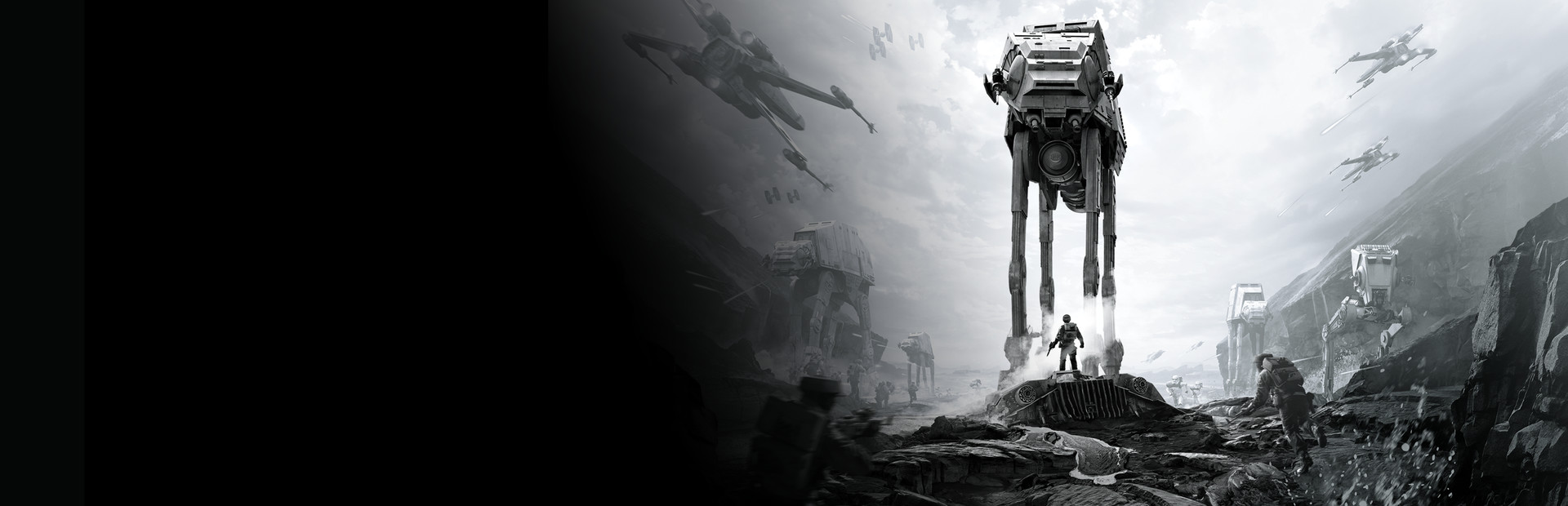
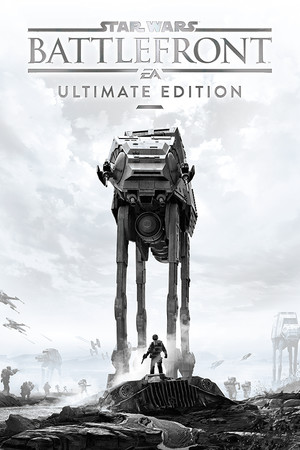
Every multiplayer shooter I pull apart starts with the same question: where does power come from, and can I plan a route to it? In this one, power sits on the floor. Vehicles, orbital strikes and heroes are not earned through kill streaks or score thresholds. They spawn as physical pickup tokens scattered across the map, and whoever walks over one gets to be Darth Vader until the timer or an enemy squad ends it. That single choice rewires the whole match. Your first minute is not about finding a firing lane, it is about learning the token rotation, and a squad that treats those spawns as contested resource nodes will consistently beat a better-aiming squad that treats them as lottery tickets. Structurally, this is a large-scale objective shooter with a lot of small satellite modes orbiting two big ones. Walker Assault and Supremacy are the 40-player headliners: one is a timed escort where rebels activate uplinks to call down Y-wing strafing runs on AT-ATs, the other a five-point tug of war that swings hard on flank timing. Below that sit the compact playlists, Blast, Drop Zone, Droid Run, Cargo, plus Fighter Squadron for atmospheric dogfights and the pure spectacle modes, Heroes vs Villains and Hero Hunt. Solo and two-player players get Survival waves and Skirmish matches against bots. The bundle sold here folds in all four season pass expansions, which is the version worth owning: Outer Rim, Bespin, the Death Star content and the Scarif set roughly double the map pool and add Lando, Greedo, Dengar, Chewbacca, Bossk, Jyn Erso and Krennic to the roster. What it never adds is a campaign. That absence is the game's defining structural hole and no amount of DLC papers over it. On the systems side, the numbers are refreshingly legible and that cuts both ways. Blasters do not carry ammo, they build heat, and venting is an active timing input rather than a reload animation, so sustained pressure is a skill rather than a magazine count. Your build is two Star Cards plus a charge card, drawn from a pool of jump packs, thermal detonators, personal shields, ion torpedoes, cycler rifles and smart rockets, with traits that level up inside the match as you perform. The entire decision space fits on one screen. For someone used to spending a night theory-crafting a Paradox army composition, that is genuinely relaxing, and I would argue it makes this a good entry point for people intimidated by heavier loadout shooters. Learn six cards, learn four token spawns, and you are playing at a competent level in under two hours. The counter-argument is just as strong: there is very little left to optimise after week one. Progression is a flat unlock ladder, not a specialisation tree, and no build you assemble at hour 40 is meaningfully cleverer than the one you had at hour 8. What holds up ten years on is craft. The photogrammetry-derived environments still look absurd in the good way, and the audio is the most faithful film reproduction in the genre, down to blaster ricochets and TIE fighter dopplering overhead. What does not hold up: hero balance is closer to rock-paper-scissors than a real matchup chart, Heroes vs Villains decays into whoever gets the first pick, and the Survival AI is wave fodder that never forces a tactical read. There is no server browser and no mod scene, which matters more than usual here, because the 2004 and 2005 Battlefronts are still being actively modded while this Frostbite build is locked shut. Matchmaking also concentrates the population into the flagship playlists, so if you specifically want the niche DLC modes, expect thinner queues than the headline review counts suggest. The tutorial content is polite but shallow, and tellingly it never explains the pickup economy that decides matches. The Steam consensus, 79 percent positive across nearly 5,800 reviews against a 76 Metacritic, reads about right to me. This is a 25 to 40 hour game rather than a 200 hour one, best consumed in short evening sessions with friends, and the bundled expansions are what keep it from feeling hollow. Buy it for the spectacle, the token-control mind game and the co-op waves. Skip it if you want a story mode, a progression system with real branching, or a competitive scene to climb.

Strategy & simulation
Tags
System Requirements
Minimum
- Processor
- Intel Pentium 4 1.5 GHz or Athlon XP 1500+
- Memory
- 256 MB
- Graphics
- 64MB 3d Graphics card with Vertex Shader and Pixel Shader (VS/PS) Capability DirectX®: 9.0c Hard Drive: 4…
Keep exploring
Community Discussion
Be the first to comment on Star Wars: Battlefront.
Reviews & Ratings
Game Info
- Developer
- DICE
- Publisher
- Electronic Arts
- Release Date
- Jun 11, 2020