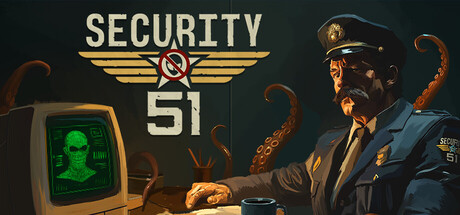
Security 51
Papers, Please took a border crossing and made it political; Security 51 takes an elevator in Area 51 and makes it existential. Whether what's standing in front of you is still human is the only question that matters.
GamerScout Verdict
Worth it for Papers, Please veterans who want the checkpoint formula pushed somewhere genuinely unsettling, with patience for one rough-edged puzzle day.
Compare Prices(5 stores)
Every store in this table quotes us in euros, so the EUR figure is the price the seller actually set, not our arithmetic — which is why EUR is also the currency we rank in. We only list an offer here when the store gives us its price in euros, so nothing in this table is a number we invented.
Pick USD, PLN, GBP, CAD or AUD in the header and we convert from EUR at the European Central Bank reference rate — converted amounts are prefixed with ~. Your bank or the store may apply a different rate at checkout. We never hide offers based on where you are: everyone sees this whole table.
We may earn a commission when you buy games through links on this page — at no extra cost to you. It never affects our rankings or verdicts.
Screenshots & Media
About Security 51
I've spent enough time with bureaucratic horror sims to know when the inspection loop is doing real work versus when it's just window dressing, and Security 51 earns its tension. Alawar, the studio behind the Beholder surveillance games, builds its checkpoint around a single, genuinely unsettling question: not whether a visitor is cleared to descend, but whether the thing that comes back up is the same person that went down. That framing changes how every document feels in your hands. The verification toolkit escalates in exactly the right order. Early shifts ask you to cross-reference names, clearance levels, positions, and schedules, the same pattern-matching muscle memory that Papers, Please trained in you. Then the fingerprint scanner arrives. Then blood testing. Then the body scanner. Each new instrument should make the job easier, but the game's smartest design decision is that more data never produces more certainty: a fingerprint match might still belong to something wrong, and a document that looks too clean is its own kind of alarm. The delayed-consequence system compounds this neatly. A bad call in shift three doesn't blow up immediately; it festers, which means you're never truly off the clock. You are, as one reviewer framed it, building a record that might convict you later. The quarantine system and escalating protocols layer on top without feeling arbitrary, because each rule change is plausibly grounded in whatever horror is spreading through the levels below. The comparison to The Thing is apt and not accidental. The SCP influence runs structural rather than aesthetic: the horror lives in the clinical gap between what your tools can measure and what the anomalies actually are. Slurred speech, behavior that doesn't match the personnel file, an elevator that the cameras log as empty but opens with a passenger inside. The game doesn't hand you a red alert when something is wrong. You have to decide, with incomplete data, under shift pressure, and the consequences follow you forward. That is good design. Where it wobbles is that the entity AI behavior received early criticism for predictability, and playtest feedback flagged the risk of the core verification loop feeling routine before the ending. Alawar responded with variable shift structures and performance mechanics, which is a positive sign, but players in early reviews have noted at least one puzzle day, referred to by the community as The Fool, that requires a replay or two before its logic clicks. That friction is either charming or annoying depending on how you feel about rules that the game hasn't yet explained. The pixel-art presentation is clean and functional. This is not a game that needs photorealism; the ambiguity lives in the text and the scanner readouts, not the sprite sheets. The single-player structure suits the material, and the multiple endings give replay value genuine teeth rather than cosmetic branching. If you have played Papers, Please, Beholder, Contraband Police, or Quarantine Zone, community consensus places Security 51 comfortably in that tier. If you haven't played any of them, the free demo that Alawar ran ahead of launch is the honest way to audit whether the verification loop holds your attention, because this game is entirely that loop, deepened and horrified but not fundamentally different from the genre's core proposition. Go in knowing that, and the pacing lands. Go in expecting action or overt horror setpieces, and you will bounce off it fast.

Strategy & simulation
Tags
System Requirements
Minimum
- OS
- Windows 10 64 bit
- Processor
- Intel Core i5-6400 or analog
- Memory
- 8 GB RAM
- Graphics
- AMD Radeon RX 550 or NVIDIA GeForce GTX 960
- Storage
- 2 GB available space
Keep exploring
Community Discussion
Be the first to comment on Security 51.
Reviews & Ratings
Game Info
- Developer
- Alawar
- Publisher
- Alawar
- Release Date
- Aug 12, 2026