Compare NieR:Automata™ prices across trusted key stores and find the best deal. Developed by Square Enix. Published by Square Enix. Released on 3/17/2017. Available on PC. Genres: Action, RPG. Metacritic score: 84/100.

Yoko Taro and PlatinumGames made something that has no right to work this well: a hack-and-slash about androids that will quietly dismantle your assumptions about what games can say.

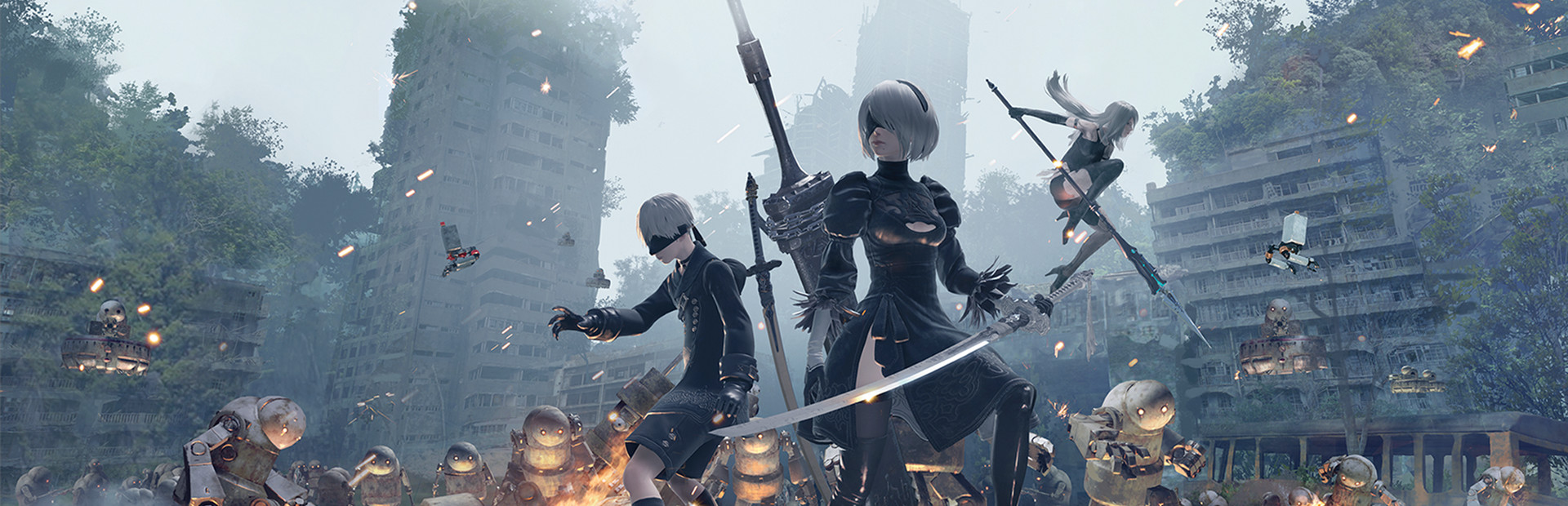
I went into NieR:Automata expecting a stylish action game with some philosophy sprinkled on top, the kind of thing that wears its Nietzsche references as costume jewelry. What I got instead was a game that restructures itself around you three times over, each restructuring hitting harder than the last. That alone earns it serious consideration from anyone who cares about narrative design. The moment-to-moment combat is the work of PlatinumGames, and it shows. Playing as 2B, you juggle short swords, long swords, spears, and combat bracers, pairing a primary weapon for light attacks and a secondary for heavy ones, while your Pod drone fires autonomously or on command. The combo system has genuine depth: small input variations change entire combo strings, and ranged attacks can be layered over melee without interrupting your rhythm. The game does not fully pressure you into using all of that depth on lower difficulties, which some players find frustrating, but if you push into hard mode the whole toolkit becomes necessary. Bullet-hell segments appear without warning as the camera pulls to a side-scrolling or top-down view, turning a chase sequence or a boss encounter into something that feels lifted from a different game entirely. It works far more often than it has any right to. The plug-in chip system is where the RPG bones show. Chips are slotted into a storage grid on your android's OS, each one consuming memory capacity, letting you build toward offensive burst, defensive sustain, auto-healing, or more exotic combinations like infinite Berserk Mode on A2. The storage grid has a hard cap and every slot counts, so you are always making trade-offs. Crucially, even HUD elements like the minimap and health bar are chip slots, meaning you can strip your UI entirely for extra combat power. It is a genuinely clever piece of design that rewards the kind of player who reads every tooltip. Chip farming in specific zones can become a repetitive loop by the third route, which is the one legitimate grind complaint the community raises, but the variety of viable builds keeps it from feeling pointless. The structure is the thing most likely to either hook or alienate you. Route A follows combat android 2B through the first ten chapters of the war against machine lifeforms. Route B replays much of the same map from the perspective of scanner android 9S, with new side quests tied to his hacking ability and a perspective shift that recontextualises events you thought you understood. Route C, covering chapters eleven through seventeen, is where the game stops being polite about what it actually wants to say. All items, chips, and weapons carry across every route, so the mechanical progress is never erased. The side quests are the weakest link: some feel like padding, and the absence of recommended level indicators means stumbling into an overlevelled zone and fighting enemies that take forever to kill without being meaningfully harder. The map is also, famously, not great. These are real friction points in an otherwise exceptional experience. The writing is the reason people replay this game years after finishing it. The machine lifeforms replicating human societies and rituals, the pacifist machine Pascal and his village, the relationship between 2B and 9S that reveals itself across all three routes: this is the material that rewards re-reads and rewards players who do not skip the terminal logs. Yoko Taro uses the medium in ways that feel specific to games, and that is rarer than it should be. The soundtrack by Keiichi Okabe is extraordinary at every difficulty. If you have any tolerance at all for action RPGs that take narrative seriously, NieR:Automata is one of the most complete arguments for games as a storytelling form that the medium has produced. Monika, Scout Team

NieR:Automata™

NieR:Automata™

Mar 17, 2017Square Enix
GamerScout Says

Yoko Taro and PlatinumGames made something that has no right to work this well: a hack-and-slash about androids that will quietly dismantle your assumptions about what games can say.

PC
Steam Deck PlayableProtonDB Platinum
Best Price Available
€0.00
at N/A
Historical low: €3.89

Compare Prices(0 stores)

Loading prices...

We may earn a commission when you buy games through links on this page — at no extra cost to you. It never affects our rankings or verdicts.

Price History

Historical low
€3.895 Jun 2026
Keyshops
€2.32€7.73€13.14€18.555 Jun12 Jun19 Jun25 Jun2 Jul
Tracking prices since 5 Jun 2026
Create alert

Screenshots & Media

About NieR:Automata™

I went into NieR:Automata expecting a stylish action game with some philosophy sprinkled on top, the kind of thing that wears its Nietzsche references as costume jewelry. What I got instead was a game that restructures itself around you three times over, each restructuring hitting harder than the last. That alone earns it serious consideration from anyone who cares about narrative design. The moment-to-moment combat is the work of PlatinumGames, and it shows. Playing as 2B, you juggle short swords, long swords, spears, and combat bracers, pairing a primary weapon for light attacks and a secondary for heavy ones, while your Pod drone fires autonomously or on command. The combo system has genuine depth: small input variations change entire combo strings, and ranged attacks can be layered over melee without interrupting your rhythm. The game does not fully pressure you into using all of that depth on lower difficulties, which some players find frustrating, but if you push into hard mode the whole toolkit becomes necessary. Bullet-hell segments appear without warning as the camera pulls to a side-scrolling or top-down view, turning a chase sequence or a boss encounter into something that feels lifted from a different game entirely. It works far more often than it has any right to. The plug-in chip system is where the RPG bones show. Chips are slotted into a storage grid on your android's OS, each one consuming memory capacity, letting you build toward offensive burst, defensive sustain, auto-healing, or more exotic combinations like infinite Berserk Mode on A2. The storage grid has a hard cap and every slot counts, so you are always making trade-offs. Crucially, even HUD elements like the minimap and health bar are chip slots, meaning you can strip your UI entirely for extra combat power. It is a genuinely clever piece of design that rewards the kind of player who reads every tooltip. Chip farming in specific zones can become a repetitive loop by the third route, which is the one legitimate grind complaint the community raises, but the variety of viable builds keeps it from feeling pointless. The structure is the thing most likely to either hook or alienate you. Route A follows combat android 2B through the first ten chapters of the war against machine lifeforms. Route B replays much of the same map from the perspective of scanner android 9S, with new side quests tied to his hacking ability and a perspective shift that recontextualises events you thought you understood. Route C, covering chapters eleven through seventeen, is where the game stops being polite about what it actually wants to say. All items, chips, and weapons carry across every route, so the mechanical progress is never erased. The side quests are the weakest link: some feel like padding, and the absence of recommended level indicators means stumbling into an overlevelled zone and fighting enemies that take forever to kill without being meaningfully harder. The map is also, famously, not great. These are real friction points in an otherwise exceptional experience. The writing is the reason people replay this game years after finishing it. The machine lifeforms replicating human societies and rituals, the pacifist machine Pascal and his village, the relationship between 2B and 9S that reveals itself across all three routes: this is the material that rewards re-reads and rewards players who do not skip the terminal logs. Yoko Taro uses the medium in ways that feel specific to games, and that is rarer than it should be. The soundtrack by Keiichi Okabe is extraordinary at every difficulty. If you have any tolerance at all for action RPGs that take narrative seriously, NieR:Automata is one of the most complete arguments for games as a storytelling form that the medium has produced.

Monika
Monika · Scout Team

RPGs

Tags

singleplayerachievementscloud-savesSingle-playerSteam AchievementsSteam Trading CardsCustom Volume ControlsAdjustable DifficultyPlayable without Timed InputStereo SoundPartial Controller SupportSteam CloudRemote Play on PhoneRemote Play on TabletFamily SharingPhilosophical NarrativeMultiple Playthroughs RequiredChip-Based Build SystemBullet-Hell SegmentsCharacter ActionExistentialist WritingNew Game Plus RevelationsPod CombatStylish ActionBittersweet EndingMulti-Route NarrativeHack-and-Slash RPGPerspective-Shifting GameplayAndroid ProtagonistYoko TaroPost-Apocalyptic WorldbuildingOS Chip Builds26 Endings

System Requirements

Minimum

Processor
Intel Core i3 2100 or AMD A8-6500
Memory
4 GB RAM
Graphics
NVIDIA GeForce GTX 770 VRAM 2GB or AMD Radeon R9 270X VRAM 2GB
DirectX
Version 11
Network
Broadband…

Recommended

Processor
Intel Core i5 4670 or AMD A10-7850K
Memory
8 GB RAM
Graphics
NVIDIA GeForce GTX 980 VRAM 4GB or AMD Radeon R9 380X VRAM 4GB
DirectX
Version 11
Network
Broadba…

DLC & Add-ons for NieR:Automata™3

Expansions, DLC packs and add-on content for this game. Click any item to see store offers.

Keep exploring

Community Discussion

Be the first to comment on NieR:Automata™.

Reviews & Ratings

Metacritic
84
Steam
87%(150,812)

Game Info

Developer
Square Enix
Publisher
Square Enix
Release Date
Mar 17, 2017
Age Rating
PEGI 18

Game Modes

singleplayer

Languages

Audio (1)
English
Subtitles (6)
EnglishFrenchItalianGermanSpanish - SpainJapanese

Features

AchievementsCloud Saves

Price Alert

Get notified when the price drops below your target!

Create Alert

No card? Pay another way

Top up your Steam Wallet or buy crypto with any card — instant delivery, no bank account needed.

More from Square Enix

Buy smarter: helpful guides

Looking for more? See games like NieR:Automata™ →

Frequently asked questions about NieR:Automata™

How much does NieR:Automata™ cost?

NieR:Automata™ pricing changes often and varies by store, edition and region. The live price table on this page compares the cheapest in-stock offers from trusted key stores like Eneba and Kinguin, so you always see the current lowest price before you buy.

Where can I buy NieR:Automata™ cheapest?

Compare NieR:Automata™ prices across every verified store in the price table on this page. We list the cheapest in-stock key and store offers, updated regularly, so you always see the best current deal before you buy.

What platforms is NieR:Automata™ available on?

NieR:Automata™ is available on PC.

When was NieR:Automata™ released?

NieR:Automata™ was released on 17 March 2017.

Who developed NieR:Automata™?

NieR:Automata™ was developed by Square Enix.

Is NieR:Automata™ worth buying?

NieR:Automata™ holds a Metacritic score of 84/100, making it one of the standout Action titles. See the full reviews, ratings and how-long-to-beat times on this page to decide.