Knights of Pen and Paper 2 Deluxiest Edition
The difficulty setting is you: you stock every fight yourself, which turns a jokey pixel-art party RPG into a surprisingly sharp exercise in build math.
GamerScout Verdict
Worth it for turn-based tacticians who want to tune every fight themselves, less so for anyone who needs a story to pull them along.
Compare Prices(3 stores)
Every store in this table quotes us in euros, so the EUR figure is the price the seller actually set, not our arithmetic — which is why EUR is also the currency we rank in. We only list an offer here when the store gives us its price in euros, so nothing in this table is a number we invented.
Pick USD, PLN, GBP, CAD or AUD in the header and we convert from EUR at the European Central Bank reference rate — converted amounts are prefixed with ~. Your bank or the store may apply a different rate at checkout. We never hide offers based on where you are: everyone sees this whole table.
We may earn a commission when you buy games through links on this page — at no extra cost to you. It never affects our rankings or verdicts.
Price History
Screenshots & Media
About Knights of Pen and Paper 2 Deluxiest Edition
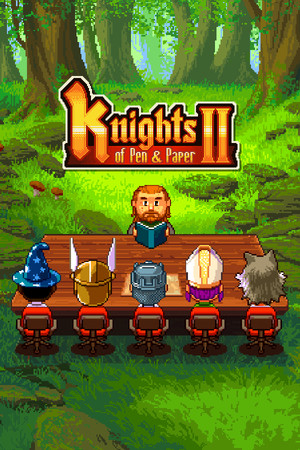
You drop your own monsters onto the table, and that single choice is the smartest difficulty system I have played in a turn-based RPG. There is no Easy or Hard toggle buried in a menu at hour zero. You sit at a virtual tabletop and stock each fight yourself, choosing how many enemies, of which type, in which room. Want a quick farming pass for crafting materials? Two weak enemies and a clean initiative order. Want to know whether your party's damage output is actually keeping pace with your levels? Load the table until the turn queue looks frightening and find out. Every encounter is a bet you place against your own build, and the arithmetic underneath it is sharper than the chunky sprites and the constant tabletop gags prepare you for. Structurally this is a party RPG wearing a game-night costume. You are not the heroes. You are a group of people around a table pretending to be heroes, and the Game Master keeps interrupting. Party building happens on two axes: you decide who is sitting in each chair, then you hand that person a class. The character and the class each carry their own modifiers, so a front-line class in one player's hands is not the same statline as the same class given to someone else. That two-layer system is where the depth hides. A full table gives you room for a tank, a healer, two damage dealers and one flexible slot, and the class synergy is genuine: crowd control that sets up a burst turn, buffs that stack into one big hit, resource management that decides whether your best ability fires every round or every third round. The loop outside combat is lighter than a grand-strategy veteran might expect, and that is deliberate. You gather materials in the field, hand them off for crafting, and slowly upgrade your gear. You also spend money on the room itself, and the furniture is not decoration. Better seating, better snacks, better table gear feed passive bonuses that quietly raise your whole party's floor. It is a modest base-building layer, but it rewards planning three or four sessions ahead instead of buying whatever is cheapest today. Newcomers should know this is one of the friendliest on-ramps into tactical party RPGs I can point at. The tutorial does not condescend, the numbers stay small enough to hold in your head, and because you author the encounters, you can never be ambushed by a difficulty spike you did not personally build. Where it disappoints: the middle stretch grinds. Because you set your own fights, the path of least resistance is farming the same safe encounter repeatedly, and nothing stops you from doing it until the tactical decisions stop being decisions. Enemy AI is simple by design and rarely surprises you after the first several hours, so the challenge comes from your own math rather than from opponent behaviour. The writing leans hard on referential humour and geek-culture nods, and your mileage depends entirely on whether that register lands; when it misses, it feels like being elbowed in the ribs on a loop. There is no multiplayer and no meaningful mod scene, so what ships is what you get. Backtracking across the map happens more often than it should. And the story is a frame, not a hook. Nothing here pulls you forward on plot alone. Who should buy it: anyone who likes assembling a party and then stress-testing it, anyone who plays in twenty-minute chunks (this is excellent controller-in-hand, half-attention gaming), and anyone curious about turn-based tactics who has bounced off harsher systems. The long-term Steam consensus, sitting near 87 percent positive across a few thousand reviews, matches my read: a comfortable, well-tuned small game that knows exactly what size it is. Approach it as a campaign you dip into rather than a completionist marathon, deliberately set yourself harder encounters than you strictly need, and it holds up nicely. Treat it as a grind and it will honour that request by becoming boring.

Strategy & simulation
Tags
System Requirements
Minimum
- Processor
- 2Ghz+
- Memory
- 1024 MB RAM
- Graphics
- 1024x768 minimum resolution ( Direct3D/OpenGL compatible card with at least 128MB)
- DirectX
- Version 9.0c
- Storage
- 300 MB available s…
Keep exploring
Community Discussion
Be the first to comment on Knights of Pen and Paper 2 Deluxiest Edition.
Reviews & Ratings
Game Info
- Developer
- Kyy Games
- Publisher
- Paradox Interactive
- Release Date
- Oct 20, 2015