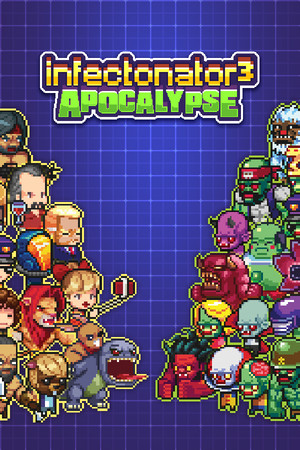
Infectonator: Survivors
A squad-management roguelike whose first hour is actively bad at selling the game underneath it. Survive to run four and the resource math turns genuinely sharp.
GamerScout Verdict
Worth it if you write off two dead squads as tuition and enjoy supply math more than twitchy squad combat.
Compare Prices(3 stores)
Every store in this table quotes us in euros, so the EUR figure is the price the seller actually set, not our arithmetic — which is why EUR is also the currency we rank in. We only list an offer here when the store gives us its price in euros, so nothing in this table is a number we invented.
Pick USD, PLN, GBP, CAD or AUD in the header and we convert from EUR at the European Central Bank reference rate — converted amounts are prefixed with ~. Your bank or the store may apply a different rate at checkout. We never hide offers based on where you are: everyone sees this whole table.
We may earn a commission when you buy games through links on this page — at no extra cost to you. It never affects our rankings or verdicts.
Price History
Screenshots & Media
About Infectonator: Survivors
The first hour of this game is a terrible advertisement for the game underneath it. You get handed a few warm bodies, no real sense of how far a day of supplies stretches, and squadmates who will happily walk into a horde because the pathfinding decided a straight line through six zombies was the efficient route. My first squad died in roughly twenty minutes. My second died faster, because I had learned exactly one wrong lesson from the first. If you bounce off that, I understand completely, and the 67 percent Steam score is basically a monument to people who bounced. But the numbers underneath are sharper than the presentation suggests, and they do not show themselves until about your fourth run. Structurally it is a loop with two halves that argue with each other. One half is the excursion: you take a small squad out, in real time, into a map that is deliberately scarcer than you want it to be, and every bullet you spend is a bullet the base does not have tomorrow. The other half is the ledger back home, where you decide who eats, what gets fortified, who gets kitted out, and who is expendable enough to send out again. Permadeath means your roster is not a cast of characters, it is a depreciating asset. Losing a well-equipped survivor is not a story beat, it is a gear write-off plus every hour of scavenging you sank into them. The genre-hybrid label is honest, but be clear about which half is load-bearing: this is a strategy game with action controls bolted on, and the action layer is the weaker one. What clicks around run four is that the game is not asking you to win fights. It is asking you to decide which fights are worth the ammunition, and to leave the map before greed sets in. Once I started treating every excursion as a budget with a hard exit condition (grab the two nearest caches, do not chase the third, go home), the difficulty curve flattened dramatically. The best move in most runs is a subtraction. Fewer survivors out, shorter routes, lower ammo burn, more hours banked into base defense so the next wave does not undo a good day. That is a real resource puzzle with real opportunity cost, and it is why I kept rebuilding after squad wipes instead of uninstalling. The problems are equally real and not subtle. Squad AI is the headline offender. Your people path badly, clump when they should spread, and occasionally take a route that reads as deliberate sabotage. In a game where one bad step deletes a permanent unit, handing that much control to a mediocre AI is a decision that ages poorly, and it is the single biggest reason the reviews sit where they do. The tutorial is the second offender. It teaches inputs, not economy, so the actual skill (knowing what a day of supplies is worth before you spend it) has to be learned through three or four dead rosters. There is no multiplayer, and the mod scene never grew into anything you could call an ecosystem, so what shipped in 2016 is what you get. Achievements, trading cards, cloud saves, family sharing. That is the whole feature sheet. So who is this for. People who enjoy attrition management and are willing to write off their first two or three squads as tuition. If you like the planning layer of survival management more than the moment-to-moment shooting, the trade works out fine, because the shooting is exactly the thing good play tries to minimise. If you want responsive squad control, clean combat feel, or a game that respects your time in hour one, look elsewhere, and do not let the pixel art convince you this is a light snack between bigger games. Individual runs are short enough for a lunch break, but the learning is front-loaded and unforgiving in a way modern management roguelikes have mostly stopped being. My honest advice: commit to four runs before you form an opinion. Anything less and you are reviewing the tutorial, not the game.

Strategy & simulation
Tags
System Requirements
Minimum
- Processor
- 2.33 GHz or faster processor
- Memory
- 512 MB RAM
- Graphics
- Any GPU that support Pixel Shader version 2.x or above
- Storage
- 100 MB available space
- Sound Card
- Any
Recommended
- Processor
- 2.33 GHz or faster processor
- Memory
- 1 GB RAM
- Graphics
- Any GPU that support Pixel Shader version 2.x or above
- Storage
- 100 MB available space
- Sound Card
- Any
Keep exploring
Community Discussion
Be the first to comment on Infectonator: Survivors.
Reviews & Ratings
Game Info
- Developer
- Toge Productions
- Publisher
- Toge Productions
- Release Date
- Aug 8, 2016