Holy Potatoes! A Weapon Shop?! - Spud Tales: Journey to Olympus
Charming shop-sim with genuine smith progression and pop-culture potato jokes, but the mid-game repetition will test anyone who demands constant strategic novelty.
GamerScout Verdict
Best for casual sim fans who want a breezy 15-hour management loop and can forgive a repetitive endgame.
Compare Prices(3 stores)
Every store in this table quotes us in euros, so the EUR figure is the price the seller actually set, not our arithmetic — which is why EUR is also the currency we rank in. We only list an offer here when the store gives us its price in euros, so nothing in this table is a number we invented.
Pick USD, PLN, GBP, CAD or AUD in the header and we convert from EUR at the European Central Bank reference rate — converted amounts are prefixed with ~. Your bank or the store may apply a different rate at checkout. We never hide offers based on where you are: everyone sees this whole table.
We may earn a commission when you buy games through links on this page — at no extra cost to you. It never affects our rankings or verdicts.
Price History
Screenshots & Media
About Holy Potatoes! A Weapon Shop?! - Spud Tales: Journey to Olympus
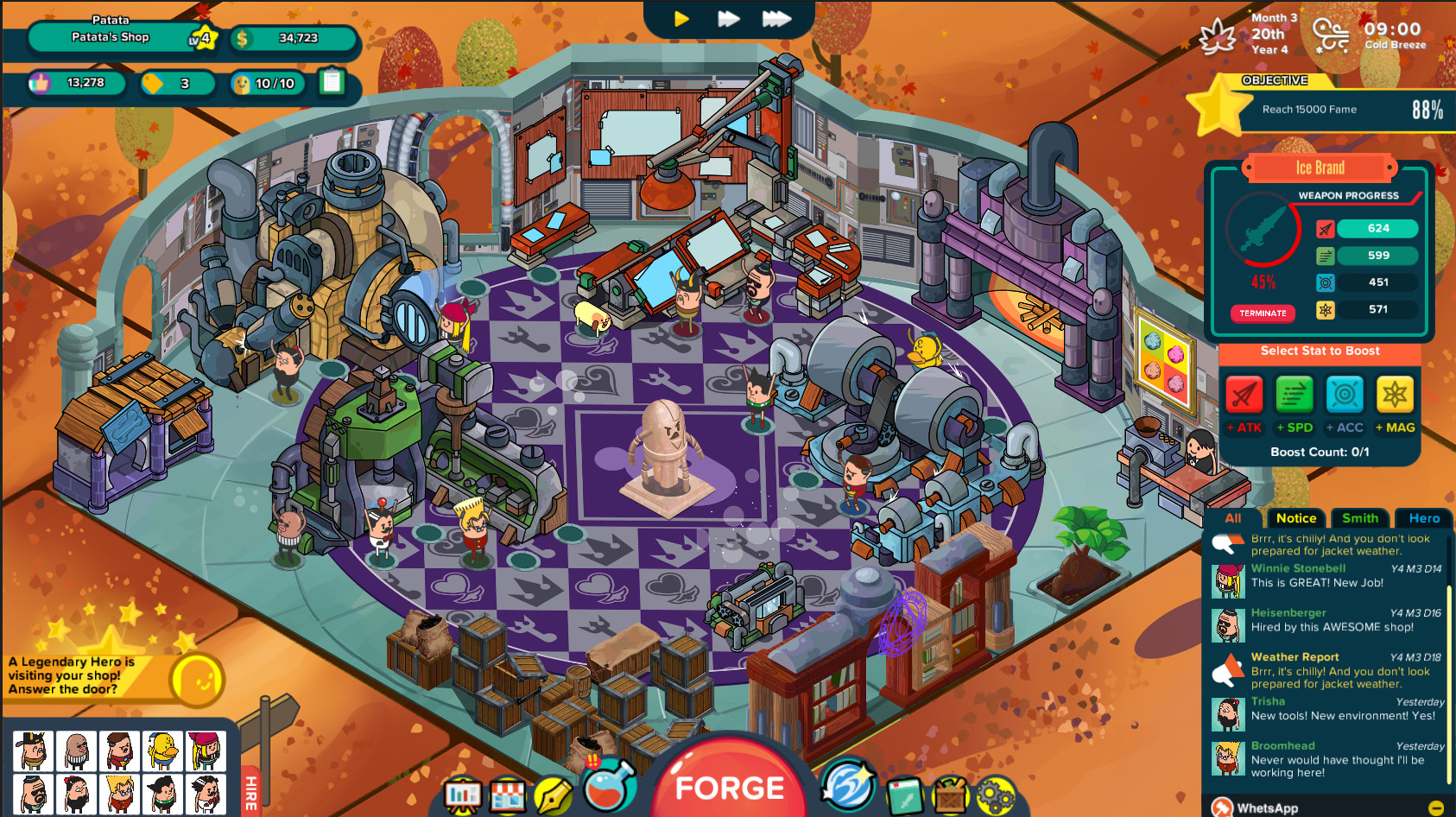
I put a few hours into this one expecting something with the mechanical density of a Kairosoft title, and what I got is closer to a lite management sim with a surprisingly layered smith-leveling system underneath the absurdist potato veneer. That gap between expectation and reality is the most important thing to communicate before you hand over your cash. The core loop is straightforward: assign your potato smiths to one of four specialist workstation roles - Designer, Craftsman, Metal Worker, or Enchanter - each tied to a distinct weapon stat (ATK, SPD, ACC, MAG respectively). Smiths also double as explorers and merchants, which creates a genuine resource-allocation tension. Send your best Craftsman out to gather materials and you lose a crafting cycle. Keep everyone at the forge and your supply chain dries up. Early on, that juggling act has real bite. The smith class tree goes deeper than the cute art style implies: base classes promote into 11 total tiers, with mid-tier hybrids like the Inventor (ATK+SPD) and Mechanic (ACC+MAG) unlocking only once the prerequisite classes hit max level. At the top sit the Virtuoso, who can boost any weapon stat, and the Master Smith, who trades boost capability for raw stat ceilings. Balancing a roster of those two endgame archetypes is the closest this game gets to a late-game strategy puzzle. Smith mood also feeds into output - a stressed or depressed potato takes a performance hit, which means the vacation system is actually a resource you manage, not a fluff feature. Weapon variety is genuinely wide. You are researching and forging daggers, swords, katanas, rifles, and cannons, with relic combinations unlocking new blueprints that the game surfaces through an in-game notification system rather than burying them in menus. Hero customers each have stat preferences, so an axe built for maximum damage scores better with a warrior than a mage looking for magic throughput, and pricing reflects that match quality. That customer-matching layer gives the selling phase more texture than a simple auction. Here is the honest caveat for strategy-heads: the depth plateaus earlier than you want it to. Once enchanting is unlocked and your smith roster has hit its first class promotions, the loop becomes formulaic. New zones refresh the content catalogue briefly, but the underlying decision sequence - explore, buy, forge, sell - repeats without introducing meaningfully new constraints. The late game shifts into a numbers-escalation mode where you are optimizing yields rather than solving new problems. The UI compounds this: late-game pop-up interruptions stack and overlap in a way that feels chaotic rather than complex, and menu navigation carries a delay that registers as sluggish rather than weighty. These are not dealbreakers, but they matter if you are the type who needs a late-game reason to keep optimizing. For who this is actually for: casual sim fans, players who enjoy Recettear-adjacent shop management, and anyone who appreciates writing that layers in pop-culture hero cameos and potato puns without apology. Newcomers to the genre will find the tutorial respectful and the early ramp-up satisfying. If you are arriving from deep grand-strategy expecting systemic complexity to compound across 50 hours, recalibrate. This is a 15-to-20 hour experience that delivers its best material in the first two-thirds and coasts on charm thereafter. At a heavy discount, which it frequently hits, the value-to-playtime ratio is solid for what it is.

Strategy & simulation
Tags
System Requirements
Minimum
- OS
- XP / Vista / 7
- Processor
- Intel 2 GHz
- Memory
- 2 GB RAM
- Graphics
- 1280 x 720 Minimum Resolution
- DirectX
- Version 9.0
- Storage
- 500 MB available space
Keep exploring
Community Discussion
Be the first to comment on Holy Potatoes! A Weapon Shop?! - Spud Tales: Journey to Olympus.
Reviews & Ratings
Game Info
- Developer
- Daylight Studios
- Publisher
- Daedalic Entertainment, Daylight Studios
- Release Date
- Jul 13, 2015