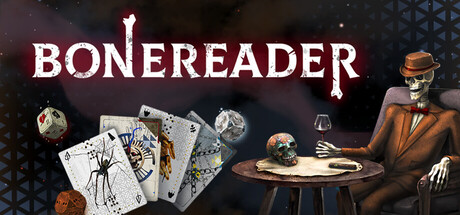
Compare BONEREADER prices across trusted key stores and find the best deal. Developed by Bonereaders. Published by DANGEN Entertainment. Released on 8/6/2026. Available on PC. Genres: Strategy.

Push through a first hour that explains itself in occult riddles and there is one of the sharper dice-and-deck probability engines on PC underneath. Impatient players will bounce.

The first hour of BONEREADER is where most people will decide it is not for them, and I think that decision is premature. The game hands you its systems in occult flavour language long before it hands them to you as numbers, so those opening runs are spent guessing at what a card actually does to your dice rather than planning around it. There is no gentle ramp, and the Steep Onboarding tag on the store page is not false advertising. My honest advice: write off your first two or three runs as the tutorial the game never quite gives you, keep a scrap of paper next to the keyboard, and let the vocabulary settle. Once it does, the woodcut horror dressing stops being a barrier and the machine underneath turns out to be unusually clean. The core loop is deckbuilding fused to dice manipulation, which is a pairing that normally fails in one of two directions. Either the dice are pure noise and the cards quietly do all the work, or the cards exist only to erase bad rolls, which makes the dice decorative. BONEREADER sits in the more interesting middle. Your cards mostly bend probability rather than deliver flat damage, so the real question on a given turn is rarely what your biggest hit is. It is how much variance you are willing to swallow to reach it, and whether you can afford the downside twice in a row if the first attempt misses. Combat is turn-based with no timed input anywhere, so you can sit and count outs for as long as you want. For a game built on dice, that patience-friendly framing matters enormously. Where it earns the strategy label is the way early commitments constrain the endgame. This is run-based roguelike structure, so your build compounds across a session, and a card you took in the second fight because it looked strong in isolation can quietly cap your ceiling six fights later when the enemy math scales past what your dice can reliably produce. That is the good kind of pain. It means your opening picks are a build order, not a shopping trip, and it means losses are legible in hindsight instead of feeling arbitrary. I will make the case that this is beginner-friendly if you approach it correctly, because the adjustable difficulty settings let you lower the floor while you learn the probability language, and because the run length keeps the feedback loop short. You are not losing a 40-hour campaign to a misread. You are losing twenty minutes and learning exactly which decision cost you. What disappoints is mostly presentation and scope. The flavour writing is genuinely good, but it is doing a job it is not suited for, and there are moments where a plain sentence about what a value actually modifies would have saved a run. A proper reference screen would fix most of the friction I described in the opening. It is also strictly single-player, and the feature list shows no workshop or mod support, which is a real ceiling for a systems game like this: dice-and-deck designs live a long time when players can build content for them, and that door appears closed for now. The build is new enough that long-term balance is an open question, and the review sample you can find is small, so treat the current sentiment as encouraging rather than settled. Controller support is thorough, including a mouse-only option and DualSense handling, and cloud saves plus family sharing are in, which suits a game you will dip into across sessions. So: not a hundred-hour campaign monster, but a tight, honest risk engine wearing an intimidating costume. If you like the mental exercise of weighing a 60 percent line against a safer 90 percent one and living with the answer, this rewards you quickly once you push past the murk. If you want a game that explains itself in the first fifteen minutes, look elsewhere, because this one expects you to meet it partway. Diego, Scout Team

BONEREADER

BONEREADER

Aug 6, 2026BonereadersDANGEN Entertainment
GamerScout Says

Push through a first hour that explains itself in occult riddles and there is one of the sharper dice-and-deck probability engines on PC underneath. Impatient players will bounce.

PC
Best Price Available
€2.24
at Kinguin
Lowest tracked: €2.24
Track this price

GamerScout Verdict

Best for deckbuilder players who enjoy counting outs and can forgive an opening hour that refuses to explain itself.

Compare Prices(5 stores)

KinguinBest price
StandardGlobalSteam KeyKey
€2.24
Priced in EUR by the store
Buy
StandardGlobalSteam KeyKey
€4.15-20%
Priced in EUR by the store
Buy
StandardEurope (EU)Steam KeyKey
€5.19
Priced in EUR by the store
Buy
StandardGlobalSteam KeyKey
€5.19
Priced in EUR by the store
Buy
StandardGlobalSteam KeyKey
€5.19
Priced in EUR by the store
Buy

Every store in this table quotes us in euros, so the EUR figure is the price the seller actually set, not our arithmetic — which is why EUR is also the currency we rank in. We only list an offer here when the store gives us its price in euros, so nothing in this table is a number we invented.

Pick USD, PLN, GBP, CAD or AUD in the header and we convert from EUR at the European Central Bank reference rate — converted amounts are prefixed with ~. Your bank or the store may apply a different rate at checkout. We never hide offers based on where you are: everyone sees this whole table.

We may earn a commission when you buy games through links on this page — at no extra cost to you. It never affects our rankings or verdicts.

Price History

Lowest tracked
€2.247 Sept 2026
Current best
€2.24
Lowest since we started tracking
Official storesKeyshops
€2.01€2.80€3.59€4.3829 Aug31 Aug3 Sept5 Sept7 Sept
Tracking prices since 29 Aug 2026
Create alert

Screenshots & Media

About BONEREADER

The first hour of BONEREADER is where most people will decide it is not for them, and I think that decision is premature. The game hands you its systems in occult flavour language long before it hands them to you as numbers, so those opening runs are spent guessing at what a card actually does to your dice rather than planning around it. There is no gentle ramp, and the Steep Onboarding tag on the store page is not false advertising. My honest advice: write off your first two or three runs as the tutorial the game never quite gives you, keep a scrap of paper next to the keyboard, and let the vocabulary settle. Once it does, the woodcut horror dressing stops being a barrier and the machine underneath turns out to be unusually clean. The core loop is deckbuilding fused to dice manipulation, which is a pairing that normally fails in one of two directions. Either the dice are pure noise and the cards quietly do all the work, or the cards exist only to erase bad rolls, which makes the dice decorative. BONEREADER sits in the more interesting middle. Your cards mostly bend probability rather than deliver flat damage, so the real question on a given turn is rarely what your biggest hit is. It is how much variance you are willing to swallow to reach it, and whether you can afford the downside twice in a row if the first attempt misses. Combat is turn-based with no timed input anywhere, so you can sit and count outs for as long as you want. For a game built on dice, that patience-friendly framing matters enormously. Where it earns the strategy label is the way early commitments constrain the endgame. This is run-based roguelike structure, so your build compounds across a session, and a card you took in the second fight because it looked strong in isolation can quietly cap your ceiling six fights later when the enemy math scales past what your dice can reliably produce. That is the good kind of pain. It means your opening picks are a build order, not a shopping trip, and it means losses are legible in hindsight instead of feeling arbitrary. I will make the case that this is beginner-friendly if you approach it correctly, because the adjustable difficulty settings let you lower the floor while you learn the probability language, and because the run length keeps the feedback loop short. You are not losing a 40-hour campaign to a misread. You are losing twenty minutes and learning exactly which decision cost you. What disappoints is mostly presentation and scope. The flavour writing is genuinely good, but it is doing a job it is not suited for, and there are moments where a plain sentence about what a value actually modifies would have saved a run. A proper reference screen would fix most of the friction I described in the opening. It is also strictly single-player, and the feature list shows no workshop or mod support, which is a real ceiling for a systems game like this: dice-and-deck designs live a long time when players can build content for them, and that door appears closed for now. The build is new enough that long-term balance is an open question, and the review sample you can find is small, so treat the current sentiment as encouraging rather than settled. Controller support is thorough, including a mouse-only option and DualSense handling, and cloud saves plus family sharing are in, which suits a game you will dip into across sessions. So: not a hundred-hour campaign monster, but a tight, honest risk engine wearing an intimidating costume. If you like the mental exercise of weighing a 60 percent line against a safer 90 percent one and living with the answer, this rewards you quickly once you push past the murk. If you want a game that explains itself in the first fifteen minutes, look elsewhere, because this one expects you to meet it partway.

Diego
Diego · Scout Team

Strategy & simulation

Tags

auto-admittedDeckbuilderDice ManipulationRoguelike RunsProbability ManagementOccult HorrorTurn-Based CombatSteep OnboardingRun-Based StrategyRisk vs RewardSynergy BuildingNo Time PressureDifficulty OptionsShort RunsSingle-Player OnlySystems-Heavy

System Requirements

Minimum

OS
Windows 11, Windows 10 64-bit
Processor
Intel i5-2300/AMD FX-4300
Graphics
NVIDIA GeForce GTX 550 Ti
Storage
600 MB available space

Recommended

OS
Windows 11, Windows 10 64-bit
Processor
Intel i5-2300/AMD FX-4300
Graphics
NVIDIA GeForce GTX 1050 or equivalent
Storage
600 MB available space

Keep exploring

Community Discussion

Be the first to comment on BONEREADER.

Reviews & Ratings

Steam
100%(14)

Game Info

Developer
Bonereaders
Publisher
DANGEN Entertainment
Release Date
Aug 6, 2026

Features

Single-playerSteam AchievementsFull controller supportSteam Trading CardsCustom Volume ControlsAdjustable DifficultyMouse Only Option#category_playable_at_your_own_pace+6 more

Price Alert

Get notified when the price drops below your target!

Create Alert
Best price€2.24
See offer

Across the 24,365 games we track, a verified key was cheaper than the official store 90% of the time. See the method and the full numbers in our game price report.

No card? Pay another way

Top up your Steam Wallet or buy crypto with any card — instant delivery, no bank account needed.

More from Bonereaders

Buy smarter: helpful guides

Frequently asked questions about BONEREADER

How much does BONEREADER cost?

As of 7 September 2026, the cheapest in-stock offer for BONEREADER is €2.24 at Kinguin, out of 5 live offers we track across verified key stores. Prices change daily — the table on this page is refreshed continuously.

Where can I buy BONEREADER cheapest?

The lowest in-stock price we track for BONEREADER is €2.24 at Kinguin (7 September 2026). We compare 5 live offers from verified key stores — the full table with every store and its trust score is on this page.

What platforms is BONEREADER available on?

BONEREADER is available on PC.

When was BONEREADER released?

BONEREADER was released on 6 August 2026.

Who developed BONEREADER?

BONEREADER was developed by Bonereaders and published by DANGEN Entertainment.