Yooka-Laylee
A collectathon that lives or dies on one decision: unlock a fresh world, or grow the one you're already standing in. Patient players get a warm N64 throwback. Rushers get a camera fight.
GamerScout Verdict
Worth it if you miss Banjo-era exploration and can forgive a fussy camera; skip it if hunting collectibles feels like chores.
Compare Prices(6 stores)
Every store in this table quotes us in euros, so the EUR figure is the price the seller actually set, not our arithmetic — which is why EUR is also the currency we rank in. We only list an offer here when the store gives us its price in euros, so nothing in this table is a number we invented.
Pick USD, PLN, GBP, CAD or AUD in the header and we convert from EUR at the European Central Bank reference rate — converted amounts are prefixed with ~. Your bank or the store may apply a different rate at checkout. We never hide offers based on where you are: everyone sees this whole table.
We may earn a commission when you buy games through links on this page — at no extra cost to you. It never affects our rankings or verdicts.
Price History
Screenshots & Media
About Yooka-Laylee
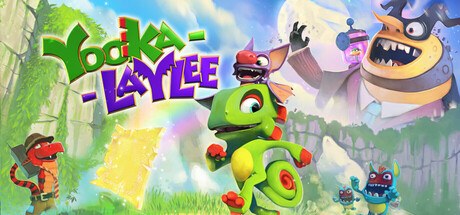
Every Pagie I picked up forced the same small decision, and that decision turned out to be the entire game: spend it to crack open a brand new Grand Tome, or pour it back into the world I was already standing in to make that world physically larger. Yooka-Laylee builds its whole structure on that fork. Expanding a book adds terrain, new characters, and new Pagies to a level you already half-know, so a place that felt thin ten minutes ago suddenly grows a second half. The effect on how you play is real. Treat Pagies as a score to rack up and you end up with five skinny, underbuilt worlds. Treat them as a budget and commit to two or three, and you get the dense, layered playgrounds this team clearly wanted to build. I enjoyed my run far more once I stopped hoarding and started investing. Underneath that, this is a collectathon in the purest sense, made by people who built the originals. You are a chameleon and a bat working through a corporate villain's tower, hoovering up Quills to buy moves from Trowzer, a trouser-wearing snake who parcels out your abilities one paywall at a time. Those moves matter more than the collectibles do, because each one retroactively reopens ground you already covered. The sonar blast, the roll, the glide, the underwater dash: every purchase is a key to doors you walked past an hour ago. Tonics layer on top, letting you swap in modifiers for extra Quill gain, easier combat, or old-school visual filters, which quietly doubles as a difficulty slider for anyone who wants one. If you grew up with 3D platformers on a chunky grey console, the vocabulary here will feel like coming home. If you did not, expect a lot of running back to old corners. What genuinely works is the craft in the corners. The score, split between Grant Kirkhope and David Wise, is the best argument for the whole project. It shifts as you move between areas of a level rather than looping flatly, and it carries a lot of the mood that the writing sometimes fumbles. The environments have a real sense of place: a swampy maze, a casino floor humming with neon, a frozen expanse with a proper cold silence to it. There is texture in the small stuff too, like Rextro's deliberately janky in-world arcade cabinets, the minecart runs, and the transformation puzzles that turn you into a plant or a snowplough for a stretch. The split-screen games and the second-player helper mode are the kind of thing you fire up with somebody on the couch or over Remote Play Together for twenty minutes, not something to plan an evening around. That is fine. They know their scale. What does not work is mostly friction. The camera struggles in tight interiors and during precise platforming, and it will absolutely cost you a jump or two in the later worlds. Some levels sprawl without enough landmarks, which makes hunting the last few Pagies feel like walking a grid rather than exploring. The quiz sections stop the game dead. And the dialogue leans hard on gag-a-second chatter and squawky voice blips that wear out well before the credits. This is a game that trusts your patience a lot, and it does not always earn that trust back the way its best moments do. It is a 73 on Metacritic and sits around three-quarters positive on Steam for exactly these reasons: nobody thinks it is broken, plenty of people think it is fussy. I will still defend it. The slow start, the gated moveset, the deliberate choice to make you revisit rather than move on: those are all intentional, and they pay off in the back half if you let them. This is not a tight six-hour experience that knows exactly when to stop. It is a long, generous, occasionally shaggy thing made by a small studio swinging at a genre nobody else was making anymore, and the parts they cared most about (the music, the level texture, the joy of finally getting a move that opens up everything) are the parts that hold. Go in wanting to linger, not to finish.

Indie & narrative
Tags
System Requirements
Minimum
- Processor
- Intel i5-2500 3.3GHz
- Memory
- 8 GB RAM
- Graphics
- NVidia GTS450 / AMD Radeon 6850HD
- DirectX
- Version 11
- Storage
- 9 GB available space
- Sound Card
- Windows Compatible Card
Recommended
Requires a 64-bit processor and operating system
DLC & Add-ons for Yooka-Laylee1
Expansions, DLC packs and add-on content for this game. Click any item to see store offers.
Keep exploring
Community Discussion
Be the first to comment on Yooka-Laylee.
Reviews & Ratings
Game Info
- Developer
- Playtonic Games
- Publisher
- Playtonic Friends
- Release Date
- Apr 11, 2017