
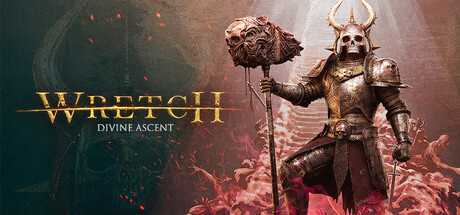
Wretch: Divine Ascent
Wins and losses get decided while you rotate boots in a backpack, not during the fight. Brilliant if you optimise for fun, hollow if you wanted to swing the sword yourself.
GamerScout Verdict
For optimisers who see an inventory grid as a puzzle worth solving; skip it entirely if you want combat inputs.
Compare Prices(3 stores)
Every store in this table quotes us in euros, so the EUR figure is the price the seller actually set, not our arithmetic — which is why EUR is also the currency we rank in. We only list an offer here when the store gives us its price in euros, so nothing in this table is a number we invented.
Pick USD, PLN, GBP, CAD or AUD in the header and we convert from EUR at the European Central Bank reference rate — converted amounts are prefixed with ~. Your bank or the store may apply a different rate at checkout. We never hide offers based on where you are: everyone sees this whole table.
We may earn a commission when you buy games through links on this page — at no extra cost to you. It never affects our rankings or verdicts.
Price History
Screenshots & Media
About Wretch: Divine Ascent
If you are the sort of player who will rotate a boot twice to free up two grid cells for a better synergy, Wretch: Divine Ascent was built for you, and if you want to actually swing the sword, walk away now. Here is the justification. This is an auto battler where every decision you will ever make happens before a single blow lands. You take a roguelike run, you pack a bag, you hit go, and then you watch two loadouts resolve each other without your input. The Mostly Positive rating (77 percent across a bit over 1,100 reviews) reads to me like a clean split between people who understood that going in and people who saw the Action genre tag and expected to press something. Mechanically it is a packing puzzle wearing dark medieval armour. Runs are short and self-contained. Between fights you are offered gear, each piece takes up a physical footprint in a bounded inventory, and the pieces talk to each other based on how you arrange them. That last part is the whole game. An item that is strong in isolation can be a net loss because its shape carves your bag into unusable slivers, and a mediocre item can carry a run because it slots cleanly beside three things that want it there. Empty cells are not neutral, they are wasted damage. Once the fight starts you are a spectator, watching your arrangement either hold or fall apart against an AI opponent or, in the 1v1 online mode, against someone else's bag. I normally spend this paragraph arguing that some 200-hour grand strategy monster is beginner-friendly if you approach it correctly, and the same logic applies here for the opposite reason. The systems look intimidating on paper, but the failure cost is close to zero. A run is a short commitment rather than an evening, and losing one teaches you more than any tutorial screen can. My advice for your first five runs is to be aggressively narrow: pick one synergy line early, refuse every item that does not feed it even when the raw numbers look better, and treat any run where you finish with a half-empty bag as a loss regardless of the result. Flat stat increases are a trap in this kind of design because they scale linearly while synergies scale multiplicatively. Once that clicks, the difficulty stops being the game and the optimisation starts being the game. Full controller support and cloud saves also mean you can think about a bag on the couch and finish the run at a desk. What does not work is mostly structural and worth knowing before you commit. Because you have no agency once combat begins, a run that offers you nothing coherent is simply dead, and you will sit through the confirmation of that fact rather than playing your way out of it. Variance in what gets offered is the main source of frustration in a genre that otherwise rewards planning, and no amount of skill fixes a run that never presents the second half of your combo. The 1v1 PvP is the most interesting part of the package and also the most fragile, because a competitive ladder needs population to stay healthy, and the review count here suggests a committed audience rather than a huge one. Check that the queues are moving before you build your expectations around them. Presentation is functional rather than striking. The dark medieval look does its job, but you are going to be staring at a grid for ninety percent of your time in it. So: worth it if the phrase build optimisation makes you sit up, and genuinely not worth it if you read Action in the genre list and pictured a sword in your hand. This is a thinking game with a combat animation attached, and it is honest about that from the very first run. Approach it as a puzzle box rather than a fantasy adventure and it will hold you far longer than the run length suggests.

Strategy & simulation
Tags
System Requirements
Minimum
- OS
- Windows10& Windows11
- Processor
- AMD Ryzen 5 5600X OR i5-11600K and equivalent or higher-level processors
- Memory
- 4 GB RAM
- Graphics
- GTX 1630 or AMD RX 560 and equivalent or higher-level graphics processors Network…
Recommended
Network: Broadband Internet connection
Keep exploring
Community Discussion
Be the first to comment on Wretch: Divine Ascent.
Reviews & Ratings
Game Info
- Developer
- Ogopogo
- Publisher
- SapStaR Games
- Release Date
- Nov 19, 2025