Warhammer 40,000: Mechanicus - Omnissiah Edition
A tomb crawl where looting one more room is how you lose. Greed gets its own meter here, and the payoff is the most gleefully breakable build toys in 40k tactics.
GamerScout Verdict
Buy it for the build-crafting and the visible greed meter, not for XCOM-grade tactics or a smart late-game AI.
Compare Prices(4 stores)
Every store in this table quotes us in euros, so the EUR figure is the price the seller actually set, not our arithmetic — which is why EUR is also the currency we rank in. We only list an offer here when the store gives us its price in euros, so nothing in this table is a number we invented.
Pick USD, PLN, GBP, CAD or AUD in the header and we convert from EUR at the European Central Bank reference rate — converted amounts are prefixed with ~. Your bank or the store may apply a different rate at checkout. We never hide offers based on where you are: everyone sees this whole table.
We may earn a commission when you buy games through links on this page — at no extra cost to you. It never affects our rankings or verdicts.
Price History
Screenshots & Media
About Warhammer 40,000: Mechanicus - Omnissiah Edition
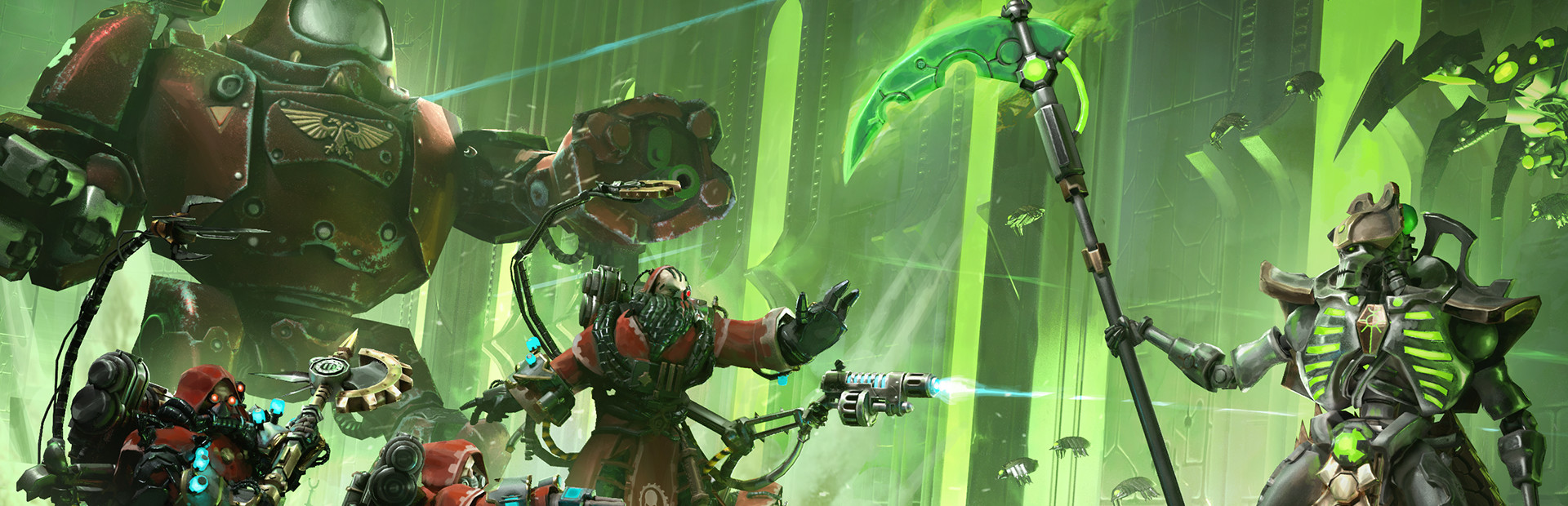
The store page sells a Tech-Priest expedition into a Necron tomb where every room you strip for salvage wakes something worse, and that pitch is honest. The Awakening meter is real, it climbs as you crack doors and drain nodes, and it is the smartest thing Bulwark Studios built into this game. Where the marketing oversells is the word tactics. Coming off XCOM and Gears Tactics I went looking for cover percentages and flanking math, and there is essentially none of that. This is a resource-economy puzzle wearing a tactics skin, and once I stopped resenting that and started treating every map like a build order, it clicked hard. The actual loop works like this. Each mission drops your Tech-Priests onto a tomb map studded with cognition nodes. Cognition is the currency that fires almost every ability you own, from a Secutor's melee chain to an Enginseer's repair burst, and the only way to bank it is to walk people onto those nodes and spend turns doing so. So every turn is a three-way split: push the objective, detour for cognition, or detour for the blackstone and artefacts that fund permanent upgrades. Taking everything is always tempting and always pushes the Awakening track, which wakes more Necrons now and stacks the final assault against you later. Greed is priced openly, on a bar at the top of the screen. Very few strategy games make their risk curve that legible, and none of the good decisions in a mission feel accidental because of it. Progression is where the weekend went. The six disciplines (Dominus, Secutor, Explorator, Enginseer, Lexmechanic, Xenarite) behave less like locked classes and more like trees you mix at will, and augment slots let you bolt arc weapons, phosphor blasters, eradication rays and servo-arms onto whichever body you fancy. My Xenarite and Secutor hybrid finished the campaign deleting Immortals before they could act, which is either a balance failure or the point, depending on your mood. Underneath that sit servitors and Kastelan robots as disposable bodies, plus canticles that buff the whole squad mid-fight. This is also why I keep recommending it to people who say strategy games intimidate them. The tutorial teaches cognition, then Awakening, then augments, in that order, at a pace that respects a newcomer, and no step assumes you can name a Forge World. The 91 percent positive rating across roughly fourteen thousand Steam reviews is not a lore-fan bloc voting loyalty, it is people finding a genuinely readable systems game. What disappoints is repetition and a collapse in difficulty. The tomb tilesets blur together fast, mission objectives recycle harder than the mission-select map admits, and by the back third of a campaign that runs somewhere around twenty hours, a well-fed roster steamrolls encounters that were tense in the opening hours. The Necron AI does not adapt to that. It advances, it reanimates, it rarely surprises you twice. The narrative sections are largely text choices with light consequence rather than branching you can plan around, and the Heretek content bundled into this edition adds enemies and missions without fixing the pacing sag. There is no mod ecosystem to speak of and no post-campaign mode, so replay value lives entirely in trying a different discipline spread on a higher difficulty. Who should buy it: anyone who enjoys optimising a squad more than out-manoeuvring one, anyone curious about 40k who wants a self-contained twenty-hour entry point instead of a 200-hour commitment, and anyone who wants a strategy game that plays cleanly on a controller from the sofa. Who should skip it: players who need reactive AI, deep replayability, or the positional chess of a proper cover shooter. Play it on the harder settings from the start, resist the urge to loot every side room, and it stays sharp far longer than it does otherwise.

Strategy & simulation
Tags
System Requirements
Minimum
Requires a 64-bit processor and operating system OS *: 64-bit Windows 7, 64-bit Windows 8 (8.1) or 64-bit Windows 10 Processor: Intel Core i3 with minimum 3.30 GHz (if the GHz is lower than 3.30 12 GB RAM is…
Recommended
- Processor
- 3GHz Quad Core
- Memory
- 8 GB RAM
- Graphics
- 4GB AMD Radeon R9 380, 4GB NVIDI…
Keep exploring
Community Discussion
Be the first to comment on Warhammer 40,000: Mechanicus - Omnissiah Edition.
Reviews & Ratings
Game Info
- Developer
- Bulwark Studios
- Publisher
- Kasedo Games
- Release Date
- Nov 15, 2018