
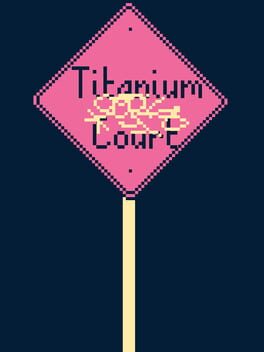
Compare Titanium Court prices across trusted key stores and find the best deal. Developed by AP Thomson. Published by Fellow Traveller. Released on 4/23/2026. Available on PC. Genres: Strategy. Metacritic score: 87/100.

Match-3 as a resource engine, tower defense as the battlefield, roguelike runs holding it all together, and a surrealist narrative that somehow makes it hit harder than the sum of its parts.

I keep a running list of games that genuinely resist categorisation, and Titanium Court just jumped to the top of it. AP Thomson, the solo developer who already won the IGF Seumas McNally Grand Prize for Consume Me, has done it back-to-back, and after spending time with this one it is not hard to understand why. The loop is built from three layers that should have no business working together: a match-3 puzzle phase, a tower defense autobattler, and a roguelike campaign structure woven through with a lo-fi visual novel. The seams between them are nearly invisible. The mechanical flow is cleaner than it first sounds. Each battle opens in High Tide: you swap coloured terrain tiles on a five-colour grid, matching three or more to harvest resources and reshape the board before your moves run out. Every tile you place is also a positional decision for what comes next, because Low Tide follows immediately, and that is when you spend those resources deploying units, casting spells, and constructing structures as enemies advance. The split between setup and execution is not just a genre gimmick. Reading between the lines of what every major outlet has said, the High Tide and Low Tide phases feed each other with real mechanical intent, your match-3 choices creating asymmetric starting conditions that ripple through the combat in ways a flat autobattler never could. Runs consist of seven battles each, closed out by a boss, and the game unlocks new jobs, spells, and units over time rather than handing you persistent stat upgrades. That makes it a purer roguelike than roguelite, which will frustrate players who want incremental power curves but rewards anyone who learns to read board states. For players worried about the difficulty ceiling, the Comfort and Strife systems do real work. Comfort accumulates after each run, and higher Comfort lets you carry advantages into a campaign: bonus starting resources, reduced enemy appearance rates, and similar quality-of-life cushions. Strife runs in the opposite direction, stacking chosen penalties for players who want escalating challenge. Both meters are tied to plot progression, which means difficulty customisation is also story progression, a neat design decision. The adjustable difficulty option in the feature list is not a token accessibility checkbox; it is structurally integrated. Where Titanium Court earns its 87 on Metacritic and its 95 percent positive Steam rating is in the writing. Between runs you return to the court itself for exploration that borrows from point-and-click adventure games and visual novels, and the dialogue is the kind of sharp, absurdist prose that refuses to punch down into lazy randomness. Critics across the board flagged it specifically. The game also carries a meta-narrative layer that gets darker as runs accumulate, eventually turning its themes on the player in ways that would feel cheap if the mechanical foundation was not already solid. The soundtrack, for the record, is deeply strange in a way that suits every beat. The honest caveat is that the match-3 phase is load-bearing. If swapping tiles for resources hits you as tedious rather than strategic, the rest of the design cannot fully compensate, and at least one major outlet made exactly that point. Players who tolerate match-3 as a genre will find a game with genuine strategic depth and one of the sharpest scripts in recent memory. Players who actively dislike it should demo first. The free demo from Steam Next Fest is still on the store page. Diego, Scout Team

Titanium Court

Titanium Court

Apr 23, 2026AP ThomsonFellow Traveller
GamerScout Says

Match-3 as a resource engine, tower defense as the battlefield, roguelike runs holding it all together, and a surrealist narrative that somehow makes it hit harder than the sum of its parts.

PC
Best Price Available
€6.24-50%
at Steam
Lowest tracked: €6.24
Track this price

GamerScout Verdict

Mandatory for fans of deep genre hybrids who can stomach match-3 as a core mechanic, not just a minigame.

Compare Prices(3 stores)

SteamBest price
StandardEurope (EU)Steam KeyKey
€6.24-50%
Priced in EUR by the store
Buy
StandardGlobalSteam KeyKey
€7.34
Priced in EUR by the store
Buy
StandardGlobalSteam KeyKey
€9.88
Priced in EUR by the store
Buy

Every store in this table quotes us in euros, so the EUR figure is the price the seller actually set, not our arithmetic — which is why EUR is also the currency we rank in. We only list an offer here when the store gives us its price in euros, so nothing in this table is a number we invented.

Pick USD, PLN, GBP, CAD or AUD in the header and we convert from EUR at the European Central Bank reference rate — converted amounts are prefixed with ~. Your bank or the store may apply a different rate at checkout. We never hide offers based on where you are: everyone sees this whole table.

We may earn a commission when you buy games through links on this page — at no extra cost to you. It never affects our rankings or verdicts.

Price History

Lowest tracked
€6.244 Sept 2026
Current best
€6.24
Lowest since we started tracking
Official storesKeyshops
€6.05€6.71€7.38€8.0410 Aug17 Aug24 Aug31 Aug7 Sept
Tracking prices since 10 Aug 2026
Create alert

Screenshots & Media

About Titanium Court

I keep a running list of games that genuinely resist categorisation, and Titanium Court just jumped to the top of it. AP Thomson, the solo developer who already won the IGF Seumas McNally Grand Prize for Consume Me, has done it back-to-back, and after spending time with this one it is not hard to understand why. The loop is built from three layers that should have no business working together: a match-3 puzzle phase, a tower defense autobattler, and a roguelike campaign structure woven through with a lo-fi visual novel. The seams between them are nearly invisible. The mechanical flow is cleaner than it first sounds. Each battle opens in High Tide: you swap coloured terrain tiles on a five-colour grid, matching three or more to harvest resources and reshape the board before your moves run out. Every tile you place is also a positional decision for what comes next, because Low Tide follows immediately, and that is when you spend those resources deploying units, casting spells, and constructing structures as enemies advance. The split between setup and execution is not just a genre gimmick. Reading between the lines of what every major outlet has said, the High Tide and Low Tide phases feed each other with real mechanical intent, your match-3 choices creating asymmetric starting conditions that ripple through the combat in ways a flat autobattler never could. Runs consist of seven battles each, closed out by a boss, and the game unlocks new jobs, spells, and units over time rather than handing you persistent stat upgrades. That makes it a purer roguelike than roguelite, which will frustrate players who want incremental power curves but rewards anyone who learns to read board states. For players worried about the difficulty ceiling, the Comfort and Strife systems do real work. Comfort accumulates after each run, and higher Comfort lets you carry advantages into a campaign: bonus starting resources, reduced enemy appearance rates, and similar quality-of-life cushions. Strife runs in the opposite direction, stacking chosen penalties for players who want escalating challenge. Both meters are tied to plot progression, which means difficulty customisation is also story progression, a neat design decision. The adjustable difficulty option in the feature list is not a token accessibility checkbox; it is structurally integrated. Where Titanium Court earns its 87 on Metacritic and its 95 percent positive Steam rating is in the writing. Between runs you return to the court itself for exploration that borrows from point-and-click adventure games and visual novels, and the dialogue is the kind of sharp, absurdist prose that refuses to punch down into lazy randomness. Critics across the board flagged it specifically. The game also carries a meta-narrative layer that gets darker as runs accumulate, eventually turning its themes on the player in ways that would feel cheap if the mechanical foundation was not already solid. The soundtrack, for the record, is deeply strange in a way that suits every beat. The honest caveat is that the match-3 phase is load-bearing. If swapping tiles for resources hits you as tedious rather than strategic, the rest of the design cannot fully compensate, and at least one major outlet made exactly that point. Players who tolerate match-3 as a genre will find a game with genuine strategic depth and one of the sharpest scripts in recent memory. Players who actively dislike it should demo first. The free demo from Steam Next Fest is still on the store page.

Diego
Diego · Scout Team

Strategy & simulation

Tags

steamMatch-3 StrategyTower DefenseRoguelikeVisual Novel ElementsAutobattlerSurrealist NarrativeResource ManagementAdjustable DifficultyIGF Grand Prize Winner

System Requirements

Minimum

Processor
x64 architecture
Memory
2 GB RAM
Graphics
OpenGL or DirectX 9 compatible graphics card.
DirectX
Version 9.0c
Storage
600 MB available space
Sound Card
Any

Keep exploring

Community Discussion

Be the first to comment on Titanium Court.

Reviews & Ratings

Metacritic
87
Steam
95%(1,027)

Game Info

Developer
AP Thomson
Publisher
Fellow Traveller
Release Date
Apr 23, 2026

Features

Single-playerSteam AchievementsFull controller supportSteam Trading CardsCamera ComfortCustom Volume ControlsAdjustable DifficultyKeyboard Only Option+8 more

Price Alert

Get notified when the price drops below your target!

Create Alert
Best price€6.24
See offer

Across the 24,365 games we track, a verified key was cheaper than the official store 90% of the time. See the method and the full numbers in our game price report.

No card? Pay another way

Top up your Steam Wallet or buy crypto with any card — instant delivery, no bank account needed.

More from AP Thomson

Buy smarter: helpful guides

Looking for more? See games like Titanium Court →

Frequently asked questions about Titanium Court

How much does Titanium Court cost?

As of 7 September 2026, the cheapest in-stock offer for Titanium Court is €6.24 at Steam, out of 3 live offers we track across verified key stores. Prices change daily — the table on this page is refreshed continuously.

Where can I buy Titanium Court cheapest?

The lowest in-stock price we track for Titanium Court is €6.24 at Steam (7 September 2026). We compare 3 live offers from verified key stores — the full table with every store and its trust score is on this page.

What platforms is Titanium Court available on?

Titanium Court is available on PC.

When was Titanium Court released?

Titanium Court was released on 23 April 2026.

Who developed Titanium Court?

Titanium Court was developed by AP Thomson and published by Fellow Traveller.

Is Titanium Court worth buying?

Titanium Court holds a Metacritic score of 87/100, making it one of the standout Strategy titles. See the full reviews, ratings and how-long-to-beat times on this page to decide.