
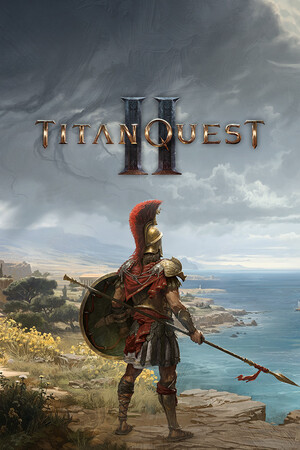
Titan Quest II
Diablo's loot treadmill with a stamina bar bolted on: sharp, deliberate combat and genuinely flexible dual-mastery builds, hobbled by a campaign that stops mid-myth.
GamerScout Verdict
Best for ARPG players who want dodge timing and build tinkering over loot spam, and who can accept a story that stops early.
Compare Prices(2 stores)
Every store in this table quotes us in euros, so the EUR figure is the price the seller actually set, not our arithmetic — which is why EUR is also the currency we rank in. We only list an offer here when the store gives us its price in euros, so nothing in this table is a number we invented.
Pick USD, PLN, GBP, CAD or AUD in the header and we convert from EUR at the European Central Bank reference rate — converted amounts are prefixed with ~. Your bank or the store may apply a different rate at checkout. We never hide offers based on where you are: everyone sees this whole table.
We may earn a commission when you buy games through links on this page — at no extra cost to you. It never affects our rankings or verdicts.
Screenshots & Media
About Titan Quest II
Diablo IV trained me to hold left click until the screen empties, and Titan Quest II unlearned that reflex in about an hour. The culprit is a stamina bar tied to your dodge roll, which turns every mob pack into a small negotiation instead of a blur. Grimlore Games has built an isometric ARPG on the Greek myth bones of the original and then bolted on a defensive layer the genre usually leaves to Souls-likes. Enemies wind up, telegraph, and commit. You read the tell, you roll, you punish, and if you spend your stamina badly you get flattened by something with a goat's legs and a grudge. It is slower than the click-till-they-drop competition, and after the first few hours I stopped wanting it to be faster. The build system is why I kept going long after the story lost me. You pick two masteries and the overlap between them becomes your class, the same dual-spec idea the series always ran on, but the trees here are far more willing to let you specialize into one strange mechanic and see whether it survives contact with a boss. Better still, respeccing is cheap and painless, so testing a hunch does not cost you an evening of grinding. That matters more than it sounds. In most ARPGs I commit to a build by hour ten and then defend that decision out of pure stubbornness. Here I rebuilt three times, and each version actually played differently rather than just producing a different color of damage number. Loot supports the experimenting with affix rolls that occasionally rewrite what a skill does rather than nudging a percentage, and pulling one of those out of a chest at hour forty is a genuinely good feeling. Where it disappoints is the part I care about most. The writing is competent tour-guide work: you move through myth-adjacent regions, meet figures you recognize, and get a serviceable framing about titans and the mortals caught underneath them. It is pleasant. It is not trying to be Disco Elysium and it is nowhere near BG3 on consequence, which is fine, but I would settle for a story that finishes its own sentence. The campaign stops before the mythology does, and you can feel precisely where the content ran out rather than where the arc resolved. Your choices are tactical, not narrative, so if you came for branching outcomes and companions who remember what you said three zones ago, recalibrate now. There is a world here worth being curious about, and the game keeps declining to be curious with you. Padding is the other gripe. Certain stretches ask you to clear the same shape of camp three times to open a gate, and I could feel the XP curve doing the asking rather than the level design. It is not egregious by genre standards, but it is noticeable exactly because the combat rewards attention, and attention is the first thing repetition kills. Drop-in online co-op takes some of that edge off. With one other person the stamina management becomes a duet, where one of you eats the boss's telegraphed swing and the other cleans up behind it, and the drop-in structure means nobody has to schedule an evening. Controller support is real support rather than a remapped menu afterthought, and Steam Cloud means the build you were fiddling with at lunch is the build waiting for you at night. So who is this for? If you loved the original and wanted someone to modernize it without converting it into a live-service chore, this is that game, and the moment-to-moment fighting is the most interesting thing to happen to isometric action RPGs in a good while. If you want an ARPG where reading an animation matters more than your gear score, also yes. If you want a finished story with a payoff, hold off, because no amount of build variety papers over an ending nobody has written yet. I will be back for the rest of the myth, ideally with a spear build that should not work.

RPGs
Tags
System Requirements
Minimum
- OS
- Windows 10 64bit / Windows 11 64bit
- Processor
- Intel Core i5-8600K / AMD Ryzen 5 2600X
- Memory
- 16 GB RAM
- Graphics
- 8 GB VRAM, AMD RX 6700 XT or NVIDIA Ge…
Recommended
- OS
- Windows 10 64bit / Windows 11 64bit
- Processor
- Intel Core i5-12400 / Ryzen 5 5600X
- Memory
- 32 GB RAM
- Graphics
- 12 GB VRAM, Nvidia GeForce RTX 3070 Ti…
Keep exploring
Community Discussion
Be the first to comment on Titan Quest II.
Reviews & Ratings
Game Info
- Developer
- Grimlore Games
- Publisher
- THQ Nordic
- Release Date
- Aug 1, 2025
