
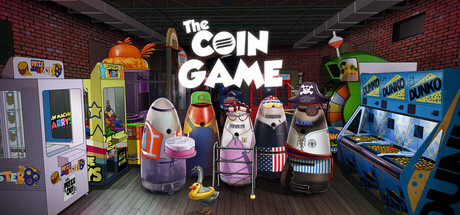
The Coin Game
Seven years in Early Access, one developer, 50+ physics-simulated arcade machines, and a survival loop that will either hook you or lose you in the first hour. Know which type you are before inserting coins.
GamerScout Verdict
Best for arcade nostalgia fans willing to overlook janky UI and sparse tutorials in exchange for genuinely satisfying physics-based machine play.
Compare Prices(3 stores)
Every store in this table quotes us in euros, so the EUR figure is the price the seller actually set, not our arithmetic — which is why EUR is also the currency we rank in. We only list an offer here when the store gives us its price in euros, so nothing in this table is a number we invented.
Pick USD, PLN, GBP, CAD or AUD in the header and we convert from EUR at the European Central Bank reference rate — converted amounts are prefixed with ~. Your bank or the store may apply a different rate at checkout. We never hide offers based on where you are: everyone sees this whole table.
We may earn a commission when you buy games through links on this page — at no extra cost to you. It never affects our rankings or verdicts.
Price History
Screenshots & Media
About The Coin Game
My instinct when a game spends seven years in Early Access is to assume the developer kept hiding behind "in development" to dodge accountability. The Coin Game is the exception that proves the rule. Solo developer devotid has built something genuinely hard to categorize: an open-world life sim wrapped around physics-faithful arcade machine replicas, set on a robot-populated island called Islandville that has no right to feel as alive as it does. The scope here is, to put it charitably, unhinged for a one-person project. The structural backbone is three modes, and understanding them upfront saves a lot of frustration. Quick Play drops any of the 50-plus machines into a blank void for immediate fiddling, useful for learning the physics of a claw machine or coin pusher before you have money on the line. Birthday Mode hands you unlimited cash courtesy of the fictional Uncle Phil, unlocks the full map, and lets you tour Larry's Arcade, UFO Arcade, One-Eyed Billy's, the Islandtime Amusements Carnival, an 18-hole mini-golf course, laser tag, and indoor go-kart racing without consequence. Spend time here first. It is not a cheat mode; it is the game's actual tutorial by another name, and the machines themselves are the real draw. Claw machines, coin pushers, skeeball, Big Bass wheels, ball droppers, and basketball shooters all behave with a fidelity to real-world physics that is the clearest labor of love in the entire project. That authenticity is what keeps a long-time community coming back and explains why the all-time Steam review score sits firmly in Very Positive territory despite a more turbulent post-1.0 reception. Survival Mode is where the game's ambitions and its limitations collide in spectacular fashion. You wake up in your home on Islandville, manage hunger, smartwatch battery, and a curfew enforced by your off-screen mother, then grind odd jobs including lawn mowing, babysitting, and newspaper delivery to fund your arcade habit. The pawn shop loop, playing games for tickets, cashing tickets for prizes, selling prizes at Barry's Pawn Shop for coin, then reinvesting into more machines, is genuinely satisfying when it clicks. The day-and-night cycle and survival meters are not particularly punishing, which keeps the mode accessible rather than brutal. The problem is that the jobs themselves fight the physics engine. Newspaper delivery in particular has been singled out by most reviewers as the game's lowest point: stuffing papers into mailboxes through a convoluted smartwatch-inventory sequence feels less like gameplay and more like a physics engine stress test nobody asked for. The tutorial gestures at what jobs exist without meaningfully explaining how any of them work, which will frustrate new players who did not spend time in Birthday Mode first. Presentation is the other honest warning to issue. Visually, the game spans a wide range, from arcade machines that look genuinely polished up close to outdoor environments that recall early PlayStation 2 geometry. The UI is functional at best and actively unpleasant to navigate at worst. Bugs including stuttering, collision oddities, and occasional lock-ups have shown up across platforms, though PC players report a more stable experience than consoles. None of this is disqualifying if you approach the game for what it actually is: an affectionate, slightly chaotic tribute to 1990s arcade culture built by one person over six years, with a dedicated community and global leaderboards that give the coin pusher and ticket grind genuine competitive teeth. If your benchmark is Arcade Paradise, note that the comparison is fair in spirit but misleading in practice. Arcade Paradise is a tightly curated experience; The Coin Game is looser, stranger, and more willing to let you fall flat on your face. The recommendation is conditional but sincere. Start with Birthday Mode, learn the machines, find the two or three that produce the best ticket-to-pawn value, then graduate to Survival Mode with that knowledge in your back pocket. Players who treat the jank as texture rather than a defect will find a surprisingly deep loop here. Players who need polished onboarding and consistent controls will bounce off it hard within the first hour.

Strategy & simulation
Tags
System Requirements
Minimum
- OS
- Windows 11
- Memory
- 8 GB RAM
- DirectX
- Version 11
- Storage
- 8 GB available space
- Graphics
- NVIDIA GeForce GT 1030 or Equivalent
- Processor
- Intel Core i7-8700K or Equivalent
Recommended
- OS
- Windows 11
- Memory
- 16 GB RAM
- DirectX
- Version 11
- Storage
- 16 GB available space
- Graphics
- NVIDIA GeForce GTX 1050 Ti or Equivalent
- Processor
- Intel Core i5-11600K or Equivalent
Keep exploring
Community Discussion
Be the first to comment on The Coin Game.
Reviews & Ratings
No ratings available
Game Info
- Developer
- devotid
- Publisher
- Kwalee
- Release Date
- Mar 19, 2026