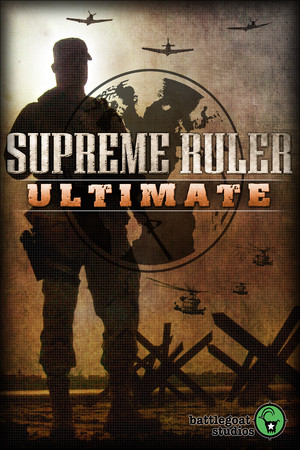
Supreme Ruler Ultimate
A 1936-to-near-future wargame sandbox that will bankrupt you on oil contracts before any army crosses your border. Ugly, enormous, and more forgiving than it looks.
GamerScout Verdict
Best for sim players who want an economy that can beat them without a shot fired, and who forgive an ugly UI.
Compare Prices(3 stores)
Every store in this table quotes us in euros, so the EUR figure is the price the seller actually set, not our arithmetic — which is why EUR is also the currency we rank in. We only list an offer here when the store gives us its price in euros, so nothing in this table is a number we invented.
Pick USD, PLN, GBP, CAD or AUD in the header and we convert from EUR at the European Central Bank reference rate — converted amounts are prefixed with ~. Your bank or the store may apply a different rate at checkout. We never hide offers based on where you are: everyone sees this whole table.
We may earn a commission when you buy games through links on this page — at no extra cost to you. It never affects our rankings or verdicts.
Price History
Screenshots & Media
About Supreme Ruler Ultimate
Four hours into a 1949 start, my armored divisions were sitting on a border with full ammunition racks and no fuel, because I had locked in oil imports on terms that looked sensible in peacetime and looked like a noose the moment the world market moved. Nobody had declared war on me. I had beaten myself with a purchasing decision made three in-game months earlier, and that is the most honest introduction to this thing I can give you. BattleGoat's 2014 package folds their earlier eras into one sandbox that runs from 1936 through the Cold War and out past the present day into speculative near-future starts. You can pick effectively any nation on the map, from the obvious great powers down to countries whose entire military is a coast guard and an optimistic budget line, then run it in real time with pause while juggling a research tree, unit production queues, resource contracts, loans, domestic approval, and a diplomacy layer that lets you build a bloc or get quietly strangled by someone else's. Combat plays out on a hex map where supply is not decoration. Units burn fuel and ammunition, forward stacks starve when the logistics chain snaps, and an offensive that outruns its own supply lines will dissolve without the enemy having to be clever about it. Now the part I will argue against the game's own reputation. It presents like a 200-hour commitment for people with wall charts, and the scale genuinely is enormous, but the on-ramp is gentler than the screenshots suggest, because you can hand entire departments to the AI and take them back one at a time. Delegate defense, finance, domestic policy and research on day one, pick a mid-sized country with a functioning economy and no immediate neighbors who hate it, and start in a Cold War scenario rather than a 1936 world start. Then watch what your ministers actually do with your money for a couple of in-game years. That is the tutorial the game does not really give you: reverse-engineering the AI's decisions, then pulling one portfolio back into your own hands per playthrough until you are running the whole cabinet yourself. Approached that way it is a much better beginner grand strategy game than its interface implies, because failure is slow and legible. You can usually see the debt spiral or the resource shortfall coming twenty in-game months out if you read the right screen. The problems are real and they are mostly presentational. The UI is dense, dated and unlovely, with information buried in tabs that never quite learned modern conventions, and the tutorial is thin enough that most of the community learns from other players instead. The AI is a competent economic manager and a mediocre general. It will build a sensible force and then feed it into your prepared positions in ways a human never would, so the late game against a collapsing opponent turns into cleanup work rather than a contest. Micromanagement scales badly too: by the time you have hundreds of units in the field, moving them is a chore no amount of theatre commands fully solves, and world-spanning wars can drag the simulation clock down. Multiplayer is supported, including online PvP, but a real-time session at this scope asks a lot of scheduling from everyone at the table. The Workshop support and included level editor take some of that sting out, since the scenario-building side is where a chunk of the long tail lives. So who is this for. If you want tight systems, readable feedback loops and a designer's hand guiding you toward interesting decisions, look elsewhere, because this is a sprawling simulation that will happily let you make boring choices for six straight hours. If you want a map that spans most of the twentieth century and beyond, an economy that can defeat you on its own merits, and enough sandbox freedom to run Argentina as an industrial superpower or fight a proxy war you invented yourself, the depth here holds up better than the 77 percent review score suggests. The people knocking it are usually reacting to the presentation. The people who stayed are the ones who found the spreadsheet underneath and liked what it was doing.

Strategy & simulation
Tags
System Requirements
Minimum
- Processor
- Intel Pentium IV or better
- Memory
- 1 GB RAM
- Graphics
- ATI/Nvidia/Intel DirectX 9 Compatible
- DirectX
- Version 9.0c
- Storage
- 2 GB available space
- Sound Card
- Direct X Compatibl…
Recommended
- Processor
- Intel/AMD Dual or Quad Core
- Memory
- 2 GB RAM
- Graphics
- ATI/Nvidia/Intel DirectX 9 Compatible
- DirectX
- Version 9.0c
- Storage
- 8 GB available space Soun…
Keep exploring
Community Discussion
Be the first to comment on Supreme Ruler Ultimate.
Reviews & Ratings
Game Info
- Developer
- BattleGoat Studios
- Publisher
- BattleGoat Studios
- Release Date
- Oct 17, 2014