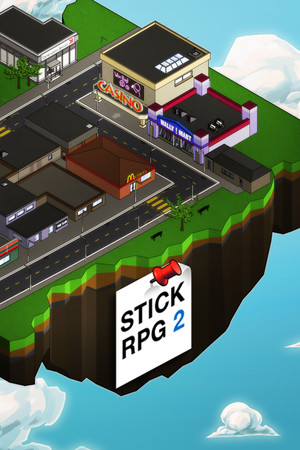
Compare Stick RPG 2: Director's Cut prices across trusted key stores and find the best deal. Developed by XGen Studios. Published by XGen Studios. Released on 6/16/2014. Available on PC. Genres: RPG.

A stat-stacking life sim wearing a stick-figure joke as a disguise: an opaque, unfriendly first hour, then 20-plus hours of compounding builds and split endings.

The first hour here is a wall of unlabeled systems, and I want to be upfront that I nearly quit during it. You wake up as a stick figure in a flat 2D city with no idea how you got there, a clock ticking away in the corner, a few stat bars you do not yet understand, and roughly forty doors you can walk into with no reason to pick any of them. Nobody explains that sleeping burns hours, that hunger quietly eats into your performance, or that the only job you qualify for on day one pays about enough for a sandwich. It reads as aimless busywork. Push to the point where your first real paycheck lands and the shape of the thing snaps into focus: this is a game about compounding, and the opening hour is deliberately the worst version of your character's life. Structurally it is a sandbox life sim in RPG clothing. Strength, Intelligence and Charm gate almost everything, and every activity in the city is really a conversion rate between your time and one of those three numbers. The gym trades hours for muscle, university lectures trade tuition and hours for brains, and Charm comes mostly from what you wear, what you drive and a handful of choices you will not be proud of. Those stats unlock the job ladder, which funds the parts of the game that actually feel good: buying property, playing the stock market, gambling at the casino when you get impatient with honest work. There is combat, though calling it a system is generous. You punch stick figures, they fall over, you take their money and their stuff. Quest content is scattered across the map rather than spoon-fed through a journal, and I liked that more than I expected to. You find things by knocking on doors and getting turned away until your numbers are high enough, so the whole city functions as a locked-stat checklist that gives the mid-game genuine momentum. The writing is joke-first: gags about dead-end jobs, petty crime, and the general indignity of being two-dimensional. Do not come looking for character arcs or dialogue worth re-reading, because there are none. Come for the several distinct endings, which really do depend on how you built your stick figure and where you spent your days. That is the one place where the choices carry weight, and the game is smart enough to make you commit long before you know what you are committing to. What drags is exactly what you would guess. A game with a clock is a game with repetition, and grinding toward the next stat threshold means sitting through the same shift or the same lecture dozens of times while the game does nothing to make the fortieth pass feel different from the fourth. A chunk of the errands are padding in the most literal sense: fetch this, deliver that, wait for tomorrow. The Director's Cut expands on the browser original and files down some rough corners, but it cannot disguise that the core loop was built for a Flash game people played in a school computer lab. The art is crude on purpose, there is no voice acting, and the interface quietly assumes you are keeping notes on paper. Nothing here respects your time the way a modern RPG would. So who is this actually for? Players who get a real kick out of watching a number climb and planning three in-game days ahead. If the calendar management in something like Persona appeals to you minus all the social depth, or if you spent your teens optimizing a text-based business sim, there are twenty to thirty solid hours waiting. If you want a build system with tactical depth past hour ten, or writing that pays off on a second run, look elsewhere entirely. I would still nudge a lapsed Flash-era player toward it, with the honest warning that the first hour is the price of admission and it is not a cheap one. Once the money starts working for you instead of against you, the grind stops feeling like a chore and starts feeling like a plan. Monika, Scout Team

Stick RPG 2: Director's Cut

Stick RPG 2: Director's Cut

Jun 16, 2014XGen Studios
GamerScout Says

A stat-stacking life sim wearing a stick-figure joke as a disguise: an opaque, unfriendly first hour, then 20-plus hours of compounding builds and split endings.

PC
Best Price Available
€14.97-25%
at Fanatical
Lowest tracked: €14.97
Track this price

GamerScout Verdict

Best for min-maxers who love watching numbers snowball. Skip it if you need real writing or hate grinding for stat gains.

Compare Prices(3 stores)

FanaticalBest price
StandardGlobalSteam KeyKey
€14.97-25%
Priced in EUR by the store
Buy
StandardGlobalSteam KeyKey
€16.39
Priced in EUR by the store
Buy
StandardEurope (EU)Steam KeyKey
€19.50
Priced in EUR by the store
Buy

Every store in this table quotes us in euros, so the EUR figure is the price the seller actually set, not our arithmetic — which is why EUR is also the currency we rank in. We only list an offer here when the store gives us its price in euros, so nothing in this table is a number we invented.

Pick USD, PLN, GBP, CAD or AUD in the header and we convert from EUR at the European Central Bank reference rate — converted amounts are prefixed with ~. Your bank or the store may apply a different rate at checkout. We never hide offers based on where you are: everyone sees this whole table.

We may earn a commission when you buy games through links on this page — at no extra cost to you. It never affects our rankings or verdicts.

Price History

Lowest tracked
€14.973 Sept 2026
Current best
€14.97
Lowest since we started tracking
Official stores
€13.77€14.57€15.37€16.173 Sept4 Sept5 Sept6 Sept7 Sept
Tracking prices since 3 Sept 2026
Create alert

Screenshots & Media

About Stick RPG 2: Director's Cut

The first hour here is a wall of unlabeled systems, and I want to be upfront that I nearly quit during it. You wake up as a stick figure in a flat 2D city with no idea how you got there, a clock ticking away in the corner, a few stat bars you do not yet understand, and roughly forty doors you can walk into with no reason to pick any of them. Nobody explains that sleeping burns hours, that hunger quietly eats into your performance, or that the only job you qualify for on day one pays about enough for a sandwich. It reads as aimless busywork. Push to the point where your first real paycheck lands and the shape of the thing snaps into focus: this is a game about compounding, and the opening hour is deliberately the worst version of your character's life. Structurally it is a sandbox life sim in RPG clothing. Strength, Intelligence and Charm gate almost everything, and every activity in the city is really a conversion rate between your time and one of those three numbers. The gym trades hours for muscle, university lectures trade tuition and hours for brains, and Charm comes mostly from what you wear, what you drive and a handful of choices you will not be proud of. Those stats unlock the job ladder, which funds the parts of the game that actually feel good: buying property, playing the stock market, gambling at the casino when you get impatient with honest work. There is combat, though calling it a system is generous. You punch stick figures, they fall over, you take their money and their stuff. Quest content is scattered across the map rather than spoon-fed through a journal, and I liked that more than I expected to. You find things by knocking on doors and getting turned away until your numbers are high enough, so the whole city functions as a locked-stat checklist that gives the mid-game genuine momentum. The writing is joke-first: gags about dead-end jobs, petty crime, and the general indignity of being two-dimensional. Do not come looking for character arcs or dialogue worth re-reading, because there are none. Come for the several distinct endings, which really do depend on how you built your stick figure and where you spent your days. That is the one place where the choices carry weight, and the game is smart enough to make you commit long before you know what you are committing to. What drags is exactly what you would guess. A game with a clock is a game with repetition, and grinding toward the next stat threshold means sitting through the same shift or the same lecture dozens of times while the game does nothing to make the fortieth pass feel different from the fourth. A chunk of the errands are padding in the most literal sense: fetch this, deliver that, wait for tomorrow. The Director's Cut expands on the browser original and files down some rough corners, but it cannot disguise that the core loop was built for a Flash game people played in a school computer lab. The art is crude on purpose, there is no voice acting, and the interface quietly assumes you are keeping notes on paper. Nothing here respects your time the way a modern RPG would. So who is this actually for? Players who get a real kick out of watching a number climb and planning three in-game days ahead. If the calendar management in something like Persona appeals to you minus all the social depth, or if you spent your teens optimizing a text-based business sim, there are twenty to thirty solid hours waiting. If you want a build system with tactical depth past hour ten, or writing that pays off on a second run, look elsewhere entirely. I would still nudge a lapsed Flash-era player toward it, with the honest warning that the first hour is the price of admission and it is not a cheap one. Once the money starts working for you instead of against you, the grind stops feeling like a chore and starts feeling like a plan.

Monika
Monika · Scout Team

RPGs

Tags

auto-admittedLife SimStat Min-MaxingMultiple EndingsSandbox CityTime ManagementEconomy ManagementStick Figure ArtFlash Game RootsDark Humor

System Requirements

Minimum

Processor
Pentium M 1.6 Ghz or better
Memory
1 GB RAM
Graphics
Any
Storage
100 MB available space
Sound Card
Any

Keep exploring

Community Discussion

Be the first to comment on Stick RPG 2: Director's Cut.

Reviews & Ratings

Steam
85%(1,130)

Game Info

Developer
XGen Studios
Publisher
XGen Studios
Release Date
Jun 16, 2014

Features

Single-playerFamily Sharing

Price Alert

Get notified when the price drops below your target!

Create Alert
Best price€14.97
See offer

Across the 24,365 games we track, a verified key was cheaper than the official store 90% of the time. See the method and the full numbers in our game price report.

No card? Pay another way

Top up your Steam Wallet or buy crypto with any card — instant delivery, no bank account needed.

More from XGen Studios

Buy smarter: helpful guides

Looking for more? See games like Stick RPG 2: Director's Cut →

Frequently asked questions about Stick RPG 2: Director's Cut

How much does Stick RPG 2: Director's Cut cost?

As of 7 September 2026, the cheapest in-stock offer for Stick RPG 2: Director's Cut is €14.97 at Fanatical, out of 3 live offers we track across verified key stores. Prices change daily — the table on this page is refreshed continuously.

Where can I buy Stick RPG 2: Director's Cut cheapest?

The lowest in-stock price we track for Stick RPG 2: Director's Cut is €14.97 at Fanatical (7 September 2026). We compare 3 live offers from verified key stores — the full table with every store and its trust score is on this page.

What platforms is Stick RPG 2: Director's Cut available on?

Stick RPG 2: Director's Cut is available on PC.

When was Stick RPG 2: Director's Cut released?

Stick RPG 2: Director's Cut was released on 16 June 2014.

Who developed Stick RPG 2: Director's Cut?

Stick RPG 2: Director's Cut was developed by XGen Studios.