
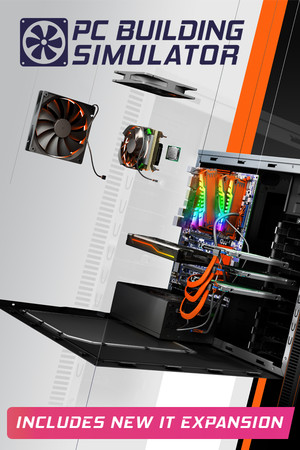
PC Building Simulator - AORUS Workshop
Best treated as a hardware compatibility puzzle with a repair shop bolted on. Superb at teaching real parts, out of ideas once money stops being a constraint.
GamerScout Verdict
Buy it to learn real PC hardware and spec builds risk-free, not for a business career that runs out of decisions by hour 25.
Compare Prices(3 stores)
Every store in this table quotes us in euros, so the EUR figure is the price the seller actually set, not our arithmetic — which is why EUR is also the currency we rank in. We only list an offer here when the store gives us its price in euros, so nothing in this table is a number we invented.
Pick USD, PLN, GBP, CAD or AUD in the header and we convert from EUR at the European Central Bank reference rate — converted amounts are prefixed with ~. Your bank or the store may apply a different rate at checkout. We never hide offers based on where you are: everyone sees this whole table.
We may earn a commission when you buy games through links on this page — at no extra cost to you. It never affects our rankings or verdicts.
Screenshots & Media
About PC Building Simulator - AORUS Workshop
The store page sells you a repair shop career: contracts, a bank balance, a business to grow. Sim players like me should adjust that framing before the first invoice, because the business layer is scaffolding. The actual game underneath is a diagnostics puzzle, and it is a genuinely good one. A customer emails a vague complaint, you open the case, and you work backwards from symptoms to a fault: a dead PSU, a stick of RAM in the wrong channel, thermal paste that has turned to chalk, a GPU that was never going to fit that chassis. Every part is a licensed real component with real specs, so the puzzle is constrained by the same rules you would hit at an actual workbench. That constraint is the whole appeal, and it holds up. The loop rewards build-order thinking more than people expect. Cheapest completion is rarely the correct answer once turnaround time and repeat customers enter the maths, and the interesting decisions sit in the middle band: which upgrade path to quote, whether to source a part now or hold, when a job stops being clean-and-reseat and becomes replace-and-mark-up. Overclocking and benchmark chasing add a numbers layer with honest feedback. Push the clocks, watch the temperatures climb, run the benchmark, see the score move, back off when stability dies. Free build mode strips the economy out entirely and hands you the full parts catalogue, and a surprising number of players end up living there, spec'ing out a rig they are seriously considering buying in real life. If you have never opened a PC case, this is the most forgiving on-ramp I have found anywhere in the sim genre, and I want to spend a moment defending that. The tutorial respects newcomers, which is rarer than it should be: it explains why a CPU has an orientation arrow rather than just telling you where to click. Progression is deliberately low stress. No failure state wipes a run, no timer breathes down your neck, no rival undercuts your quotes. That makes it an odd sim, because pressure is normally the engine, but it also makes it a legitimately useful teaching tool. I have watched people go from asking what a chipset is to confidently reading a motherboard spec sheet in roughly ten hours. Steam Workshop support extends the shelf life well past the campaign, with community cases, part packs and wallpapers keeping it in rotation years after its January 2019 release. The disappointment lands exactly where you would predict: the late game. Once your bank balance stops mattering, and it will, usually around the point you can buy top-tier parts without checking the number, the economy has nothing left to say. Contracts start repeating. The pool of diagnostic scenarios is finite, and eventually you identify the fault from the email subject line before the case is even open. There is no AI to outplay, no market to read, no supply shock to absorb. A grand strategy game at hour 40 is compounding forty hours of your earlier decisions; this one is running the same twenty-minute service ticket with different sticker prices attached. It is single-player only, so there is no shared workshop to keep things social either. One more honest caveat: the catalogue is frozen at whatever the licensing deals covered, so treat it as a period snapshot of hardware rather than a live buying reference. Read it as a 20 to 30 hour game with an unlimited sandbox attached and it becomes very easy to recommend. The overwhelmingly positive standing across more than fifty thousand Steam reviews is not an accident, because it delivers precisely what it describes for the length of time that actually matters. Just do not expect management depth the store page hints at, and do not plan a 200-hour career here. Build ten machines properly, learn the compatibility rules until they are automatic, then move into free build mode and stay there. That is the version of this game worth your evenings.

Strategy & simulation
Tags
System Requirements
Minimum
- Processor
- Intel Core i5-2500K or AMD Athlon X4 740 (or equivalent)
- Memory
- 4 GB RAM
- Graphics
- GeForce GTX 660 (2048 MB) or Radeon R9 285 (2048 MB) - Integrated GPUs may work but ar…
Keep exploring
Community Discussion
Be the first to comment on PC Building Simulator - AORUS Workshop.
Reviews & Ratings
Game Info
- Developer
- Claudiu Kiss, The Irregular Corporation
- Publisher
- The Irregular Corporation
- Release Date
- Jan 29, 2019
