
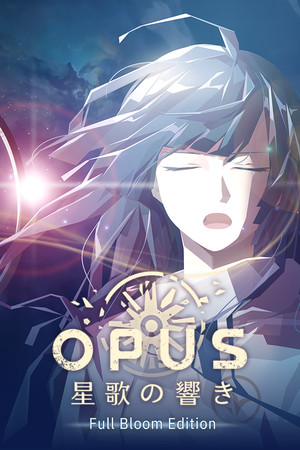
OPUS: Echo of Starsong Full Bloom Edition
A space romance that makes you earn its ending: slow-burning, hand-drawn, mechanically thin, and worth every hour if you let the quiet parts breathe.
GamerScout Verdict
Best for players who want a sci-fi romance to sit inside, not a space sim to master.
Compare Prices(2 stores)
Every store in this table quotes us in euros, so the EUR figure is the price the seller actually set, not our arithmetic — which is why EUR is also the currency we rank in. We only list an offer here when the store gives us its price in euros, so nothing in this table is a number we invented.
Pick USD, PLN, GBP, CAD or AUD in the header and we convert from EUR at the European Central Bank reference rate — converted amounts are prefixed with ~. Your bank or the store may apply a different rate at checkout. We never hide offers based on where you are: everyone sees this whole table.
We may earn a commission when you buy games through links on this page — at no extra cost to you. It never affects our rankings or verdicts.
Price History
Screenshots & Media
About OPUS: Echo of Starsong Full Bloom Edition
Everyone hands newcomers To the Moon when they want a story game that leaves a bruise, and I understand the reflex, but OPUS: Echo of Starsong asks for something back that To the Moon never demands. It puts you in a cockpit, gives you a star map, and makes you decide when to stop looking. SIGONO built this as a visual novel at its core, and Full Bloom is the version to play, but calling it a visual novel undersells how much empty space sits between the story beats on purpose. That empty space is the whole trick. Click through it impatiently and the ending will not land. Sit inside it and it absolutely will. You play Jun, a boy with no standing in a scarred asteroid belt, traveling with Eda, a Lumen singer who can hear the song a hidden asteroid gives off. That premise doubles as the core loop. You listen for a resonance, triangulate it against your map, burn fuel getting there, then pick your way through the interior on foot. The inputs are simple: steer, scan, mine what you need to keep flying, work through a light spatial puzzle, talk. Nobody is going to call this a deep systems game. What it does have is a belt written like an actual place, with salvage clans, war leftovers, and an entire economy built on people who can hear things nobody else can. What works is craft, and craft carries this thing a very long way. The art direction moves between painterly story panels and small sprite-scale exploration without either half feeling like filler, and the score does the thing I keep begging indie composers to do: it knows when to shut up. Long stretches are engine hum and radio static, so when a vocal line finally arrives it feels like something cracking open. Full Bloom adds voice work, and the performances land the quiet lines better than the loud ones, which is exactly the right priority for a story pitched at this register. The writing also resists melodrama for far longer than you expect, which is why the last stretch hits as hard as it does. Full controller support and Remote Play on phone or tablet mean you can take it to a couch, which is honestly how I would recommend playing it. What does not work is anything you would call a system if you squinted. The asteroid exploration is thin, and by the back half you are repeating a search pattern you understood hours earlier. Navigating between sites involves more backtracking than the pacing can absorb, and with no meaningful fail state, the fuel and mining economy reads as ritual rather than tension. The opening couple of hours are slow in a way that visibly costs this game players, and I will defend that slowness because the payoff genuinely justifies it, but I am not going to pretend the ramp is elegant. It is also strictly linear with a single path through, so if replay value for you means branching choices, there is nothing waiting here. A 96 percent Steam score across nine thousand reviews tells you the people who stayed were rewarded. It does not tell you how many bounced in chapter two. Play this if you want a sci-fi romance that treats grief as a structure instead of a plot twist, if you like how much silence SIGONO is willing to hold, and if a game that stops exactly when it should sounds like a feature rather than a shortfall. Skip it if you need mechanics that keep growing, or if the phrase slow burn already makes you tired. Everyone else: dim the lights, put on headphones, and give it the evening it is asking for. Very few small studios trust their audience this much, and fewer still deserve to.

Indie & narrative
Tags
System Requirements
Minimum
- OS
- Windows 10
- Processor
- Intel Core i5-2300 | AMD FX-4350
- Memory
- 4 GB RAM
- Graphics
- Nvidia GeForce GTX 570, 1 GB | AMD Radeon HD 7850, 2 GB
- DirectX
- Version 11
- Storage
- 4 GB available space Sound Card…
Recommended
- OS
- Windows 10
- Processor
- intel i7-7700 / AMD Ryzen 5 3500
- Memory
- 8 GB RAM
- Graphics
- AMD Radeon RX 560 4GB / Nvidia GTX 950 2GB
- DirectX
- Version 11
- Storage
- 4 GB available space
- Sound Card
- 100% Dire…
Keep exploring
Community Discussion
Be the first to comment on OPUS: Echo of Starsong Full Bloom Edition.
Reviews & Ratings
Game Info
- Developer
- SIGONO INC.
- Publisher
- SIGONO INC.
- Release Date
- Aug 31, 2021