
Compare Necrophosis prices across trusted key stores and find the best deal. Developed by Dragonis Ares, Adonis Brosteanu. Published by Dragonis Games. Released on 4/25/2025. Available on PC. Genres: Action, Adventure, Indie.

Painted rot, cathedral silence, and no explanations offered. Bring headphones and patience, and ignore the Action tag sitting in its genre list.

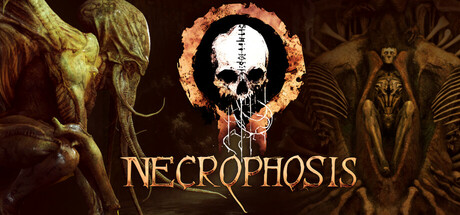
The store page sets a precise expectation: dread that builds instead of pouncing, decay rendered like oil paint, and no tidy resolution waiting at the end. Two of those three land almost exactly as promised, and the third is less a warning than the entire design principle. Where the listing misleads a little is the word Action sitting in the genre field. Nothing here plays like an action game. What you actually get is a slow walk through architecture that was never meant to hold a human body, and a sound design that keeps insisting you are not alone in it. Set that expectation correctly and the rest opens up. Mechanically it is lean, and lean on purpose. You move in first person, you look, and you occasionally solve something small: a mechanism to turn, a sequence to read in the right order, an object that belongs in a socket two rooms back. The light puzzle solving is exactly that, light. It exists to slow your hands down so your eyes can catch up with the room, not to test your logic. Progression is spatial rather than systemic. No skill trees, no inventory management, no numbers climbing in the corner of the screen. Controller support is full and genuinely comfortable for this kind of drifting pace, Steam Cloud saves are in, and the achievements give completionists a reason to sweep the edges of each area. Single-player only, which is the right call. Nothing about this atmosphere would survive a second voice in the room. The art is the reason to show up, and I do not offer that as a consolation prize. It sits in the same visual lineage as Beksinski's paintings: bone-colored cathedral interiors, masonry that looks grown rather than built, corridors of ash and rust where the horizon dissolves into haze. What impresses me is the consistency. A two-person team could easily have front-loaded one showpiece hall and coasted, and instead almost every space earns its own composition, framed like the developers knew exactly where you would be standing when you walked in. Scale is the other trick. Doorways sized for something that is not you, ceilings that vanish upward, stairs that continue past the point where a real building would stop. It makes you feel small without a line of dialogue saying so. The sound work matches. Low drones you feel more than hear, distant wet mechanical noises with no visible source, long stretches of near-silence that make your own footsteps feel intrusive. Play it with headphones in a dark room or do not bother. Half the horror is spatial audio convincing you something shifted behind a pillar you already checked. The disappointments are real and worth naming. Slow-burn pacing has a failure mode, and this hits it in the middle stretch, where the visual language starts repeating itself and the awe curve flattens before the last act pulls it back up. Navigation gets genuinely confusing in the darkest corridors, less because the level design is bad and more because everything is beautiful in the same register, which quietly strips away landmarks. The environmental storytelling asks a great deal and confirms very little. If you need a plot you can restate to a friend afterward, you will finish frustrated and go hunting for forum theories, and I do not think the game would consider that a failure on its part. There is also the usual small-team roughness: some stiffness in animation, moments where an interaction prompt is fussier than it needs to be. None of it ended a session for me, but none of it is invisible either. So who is it for. People who bounce off horror built on loud noises but stay awake thinking about a painting. People who consider an art book a legitimate reason to buy a game. If your ideal evening is walking slowly through somebody else's nightmare, letting it stay as strange as it wants to be and not demanding it explain itself on the way out, this one will sit with you for weeks. Kai, Scout Team

Necrophosis

Necrophosis

Apr 25, 2025Dragonis Ares, Adonis BrosteanuDragonis Games
GamerScout Says

Painted rot, cathedral silence, and no explanations offered. Bring headphones and patience, and ignore the Action tag sitting in its genre list.

PC
Best Price Available
€12.83-14%
at Eneba
Lowest tracked: €12.83
Track this price

GamerScout Verdict

Best for patient horror fans who want atmosphere and ambiguity instead of answers, jump scares, or anything like combat.

Compare Prices(3 stores)

EnebaBest price
StandardGlobalSteam KeyKey
€12.83-14%
Priced in EUR by the store
Buy
StandardEurope (EU)Steam KeyKey
€14.99
Priced in EUR by the store
Buy
StandardGlobalSteam KeyKey
€20.89
Priced in EUR by the store
Buy

Every store in this table quotes us in euros, so the EUR figure is the price the seller actually set, not our arithmetic — which is why EUR is also the currency we rank in. We only list an offer here when the store gives us its price in euros, so nothing in this table is a number we invented.

Pick USD, PLN, GBP, CAD or AUD in the header and we convert from EUR at the European Central Bank reference rate — converted amounts are prefixed with ~. Your bank or the store may apply a different rate at checkout. We never hide offers based on where you are: everyone sees this whole table.

We may earn a commission when you buy games through links on this page — at no extra cost to you. It never affects our rankings or verdicts.

Price History

Lowest tracked
€12.8327 Aug 2026
Current best
€12.83
Lowest since we started tracking
Keyshops
€11.80€12.49€13.17€13.8627 Aug28 Aug29 Aug30 Aug31 Aug
Tracking prices since 27 Aug 2026
Create alert

Screenshots & Media

About Necrophosis

The store page sets a precise expectation: dread that builds instead of pouncing, decay rendered like oil paint, and no tidy resolution waiting at the end. Two of those three land almost exactly as promised, and the third is less a warning than the entire design principle. Where the listing misleads a little is the word Action sitting in the genre field. Nothing here plays like an action game. What you actually get is a slow walk through architecture that was never meant to hold a human body, and a sound design that keeps insisting you are not alone in it. Set that expectation correctly and the rest opens up. Mechanically it is lean, and lean on purpose. You move in first person, you look, and you occasionally solve something small: a mechanism to turn, a sequence to read in the right order, an object that belongs in a socket two rooms back. The light puzzle solving is exactly that, light. It exists to slow your hands down so your eyes can catch up with the room, not to test your logic. Progression is spatial rather than systemic. No skill trees, no inventory management, no numbers climbing in the corner of the screen. Controller support is full and genuinely comfortable for this kind of drifting pace, Steam Cloud saves are in, and the achievements give completionists a reason to sweep the edges of each area. Single-player only, which is the right call. Nothing about this atmosphere would survive a second voice in the room. The art is the reason to show up, and I do not offer that as a consolation prize. It sits in the same visual lineage as Beksinski's paintings: bone-colored cathedral interiors, masonry that looks grown rather than built, corridors of ash and rust where the horizon dissolves into haze. What impresses me is the consistency. A two-person team could easily have front-loaded one showpiece hall and coasted, and instead almost every space earns its own composition, framed like the developers knew exactly where you would be standing when you walked in. Scale is the other trick. Doorways sized for something that is not you, ceilings that vanish upward, stairs that continue past the point where a real building would stop. It makes you feel small without a line of dialogue saying so. The sound work matches. Low drones you feel more than hear, distant wet mechanical noises with no visible source, long stretches of near-silence that make your own footsteps feel intrusive. Play it with headphones in a dark room or do not bother. Half the horror is spatial audio convincing you something shifted behind a pillar you already checked. The disappointments are real and worth naming. Slow-burn pacing has a failure mode, and this hits it in the middle stretch, where the visual language starts repeating itself and the awe curve flattens before the last act pulls it back up. Navigation gets genuinely confusing in the darkest corridors, less because the level design is bad and more because everything is beautiful in the same register, which quietly strips away landmarks. The environmental storytelling asks a great deal and confirms very little. If you need a plot you can restate to a friend afterward, you will finish frustrated and go hunting for forum theories, and I do not think the game would consider that a failure on its part. There is also the usual small-team roughness: some stiffness in animation, moments where an interaction prompt is fussier than it needs to be. None of it ended a session for me, but none of it is invisible either. So who is it for. People who bounce off horror built on loud noises but stay awake thinking about a painting. People who consider an art book a legitimate reason to buy a game. If your ideal evening is walking slowly through somebody else's nightmare, letting it stay as strange as it wants to be and not demanding it explain itself on the way out, this one will sit with you for weeks.

Kai
Kai · Scout Team

Indie & narrative

Tags

auto-admittedSurreal HorrorAtmospheric ExplorationPainterly Art DirectionEnvironmental StorytellingDread Over Jump ScaresSlow-Burn PacingSound Design ShowcaseSmall Team Passion ProjectLight Puzzle SolvingFirst-Person HorrorDark FantasyPsychological HorrorAmbiguous EndingHeadphones RecommendedWalking Sim AdjacentArt HouseTwo-Person Dev TeamAtmospheric Soundscape

System Requirements

Minimum

OS
64-bit Windows 10
Processor
QuadCore AMD Ryzen 3 3300X / Intel Core i5-8400
Memory
8 GB RAM
Graphics
NVIDIA GeForce GTX 1060 (4 GB)
DirectX
Version 11
Storage
15 GB available space Additional Not…

Recommended

OS
Windows 10/11
Processor
AMD Ryzen 5 3600/Intel Core i7-8700
Memory
16 GB RAM
Graphics
NVIDIA GeForce RTX 2060 (8 GB)
Storage
15 GB available space

Keep exploring

Community Discussion

Be the first to comment on Necrophosis.

Reviews & Ratings

Steam
90%(875)

Game Info

Developer
Dragonis Ares, Adonis Brosteanu
Publisher
Dragonis Games
Release Date
Apr 25, 2025

Features

Single-playerSteam AchievementsFull controller supportSteam CloudFamily Sharing

Price Alert

Get notified when the price drops below your target!

Create Alert
Best price€12.83
See offer

Across the 23,983 games we track, a verified key was cheaper than the official store 90% of the time. See the method and the full numbers in our game price report.

No card? Pay another way

Top up your Steam Wallet or buy crypto with any card — instant delivery, no bank account needed.

Buy smarter: helpful guides

Looking for more? See games like Necrophosis →

Frequently asked questions about Necrophosis

How much does Necrophosis cost?

As of 31 August 2026, the cheapest in-stock offer for Necrophosis is €12.83 at Eneba, out of 3 live offers we track across verified key stores. Prices change daily — the table on this page is refreshed continuously.

Where can I buy Necrophosis cheapest?

The lowest in-stock price we track for Necrophosis is €12.83 at Eneba (31 August 2026). We compare 3 live offers from verified key stores — the full table with every store and its trust score is on this page.

What platforms is Necrophosis available on?

Necrophosis is available on PC.

When was Necrophosis released?

Necrophosis was released on 25 April 2025.

Who developed Necrophosis?

Necrophosis was developed by Dragonis Ares, Adonis Brosteanu and published by Dragonis Games.