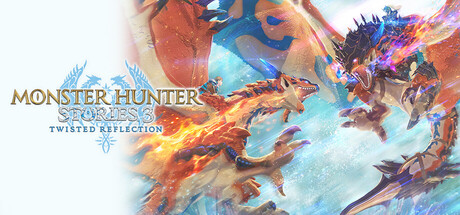
Monster Hunter Stories 3: Twisted Reflection - Additional Side Story: Rudy
Survive a condescending first hour and you get one of the deepest monster-breeding build systems on PC. Just know the postgame is a grind treadmill wearing a friendly face.
GamerScout Verdict
Worth it for build-crafters chasing gene synergy depth, not for anyone who needs prestige writing or hates grind gates.
Compare Prices(3 stores)
Every store in this table quotes us in euros, so the EUR figure is the price the seller actually set, not our arithmetic — which is why EUR is also the currency we rank in. We only list an offer here when the store gives us its price in euros, so nothing in this table is a number we invented.
Pick USD, PLN, GBP, CAD or AUD in the header and we convert from EUR at the European Central Bank reference rate — converted amounts are prefixed with ~. Your bank or the store may apply a different rate at checkout. We never hide offers based on where you are: everyone sees this whole table.
We may earn a commission when you buy games through links on this page — at no extra cost to you. It never affects our rankings or verdicts.
Screenshots & Media
About Monster Hunter Stories 3: Twisted Reflection - Additional Side Story: Rudy
I almost bounced off this one inside the first forty minutes, so let me get the warning out of the way early. The opening hour is a supervised tour: pop-up tutorials for menus you already understand, a companion explaining elemental weakness as if you have never met a fire monster, and a story pace that walks when it should jog. If you have touched anything in the monster-collecting genre since the nineties, that stretch feels like being handed a helmet before you are allowed near the stairs. Push through it anyway. Somewhere around the two hour mark the game stops holding your wrist and hands you a breeding system with real depth, and the whole thing re-frames itself as a build-crafting RPG wearing a friendly children's book cover. Combat is turn-based and reads simple on the surface: attack types trade off against each other in a rock-paper-scissors triangle, monsters lock into head-to-head clashes, and a bond gauge builds toward riding your partner and firing off the big cooperative attack. The depth lives in the gene grid. Every monster carries genes in a slotted board, you move them between creatures, and lining up matching types in rows and columns pays out synergy bonuses that reshape a build instead of nudging a stat by three percent. Layer in elemental weaknesses and part breaking, both carried over from the mainline hunting games, and fights start rewarding preparation over reflexes. I spent an embarrassing stretch in the breeding menu rebuilding the same monster four times to chase one column, and I regret none of it. Past hour forty the build variety still had corners I had not opened, which is more than I can say for most games making that promise. The writing is warmer than it is sharp. Rudy's arc is a coming-of-age story told without irony: friendship, inherited expectations, the familiar beats about proving yourself to a village that already decided what you are. This is not the layered, re-readable dialogue I chase in the CRPGs I usually cover, and nobody here is going to argue with your own skull about political theory. What it has instead is consistency. Characters keep their voices, the bond between rider and monster is treated as an actual relationship rather than an inventory slot, and the world holds a coherent internal logic about how people and monsters share ground. The subtitle is doing thematic work rather than sitting there as flavor, and the back half pays off setup that the quiet early hours planted. Dragons get their due as well, which earns points from me on principle. The disappointments are real and they cluster in one place. This is a Capcom RPG, so the postgame is a treadmill: repeatable expeditions, rare gene hunting with drop rates tuned to keep you logged in, and filler quests that ask you to fetch three of something you already have twelve of. The mid-game sags for a stretch where progress is gated behind side content with nothing to say, and the padding is obvious enough that you can feel the designers stalling. Difficulty spikes also arrive without warning after long flat stretches, which I suspect explains the gap between the glowing critic reception and the more measured player sentiment on Steam. Critics finished the campaign and left happy. Players stayed for the postgame and found the grind. On the practical side, it is single-player only, plays fine on keyboard and mouse or a controller, and the accessibility support is better than the genre average, with adjustable text size, subtitle controls, and an option to remove timed inputs entirely. That last one matters more than it sounds, because the clash system leans on reactions that not everyone wants to be graded on. Get it if you want a monster-collecting RPG with a genuine build layer underneath the cute exterior and you have the patience to outlast a condescending opening. Skip it if you need prose that rewards a second read, or if grind gates between you and the interesting genes will curdle the whole experience.

RPGs
Tags
System Requirements
Minimum
- OS
- Windows®11 (64-bit Required)
- Processor
- Intel® Core™ i3-9100 or AMD Ryzen™ 3 3200G
- Memory
- 16 GB RAM
- Graphics
- NVIDIA GeForce GTX 1660(VRAM 6GB) or AMD R…
Recommended
- OS
- Windows®11 (64-bit Required)
- Processor
- Intel® Core™ i5-10400 or AMD Ryzen™ 5 3600
- Memory
- 16 GB RAM
- Graphics
- NVIDIA GeForce RTX 2060 Super(VRAM 8GB…
Keep exploring
Community Discussion
Be the first to comment on Monster Hunter Stories 3: Twisted Reflection - Additional Side Story: Rudy.
Reviews & Ratings
Game Info
- Developer
- CAPCOM Co., Ltd.
- Publisher
- CAPCOM Co., Ltd.
- Release Date
- Mar 12, 2026