
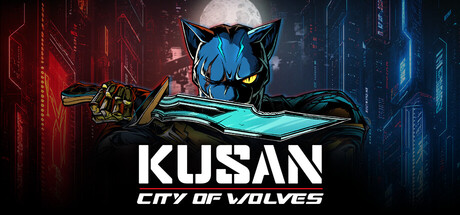
Kusan: City of Wolves
Hotline Miami's brutality reborn in a neon-soaked anthropomorphic city, if the one-hit kill loop hooks you in the first ten minutes, you will not put this down.
GamerScout Verdict
Built for players who treat a room reset as a puzzle, not a punishment, one of the sharpest indie action games of 2026.
Compare Prices(6 stores)
Every store in this table quotes us in euros, so the EUR figure is the price the seller actually set, not our arithmetic — which is why EUR is also the currency we rank in. We only list an offer here when the store gives us its price in euros, so nothing in this table is a number we invented.
Pick USD, PLN, GBP, CAD or AUD in the header and we convert from EUR at the European Central Bank reference rate — converted amounts are prefixed with ~. Your bank or the store may apply a different rate at checkout. We never hide offers based on where you are: everyone sees this whole table.
We may earn a commission when you buy games through links on this page — at no extra cost to you. It never affects our rankings or verdicts.
Price History
Screenshots & Media
About Kusan: City of Wolves
I went in expecting a competent Hotline Miami clone and came out genuinely surprised by how much identity CIRCLEfromDOT packed into a four-person project. Kusan is a top-down action game built almost entirely around the same ruthless premise that made Hotline Miami legendary: one bullet ends you, one mistake resets a room, and every cleared floor feels like a small personal victory. But calling it a clone undersells the craft at work here. The studio built a distinct neo-noir world populated by anthropomorphic animals, told through comic-panel cutscenes that give the story of Jin, a burnt-out ex-soldier running his operation out of a laundromat, a genuinely moody graphic-novel texture. The narrative has some murky patches and does not always explain its own motivations cleanly, but the atmosphere it generates more than compensates. The combat system is where the game earns its reputation. Jin arrives with two signature tools: the War Hand, a mechanical prosthetic arm capable of quick strikes and a charged punch that reaches across rooms, and the Quantum Knife, which can be thrown and caught mid-air to keep attack chains unbroken. Pistol, revolver, shotgun, and crossbow fill out the ranged options, and all of them get layered into the Techtrix upgrade grid, a chip-placement system where each upgrade occupies a unique shape in a limited inventory case. Deciding which chips to fit before a mission becomes genuinely interesting rather than a formality. Parrying is the other pillar. Boss encounters are explicitly designed around it: late-chapter fights require timed parries to redirect rockets and projectiles back at the source, and getting that timing right delivers the kind of satisfaction usually associated with Sekiro-adjacent games. There are also two aim-assist modes, Stylish for smoother chain execution and Free Aiming for directional control, with a tunable Target Guidance Range slider, which is a small but thoughtful concession given the game offers zero difficulty options otherwise. Fifty-four hand-crafted stages across multiple chapters means there is real breadth here, and the level design avoids becoming a corridor parade. Mid-game rooms start connecting into multi-space layouts, and the street sections introduce vehicle hazards including cars that Jin can parry. A style meter, ranked from Commander through Beast to Assassin, adds a Devil May Cry-flavored layer, though several reviewers and players noted the meter behaves inconsistently, depleting during what feel like legitimate kill chains and occasionally sticking on a rank for unclear reasons. It is a rough edge on an otherwise precise machine. End-of-stage grading up to SS rank gives perfectionists a reason to replay every level, and the replayability is real: the game does not lock you into one weapon approach, so experimenting with a Quantum Knife-heavy build versus a shotgun-and-War-Hand loadout produces meaningfully different runs. The soundtrack, composed by hip-hop artist Loptimist, deserves its own mention. In a genre where the music often just signals urgency, Kusan's score actually shapes how you play. The beats are deliberate and propulsive in a way that makes aggressive reads feel earned rather than reckless. It is the kind of soundtrack that gets released separately because the developers know it can hold its own weight, and it does. Visually, the neon-noir pixel art is dense and occasionally cluttered during the busiest moments, which is a fair criticism, but the animation quality and the character design of this anthropomorphic city give the game a personality that most indie action titles never find. For anyone who loves precise, punishment-forward action and can accept that the narrative ambition slightly outpaces its clarity, Kusan is a focused, confident, and deeply satisfying experience from a studio that clearly understands what flow means.

Indie & narrative
Tags
System Requirements
Minimum
- OS
- Windows 10 (64bit)
- Processor
- Intel Core i5-6600 or AMD Ryzen 5 1600
- Memory
- 8 GB RAM
- Graphics
- GeForce GTX 660, 2 GB or AMD Radeon R9 270X, 2 GB
- Storage
- 3 GB availa…
Recommended
- OS
- Windows 11 (64bit)
- Processor
- Intel Core i5-8400 or AMD Ryzen 5 2600
- Memory
- 16 GB RAM
- Graphics
- NVIDIA GeForce GTX 970, 4 GB or AMD Radeon RX 590, 8…
Keep exploring
Community Discussion
Be the first to comment on Kusan: City of Wolves.
Reviews & Ratings
Game Info
- Developer
- CIRCLEfromDOT
- Publisher
- PQube
- Release Date
- Jul 30, 2026