
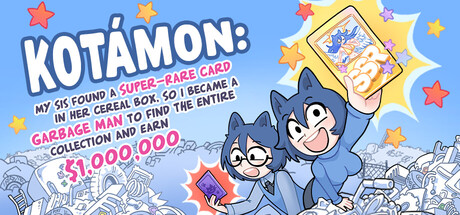
KOTAMON: My Sis Found A Super-Rare Card In Her Cereal Box, So I Became A Garbage Man To Find The Entire Collection And Earn $1,000,000
A trash-sorting sim with a card-speculation economy hiding underneath it. Strong on-ramp if management games usually intimidate you, thin once the market stops surprising you.
GamerScout Verdict
Buy it as a low-stress intro to economy sims; skip it if you need an opponent or a ceiling past a few dozen hours.
Compare Prices(1 stores)
Every store in this table quotes us in euros, so the EUR figure is the price the seller actually set, not our arithmetic — which is why EUR is also the currency we rank in. We only list an offer here when the store gives us its price in euros, so nothing in this table is a number we invented.
Pick USD, PLN, GBP, CAD or AUD in the header and we convert from EUR at the European Central Bank reference rate — converted amounts are prefixed with ~. Your bank or the store may apply a different rate at checkout. We never hide offers based on where you are: everyone sees this whole table.
We may earn a commission when you buy games through links on this page — at no extra cost to you. It never affects our rankings or verdicts.
Price History
Screenshots & Media
About KOTAMON: My Sis Found A Super-Rare Card In Her Cereal Box, So I Became A Garbage Man To Find The Entire Collection And Earn $1,000,000
It asks for patience first, and I mean the specific kind of patience I normally reserve for staring at a trade balance screen in a Paradox title. The opening couple of hours of KOTAMON are you, a bag, and a great deal of other people's refuse, sorted into whatever categories the dump site owner is willing to pay for. No tech tree. No opening gambit. What you get instead is a throughput problem: how much can you clear per shift, how quickly does that convert into cash, and how much of that cash goes back into the card hunt rather than into your pocket. Once I stopped treating it as a novelty title with a very long name and started treating it as a small logistics sim with a gambling layer bolted on top, it clicked properly. Before that, I genuinely did not understand why 601 people had rated it as warmly as they have. The loop is easy to describe and harder to put down. The dump site owner hands you orders, which work as soft objectives: bring in this much of that, clear this area, hit this quota. You rummage. Most of what surfaces is worth pocket change. Occasionally it is a Kotamon card, and the cards are the actual game. They carry values, those values move, and something that looked like filler two sessions ago can become the thing that funds your next stretch. The headline goal is a complete collection and a million dollars, which reads as a joke until you run the arithmetic on what a full set is worth against what a single shift actually earns. That gap is the design. The decision I ended up chewing on most is time allocation, and it is a better one than the premise suggests. Orders are reliable income: known effort, known payout, no variance. Free rummaging is pure variance. Every minute spent chasing a hunch about a promising pile is a minute not spent on a quota you already know clears. My approach was to run orders almost exclusively at the start, build a hard floor under my hourly income, then push roughly 40 percent of each session into speculative digging once that floor felt safe. That is the closest thing here to a build order, and nothing in the game will tell you to do it. Newcomers who chase rares from minute one will stall out and blame the pacing. Where it disappoints is opposition, or rather the total lack of it. Nobody else is hunting these cards. There is no rival collector bidding you up, no AI presence reacting to your finds, no competition for the good piles. The market moves, but it moves at you rather than against you, and past a certain point I could feel the absence of anything pushing back on my plan. The second problem is texture. Sorting is satisfying in exactly the way cleaning games are satisfying, right up to the session where the pile layouts stop surprising you, and for me that arrived comfortably before the million. Roughly one reviewer in five is unhappy, and I would put money on most of them hitting that same wall. Singleplayer, achievements, cloud saves: that is the entire feature list, so do not walk in assuming a modding scene will extend its life for you. So who is this for. Not the grand-strategy veteran looking for their next 300-hour campaign, because the ceiling here is measured in dozens of hours, not hundreds. It is for the person who has always wanted to enjoy economy sims and bounced off the spreadsheets, because this teaches the three concepts that actually matter (income floor, variance, reinvestment) using garbage bags and trading cards instead of tariffs and stockpiles. It is also a decent low-stress companion game if you want something to run alongside a podcast. Go in with a plan for your first five hours, resist selling your first genuine rare, and it will hold you longer than the title deserves. Go in expecting depth on the level of a proper management sim and you will be finished with it in a weekend.

Strategy & simulation
Tags
System Requirements
Minimum
- OS
- Windows 10
- Memory
- 4 GB RAM
- Storage
- 3 GB available space
- Graphics
- GeForce 960 4gb VRAM or analogue
- Processor
- Intel Core i3 or analogue
Recommended
- OS
- Windows 11
- Memory
- 8 GB RAM
- Storage
- 5 GB available space
- Graphics
- GeForce 1070 Ti or analogue
- Processor
- Intel Core i7 or analogue
Keep exploring
Community Discussion
Be the first to comment on KOTAMON: My Sis Found A Super-Rare Card In Her Cereal Box, So I Became A Garbage Man To Find The Entire Collection And Earn $1,000,000.
Reviews & Ratings
Game Info
- Developer
- KotaMota Games
- Publisher
- Polnoch
- Release Date
- Aug 20, 2026

![This is probably a better way to get a million dollars than most jobs. [18+] #Middlespace #DiaperBrained #AIOptedOut](https://static-cdn.jtvnw.net/previews-ttv/live_user_katrinapampurrs-440x248.jpg)
