
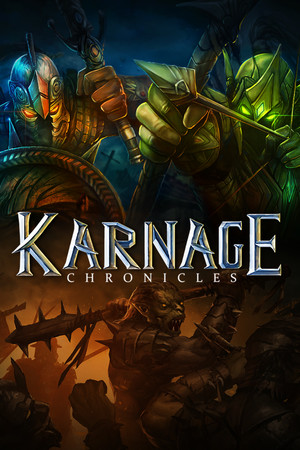
Karnage Chronicles
Give it an hour of flailing and it becomes some of the best physics melee in VR. Just do not come for the story, and bring a co-op partner if you can find one.
GamerScout Verdict
Best for headset owners with a co-op partner who want real swing mechanics; skip if you need a story to pull you forward.
Compare Prices(3 stores)
Every store in this table quotes us in euros, so the EUR figure is the price the seller actually set, not our arithmetic — which is why EUR is also the currency we rank in. We only list an offer here when the store gives us its price in euros, so nothing in this table is a number we invented.
Pick USD, PLN, GBP, CAD or AUD in the header and we convert from EUR at the European Central Bank reference rate — converted amounts are prefixed with ~. Your bank or the store may apply a different rate at checkout. We never hide offers based on where you are: everyone sees this whole table.
We may earn a commission when you buy games through links on this page — at no extra cost to you. It never affects our rankings or verdicts.
Price History
Screenshots & Media
About Karnage Chronicles
The first hour will convince you that you have never held a sword in your life. Every weapon here carries real weight and momentum, so your opening swings are flails, your shield arm drifts somewhere near your hip, and you will clip a real-world lamp at least once. That friction is the entry fee, and whether it is worth paying comes down to a single question: do you want a VR dungeon crawler that simulates a swing, or one that reads your intent and politely animates a hit for you? This is firmly the former. Push past the awkward acclimation window and somewhere in hour two the physics stop feeling like an obstacle and start feeling like the entire point. Underneath the wobble is a room-scale dark fantasy dungeon crawl, playable solo or in online co-op, built around melee, archery and shield work rather than the gun-heavy stuff that dominates the VR shelf. Progression runs on loot. You find better gear, you actually feel the difference in reach and swing speed in your hands, and the encounter design quietly assumes you have learned to block rather than absorb. The shield is not a cosmetic prop bolted to your off hand. Angling it, eating a blow, then countering while an enemy is still recovering is the real combat loop, and internalizing it took me longer than any timing-window parry in a flat-screen action RPG. Archery is the other half of the pitch. Drawing a bow with two hands, feeling the tension, leading a target that is closing distance on you, all of it lands with a physicality that no controller rumble has ever matched for me. Co-op is where the whole thing makes its strongest case. Solo, the dungeons are a competent physical workout with decent pacing. With a partner, they become genuinely tactical: one of you holding a chokepoint behind a shield while the other works angles with a bow is the kind of emergent coordination that most scripted RPG party systems only pretend to offer. There is also a comedy layer that no design document can plan for, because two people swinging heavy virtual objects in a confined corridor will eventually hit each other, drop a torch, and laugh about it. That social dimension carries a lot of the runtime, which is a polite way of saying you should think hard about whether you have someone to play this with. Now the parts that disappoint. The narrative is thin. As someone who cares deeply about whether a choice made in hour three pays off in hour thirty, I have to report that there is very little here to re-read, dissect, or argue about. The worldbuilding gestures at a grim fantasy setting with competent art direction, but it is set dressing around combat encounters rather than a story with characters worth remembering. Environments repeat more than I would like, and once you have solved the physics puzzle of a given enemy type, later fights ask for endurance rather than new thinking. There is no build variety in the sense a tabletop-brained player means it: no branching specializations to argue over, no theorycrafting spreadsheets, just steadily better equipment and steadily better arms. And it is VR only, which is not a flaw so much as a hard gate. No headset, no game, and heavy melee in room scale is a physical commitment on a level most sit-down RPGs never demand. So who is this actually for? Anyone who bought a headset specifically to swing things and has grown tired of wave shooters. Anyone who has a regular co-op partner and wants forty minute dungeon sessions with real skill expression. Players who want a story that rewards a second playthrough should look elsewhere, because this one gives you a reason to swing and not much reason to think about why. The player base is modest but has stuck around, which tracks: the combat is good enough that people forgive the rest. Push through that first ugly hour with the expectation that your competence, not the game, is what changes. If you go in wanting a physics sandbox with a dungeon wrapped around it rather than an RPG with combat attached, it delivers exactly that.

RPGs
Tags
System Requirements
Minimum
- Processor
- Intel Core i5 or equivalent
- Memory
- 8 GB RAM
- Graphics
- Nvidia GeForce GTX 970 or AMD equivalent
- Storage
- 3 GB available space
Recommended
- OS
- Windows 10
- Processor
- Intel Core i7 or equivalent
- Memory
- 16 GB RAM
- Graphics
- GTX 1070 or AMD equivalent
- Storage
- 3 GB available space
Keep exploring
Community Discussion
Be the first to comment on Karnage Chronicles.
Reviews & Ratings
Game Info
- Developer
- Nordic Trolls
- Publisher
- Nordic Trolls
- Release Date
- Jul 31, 2020