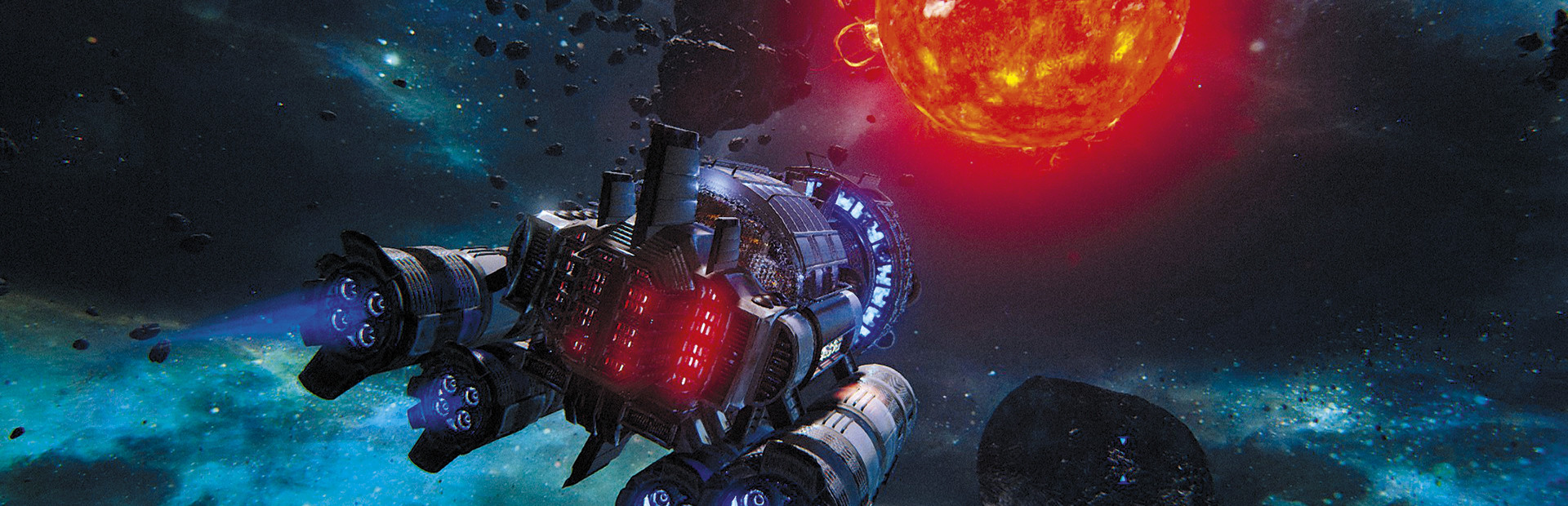
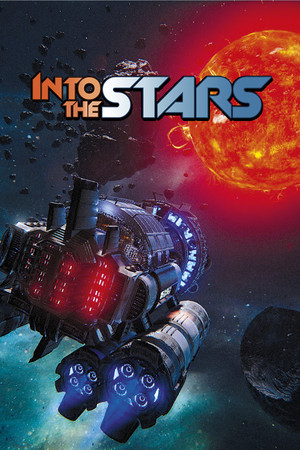
Into the Stars - Digital Deluxe
A tight three-to-six hour attrition run that teaches resource triage better than most 200-hour sims, then runs out of things to teach you by the third playthrough.
GamerScout Verdict
Worth a weekend for sim newcomers learning to ration under pressure; skip it if you want systems deep enough to optimise.
Compare Prices(4 stores)
Every store in this table quotes us in euros, so the EUR figure is the price the seller actually set, not our arithmetic — which is why EUR is also the currency we rank in. We only list an offer here when the store gives us its price in euros, so nothing in this table is a number we invented.
Pick USD, PLN, GBP, CAD or AUD in the header and we convert from EUR at the European Central Bank reference rate — converted amounts are prefixed with ~. Your bank or the store may apply a different rate at checkout. We never hide offers based on where you are: everyone sees this whole table.
We may earn a commission when you buy games through links on this page — at no extra cost to you. It never affects our rankings or verdicts.
Price History
Screenshots & Media
About Into the Stars - Digital Deluxe
Fuel is the clock, and the moment that clicked for me, every other decision on the bridge started making sense. This one hands you an ark ship, the last of humanity asleep in the hold, and a tank that drains whether you are doing something clever or nothing at all. Every scan you run, every detour toward a promising planet, every minute spent arguing with yourself about whether to burn past a hostile contact gets paid for in a resource you cannot manufacture. That single pressure valve is what turns an otherwise gentle exploration game into a genuine attrition puzzle. I plan my first ninety minutes the way I would plan an opening build order: which systems get scanned, which officers go planetside, and how much slack I leave myself before the halfway mark. The loop itself is straightforward once you have seen it twice. You sit on a first-person bridge, pick a heading, arrive somewhere, and choose between scanning for fuel, water, food, and raw materials or sending an away team down to a surface that may hand you an upgrade or may hand you a funeral. Officers are not interchangeable. They carry specialisations that gate outcomes, and when one dies on a bad roll, they stay dead for the rest of the run. Back aboard, materials go into outfitting: better shields, better sensors, better engines, the usual triangle. Combat exists but it is the weakest limb, closer to a timing minigame than a tactical layer. The honest framing is a survival sim with light roguelite structure, not a 4X and not a ship-to-ship tactics game. And here is where I will make the case I usually reserve for four-hundred-hour grand strategy. This is one of the friendliest on-ramps to the resource-triage genre I can point a newcomer toward, precisely because a run is short. You are not committing a season of your life to learn a systems language. A campaign fits in an evening, the failure states are legible, and the gap between a bad allocation decision and its consequence is measured in minutes rather than in-game decades. If you have bounced off the deep end of the genre because the tutorials assumed you already spoke the dialect, a compressed run like this drills the core instinct: spend early on what compounds, hoard late for what you cannot replace. The interface stays calm, the numbers stay few, and nothing hides behind six nested tooltips. The problem arrives on run three. Depth is what this game is thinnest on, and the community reflects that: Steam sits at a mixed reception with well under half of its five hundred plus reviews positive, and the aggregate critic number lands in the low sixties. Both feel roughly fair to me. The decision space stops widening once you have learned which planet types pay out and which encounters are traps, and by then you are executing a solved route rather than reading a situation. Event variety runs dry faster than the campaign length should allow. There is no meaningful modding scene to extend the shelf life, and the upgrade tree does not branch enough to support genuinely different builds. It looks like a game with a strategy layer underneath. Mostly it has a checklist. So calibrate by what you actually want out of it. As a short experience about rationing under pressure, with a strong sense of place and a real cost to losing people, it does the job and it does not waste your time doing it. As something to chew on for a hundred hours, build-crafting and optimising and arguing with the AI, it runs out of material long before you run out of curiosity. I would tell a genre newcomer to take the trip and pay attention to how fast the fuel gauge punishes indecision. I would tell anyone who already keeps a spreadsheet habit to treat it as a palate cleanser between the heavy stuff, not a main course.

Strategy & simulation
Tags
System Requirements
Minimum
- Processor
- 2.5 GHz or faster Intel or AMD processor
- Memory
- 8 GB RAM
- Graphics
- NVIDIA GeForce 470 GTX or AMD Radeon 6870 HD series card or higher
- DirectX
- Version 11 S…
Recommended
- Processor
- Quad-core Intel or AMD processor
- Memory
- 16 GB RAM
- Graphics
- DX11 Compatible Video Card
- DirectX
- Version 11
- Storage
- 2 GB available space
Keep exploring
Community Discussion
Be the first to comment on Into the Stars - Digital Deluxe.
Reviews & Ratings
Game Info
- Developer
- Fugitive Games
- Publisher
- Iceberg Interactive
- Release Date
- Mar 4, 2016