FRACT OSC
Finish it and you get a real synthesizer instead of a credits roll. Getting there means hours of getting lost in a wordless neon canyon with no map. Bring headphones and patience.
GamerScout Verdict
For Myst-like fans who want to learn synthesis by touch and won't rage at having no map, no text and no objective marker.
Compare Prices(2 stores)
Every store in this table quotes us in euros, so the EUR figure is the price the seller actually set, not our arithmetic — which is why EUR is also the currency we rank in. We only list an offer here when the store gives us its price in euros, so nothing in this table is a number we invented.
Pick USD, PLN, GBP, CAD or AUD in the header and we convert from EUR at the European Central Bank reference rate — converted amounts are prefixed with ~. Your bank or the store may apply a different rate at checkout. We never hide offers based on where you are: everyone sees this whole table.
We may earn a commission when you buy games through links on this page — at no extra cost to you. It never affects our rankings or verdicts.
Screenshots & Media
About FRACT OSC
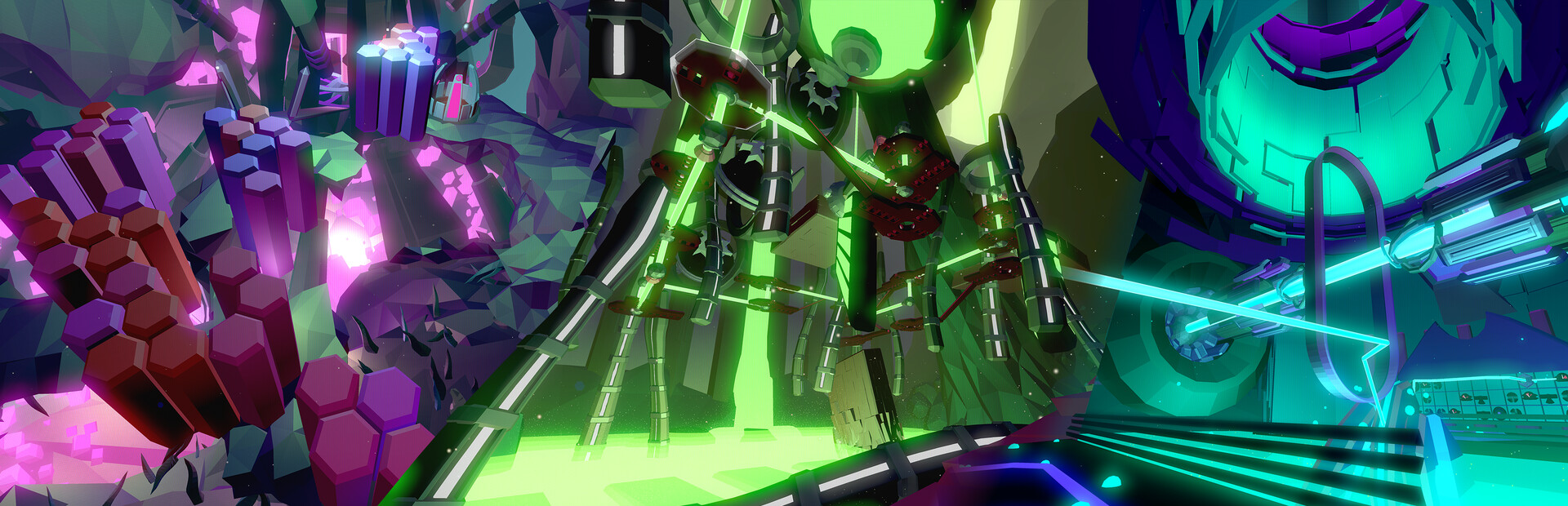
The payoff for finishing FRACT OSC is a working synthesizer, and I still open the game to noodle on it long after the puzzles stopped being a mystery. That is the whole pitch, and the game earns it slowly. Released in 2014 by Phosfiend Systems, it drops you into a dark vector canyon with no text, no voice, no tutorial prompt and no objective marker. Something enormous under the floor used to make music and now does not. You are the one who has to wake it up. What that looks like in practice is a first-person exploration puzzler in the Myst tradition, except every lock is a piece of audio hardware. You wander three huge zones built around lead, pad and bass, and the machines inside them are honest instruments rather than metaphors for instruments. You are dragging step patterns onto a grid, matching oscillator shapes, tuning a waveform until it locks, routing a signal from one tower to the next and watching the structure light up in sequence. Nothing labels itself. The game teaches synthesis vocabulary by making you handle it, which means the first hour can feel like poking a machine you have no manual for, and the fourth hour feels like you have quietly learned to read. When a zone comes back online and its layer joins the mix, the reward is not a cutscene. It is the soundtrack getting bigger because of something you did. The craft is in the atmosphere, and it has aged better than most things from its era. The look is spare neon wireframe against black, closer to Tron geometry than to any kind of realism, and it works because Phosfiend never clutters it. Scale does the emotional work. You stand at the lip of a drop, a structure the size of a district hums somewhere below you, and the audio design makes all that emptiness feel occupied rather than unfinished. The score does not sit on top of the world so much as leak out of it, and the game keeps blurring which sounds are music and which are just the place breathing. Headphones are not optional here. Half of the puzzle feedback is aural, and playing this on laptop speakers is like reading a poem through a wall. It disappoints in exactly one predictable way, and you should weigh it before committing. FRACT OSC does not respect your time in the modern sense. There is no map, no journal, no quest log, no marker telling you which of the four things you half-solved is the one that actually opened. Getting lost is not an occasional failure state, it is roughly a third of the running time, and if you play in short sessions across a week you will lose the thread of where you were headed. A few puzzles hinge on spotting a visual cue at distance that the wireframe style actively camouflages. There is light platforming that the movement is not quite precise enough for, and the controller support is partial in the literal sense, so mouse and keyboard is the safer call. I will defend a slow opening when the payoff justifies it, and this one does, but the drift in the middle stretch is a real flaw rather than intentional texture. So who is it for. People who loved Myst or Fez for the feeling of decoding a system nobody explained. People who own a hardware synth, or have always wanted an excuse to understand one. People happy to spend an evening or two somewhere quiet and strange with the lights off. It is a poor fit if you want a story you can retell afterward, a clear objective list, or any handholding at all. Get through it and the studio unlocks, a full sandbox sequencer where you build and export your own tracks, and that is the part that turns this from a game you complete into a place you keep going back to.

Indie & narrative
Tags
System Requirements
Minimum
- Processor
- Core i5 2.2 GHz or equivalent
- Memory
- 4 GB RAM
- Graphics
- Radeon 5850 or equivalent
- DirectX
- Version 9.0c
- Storage
- 1500 MB available space
- Sound Card
- Required Additional Notes…
Recommended
- Processor
- Core i7 2.4 GHz or better
- Memory
- 8 GB RAM
- Graphics
- Radeon 6850 series or equivalent
- DirectX
- Version 11
- Storage
- 2 GB available space
- Sound Card
- Required Additional No…
Keep exploring
Community Discussion
Be the first to comment on FRACT OSC.
Reviews & Ratings
Game Info
- Developer
- Phosfiend Systems
- Publisher
- Phosfiend Systems
- Release Date
- Apr 22, 2014