
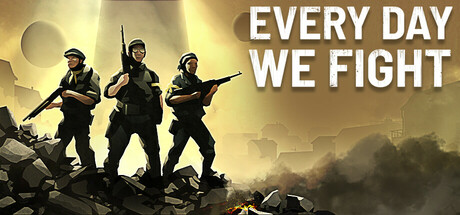
Every Day We Fight
XCOM's action-point DNA fused with first-person aiming and a time-loop roguelite skeleton - this one demands you think AND shoot straight, and punishes you when you only do one.
GamerScout Verdict
Buy if you want XCOM-style tactics with real aiming stakes; hold if thin loot variety and Early Access rough edges put you off.
Compare Prices(6 stores)
Every store in this table quotes us in euros, so the EUR figure is the price the seller actually set, not our arithmetic — which is why EUR is also the currency we rank in. We only list an offer here when the store gives us its price in euros, so nothing in this table is a number we invented.
Pick USD, PLN, GBP, CAD or AUD in the header and we convert from EUR at the European Central Bank reference rate — converted amounts are prefixed with ~. Your bank or the store may apply a different rate at checkout. We never hide offers based on where you are: everyone sees this whole table.
We may earn a commission when you buy games through links on this page — at no extra cost to you. It never affects our rankings or verdicts.
Price History
Screenshots & Media
About Every Day We Fight
I've spent enough hours in turn-based tactics games to know when a hybrid system is bolted on as a marketing bullet point versus when it actually changes how you think in combat. Every Day We Fight is the latter, and that distinction matters a lot at Early Access pricing. The core proposition is genuinely unusual: you manage three resistance fighters - Dylan, Vivian, and Leo, collectively called the Thorns - through a ruined city occupied by alien invaders called Rifters. Everything up to an engagement plays out in real time. You scout the terrain, position your squad behind cars and inside broken buildings, and set your angle of approach before a single shot fires. The moment combat triggers, the game shifts into turn-based mode. What impressed me is how seamless that handoff feels - no loading screens, no mode-select menu, just the tension ratcheting up as you commit to the fight you spent the last few minutes preparing for. The combat mechanics have real depth once you map them out. Each Thorn runs on an Action Point budget that covers movement, shooting, reloading, and ability use. Dylan is your close-quarters muscle, capable of disappearing into smoke to blind enemies. Vivian brings utility and reaction potential - she can deploy a hologram decoy to pull enemy fire and finish off targets outside your normal turn window. Leo is support: he donates action points to allies, patches wounds, and lays down covering fire. Crucially, every shot switches to a first-person aiming view. There is no RNG hit percentage to blame. If you miss, it is because you missed. Headshots strip helmets, and those stripped helmets become exploitable weak points on subsequent shots with a sniper rifle. Overwatch reactions let both sides interrupt movement, and enemies will actively dash for new cover when shot at, which keeps each encounter dynamic rather than static. The AI has some passive moments, but it is generally competent enough to force genuine decisions. The roguelite loop gives all of this structural purpose. Death resets the timeline but your characters retain their XP and unlocked abilities, and the city map itself persists between runs, opening up fast-travel options as you progress. Each character has a dedicated skill tree, and randomised loot drops on death mean you are never rebuilding from a completely clean slate. Mission types ask you to shut down alien harvesters, destroy probes, defuse bombs, and hit optional bonus objectives that gate the better weapon stashes. Secondary objectives are worth attempting even if you fail them - the risk calculus around whether to push for a weapons stash or extract safely is exactly the kind of tension good tactics games live on. For newcomers worried about complexity: a story mode lets you reload before things go wrong as many times as you want, which removes the punishment without removing the friction. The game still demands engagement regardless of which setting you choose. The weaknesses at this Early Access stage are real and worth factoring in before you commit. Item variety is thin - scrap pickups dominate exploration loot, and meaningful weapon drops are gated behind main missions and bonus objectives. The weapon pool currently covers shotguns, sniper rifles, and submachine guns, and reviewers have noted that more exotic weapon mods and equipment types would go a long way. Character writing is uneven - the voiced banter between Dylan, Vivian, and Leo during exploration is genuinely enjoyable, but cutscene dialogue has drawn criticism for feeling rushed and context-light. Tutorial flow has overlap issues with key bindings and some terrain visibility oddities that disproportionately punish players who are new to the genre. The development team is targeting a full 1.0 release roughly a year out from the July 2025 Early Access launch, with content and balancing being the stated priorities based on community feedback. For XCOM veterans and anyone who ever wished Phoenix Point's real-time aiming had a tighter tactical framework around it, this is already a compelling case to jump in early. The core loop - scout, position, engage, adapt, die, and come back smarter - is solid. The item and enemy variety will need to grow substantially to sustain long-term runs, and the tutorial needs rework before it can comfortably onboard newcomers without a guide. But the fundamental mechanical idea, turn-based positioning meeting skill-based first-person shooting inside a persistent roguelite structure, is working right now, not just on paper.

Strategy & simulation
Tags
System Requirements
Minimum
- OS
- Windows® 10 (64-bit)
- Memory
- 8 GB RAM
- DirectX
- Version 11
- Storage
- 20 GB available space
- Graphics
- NVIDIA® GeForce® GTX 1050 Ti (4 GB) / AMD® Radeon™ RX 470 (4 GB)
- Processor
- Intel® Core™ i5-4590 (quad-core) / AMD® FX-Series™ FX-8350 (quad-core)
Recommended
- OS
- Windows® 11 (64-bit)
- Memory
- 16 GB RAM
- DirectX
- Version 12
- Storage
- 20 GB available space
- Graphics
- NVIDIA® GeForce® GTX 1660 (6 GB) / AMD® Radeon™ RX 5600 (6 GB)
- Processor
- Intel® Core™ i5-6600 (quad-core) / AMD® Ryzen™ 3 2200G (quad-core)
Keep exploring
Community Discussion
Be the first to comment on Every Day We Fight.
Reviews & Ratings
No ratings available
Game Info
- Developer
- Signal Space Lab
- Publisher
- Hooded Horse
- Release Date
- Jul 10, 2025