
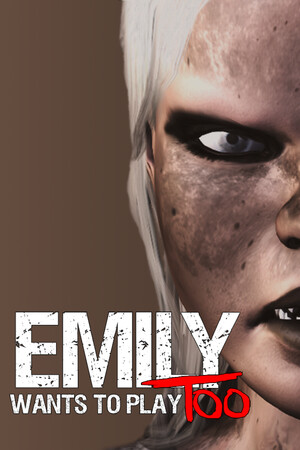
Emily Wants to Play Too
Surviving possessed dolls by memorizing their rules is either a clever tension loop or a frustrating RNG slog, depending on your patience for trial-and-error horror. Know which one you are before you load in.
GamerScout Verdict
Best for fans of the first game who want more rooms and dolls, not deeper horror or a meaningful story.
Compare Prices(3 stores)
Every store in this table quotes us in euros, so the EUR figure is the price the seller actually set, not our arithmetic — which is why EUR is also the currency we rank in. We only list an offer here when the store gives us its price in euros, so nothing in this table is a number we invented.
Pick USD, PLN, GBP, CAD or AUD in the header and we convert from EUR at the European Central Bank reference rate — converted amounts are prefixed with ~. Your bank or the store may apply a different rate at checkout. We never hide offers based on where you are: everyone sees this whole table.
We may earn a commission when you buy games through links on this page — at no extra cost to you. It never affects our rankings or verdicts.
Price History
Screenshots & Media
About Emily Wants to Play Too
I put this one through its paces specifically because the genre tags confused me: Action, Strategy, Simulation, Simulation, all for what is at its core a first-person survival horror game built around reading enemy behavior and reacting correctly under pressure. Calling it strategy is generous, but it is not entirely wrong either. The central mechanic is figuring out each doll's personal rule set and executing it while the tension builds around you. Kiki forces you into a staring contest until she vanishes. Mr. Tatters runs a brutal Red Light, Green Light where a single camera twitch during a red phase kills you instantly. Chester the ventriloquist dummy just wants to chase you, and closing doors and cutting corners buys you the seconds you need to survive his sprint. Emily herself plays Hide and Seek on a ticking timer, demanding you find her hiding spot before the clock hits zero. Stack all of those mechanics together in the later hours and you have something that genuinely demands situational awareness. The sequel improves on the original in scope. The setting moves from a cramped house to the sprawling corridors of a crime evidence facility called Central Evidence, and the roster expands with new characters including Greta, a scorched doll who is blind but reacts immediately to sprinting or noise, and Maxwell Steele, who turns invisible unless you cut your flashlight. Managing the full cast across a larger map is where the game earns its strategy tag in a limited but real way. You are constantly making small priority calls: do you handle Kiki before Chester corners you, or do you push toward Emily before the timer expires? The difficulty ramp across the hourly structure is paced reasonably well, introducing one threat at a time before dropping them all on you simultaneously. That said, the design has real cracks. Performance issues were reported at launch and some persist. Certain doll interactions carry enough random variance that a well-played attempt can end not because you made a mistake but because Chester and Mr. Tatters spawned on top of each other in a hallway with no exit. The tutorial is nearly absent, which some players read as atmospheric minimalism and others read as poor design. Honestly, both readings are defensible. The graphics are functional rather than impressive, and the sound design lands unevenly: ambient footsteps and environmental creaks genuinely unsettle, but the jump scare audio spikes have a cheap quality that dulls on repeat exposure. A speedrun mode adds some replay value for completionists, and the achievement list can be cleared in a handful of hours without extreme difficulty. Who is this for? Jump-scare fans who like a light mechanical skeleton underneath the frights will find enough here to keep them occupied for a session or two. Genre veterans or anyone expecting the atmospheric depth of Outlast or Amnesia will hit a wall of repetition quickly. The original Emily Wants to Play is a prerequisite for context, though not strictly for comprehension. If you played the first one and liked its loop, the sequel delivers more rooms, more dolls, and marginally more complexity. If you bounced off the original, nothing here will change your mind.

Strategy & simulation
Tags
System Requirements
Minimum
- OS
- Windows 7,8,10
- DirectX
- Version 11
- Storage
- 4 GB available space
- Graphics
- Nvidia GTX 770 or equivalent
- Processor
- i5 or AMD equivalent
- Sound Card
- Yeah probably so
Recommended
- OS
- Windows 10 64-bit
- DirectX
- Version 11
- Storage
- 4 GB available space
- Graphics
- GTX 970 or higher
- Processor
- i7
Keep exploring
Community Discussion
Be the first to comment on Emily Wants to Play Too.
Reviews & Ratings
No ratings available
Game Info
- Developer
- Shawn Hitchcock
- Publisher
- Hitchcock Games
- Release Date
- Dec 13, 2017