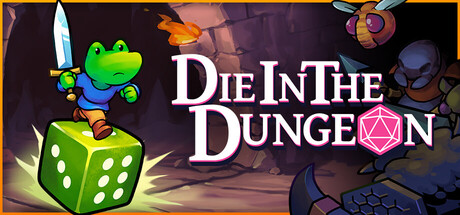
Die in the Dungeon
Forget Slay the Spire's hand of cards. Here your deck is a bag of dice, your battlefield is a spatial grid, and every run asks harder questions than the last, in a package that somehow costs less than lunch.
GamerScout Verdict
Best for Slay the Spire veterans ready to trade hand management for a spatial dice puzzle with real build depth.
Compare Prices(9 stores)
Every store in this table quotes us in euros, so the EUR figure is the price the seller actually set, not our arithmetic — which is why EUR is also the currency we rank in. We only list an offer here when the store gives us its price in euros, so nothing in this table is a number we invented.
Pick USD, PLN, GBP, CAD or AUD in the header and we convert from EUR at the European Central Bank reference rate — converted amounts are prefixed with ~. Your bank or the store may apply a different rate at checkout. We never hide offers based on where you are: everyone sees this whole table.
We may earn a commission when you buy games through links on this page — at no extra cost to you. It never affects our rankings or verdicts.
Price History
Screenshots & Media
About Die in the Dungeon
I have a folder on my desktop labeled 'Roguelites Worth Finishing.' Most games never make it in. Die in the Dungeon earned a slot within two hours, and here is why that surprised me: on the surface it looks like a budget-tier novelty, a dice skin stretched over a Slay the Spire skeleton. It is not. ATICO spent 15 months in Early Access pressure-testing three interlocking systems, board positioning, die face management, and relic synergies, and the 1.0 release that landed in May 2026 is the result of that work. The Steam reception reflects it: over 3,000 reviews at 93% positive across English-language players is not a fluke. The core loop works like this. You pick one of four frog warrior characters, each with a distinct starting die loadout. Red dice deal damage, blue dice generate shields, green dice restore health, and purple dice act as multipliers that amplify whatever sits next to them on the board. Each turn you draw from your dice pool, slot them onto a diamond-shaped grid, and commit. The spatial puzzle is the real game. A purple boost die placed adjacent to two high-value red attack dice does something dramatically different from the same three dice placed in a row. Enemies telegraph their intentions, so you can plan counters, and some enemy types actively restrict where you can place dice, forcing you to adapt mid-turn. Prism dice (which mirror adjacent faces) add another layer that takes a couple of runs to internalize, and the 36 potions give you burst options for when the board state stops cooperating. The pool of 31 unique dice and 142 relics means no two runs converge on the same shape, especially once you start chasing the 59 achievements, which are structured to push you toward build archetypes you would otherwise ignore, poison stacking, reroll chains, glass-cannon setups. Where the game earns real credit is in its onboarding. The tutorial respects newcomers without padding. Everything in combat is hoverable, enemy intent is always visible, and the branching path map between fights lets you plan ahead toward relics, shops, healing nodes, or risk-reward unknown encounters. New players who bounce in the first two hours are almost always hitting the deceptive simplicity of floors one and two before the depth reveals itself. My advice: lock in your build direction (attack, poison, or reroll) by floor three, not floor six, and do not spend die-face rerolls before you have seen your first two relic offers. The D8 difficulty mode, which introduces the Decadent deck, dice that start powerful but degrade over time, is the post-game gauntlet for players who find the base run too comfortable after ten hours. A secret quest also unlocks the game's true ending through a tougher final boss sequence, so there is structured late-game content beyond pure score-chasing. What does not work as cleanly: random side events can feel punishing in ways that are hard to read before you have memorized the event pool, and occasional difficulty spikes between floors can swing a well-built run into a wall without much warning. Neither problem is run-ending for experienced players, but newcomers will catch at least one ugly surprise before they learn to route around dangerous unknowns. The pixel art is charming rather than ambitious, and the lack of any multiplayer or co-op mode means the full experience is purely solo, which is fine for the genre but worth knowing upfront. For anyone who tracks decision density per hour, the stat I actually care about in turn-based games, Die in the Dungeon delivers well above its price tier. The build space is wide enough to sustain 25-plus hours before repetition sets in, and ATICO has signaled continued post-launch updates. If you want a deckbuilder that swaps card draw for spatial reasoning and rewards players who think one step ahead, this is where to spend your time right now.

Strategy & simulation
Tags
System Requirements
Minimum
- OS
- Windows 10, 11
- Memory
- 4 GB RAM
- DirectX
- Version 10
- Storage
- 1 GB available space
- Graphics
- GTX 1030
- Processor
- Intel Core i3 3.0 GHz
Recommended
Requires a 64-bit processor and operating system
Keep exploring
Community Discussion
Be the first to comment on Die in the Dungeon.
Reviews & Ratings
No ratings available
Game Info
- Developer
- ATICO
- Publisher
- HypeTrain Digital
- Release Date
- May 1, 2026
