Ctrl Alt Ego
The sleeper immersive sim that Kotaku put on their 2022 top-ten list and almost nobody bought. If Prey ever felt too guided, this is what you were actually looking for.
GamerScout Verdict
Essential for immersive-sim fans who want genuine systems depth over polish, made by a tiny team who clearly understood the genre better than most.
Compare Prices(4 stores)
Every store in this table quotes us in euros, so the EUR figure is the price the seller actually set, not our arithmetic — which is why EUR is also the currency we rank in. We only list an offer here when the store gives us its price in euros, so nothing in this table is a number we invented.
Pick USD, PLN, GBP, CAD or AUD in the header and we convert from EUR at the European Central Bank reference rate — converted amounts are prefixed with ~. Your bank or the store may apply a different rate at checkout. We never hide offers based on where you are: everyone sees this whole table.
We may earn a commission when you buy games through links on this page — at no extra cost to you. It never affects our rankings or verdicts.
Price History
Screenshots & Media
About Ctrl Alt Ego
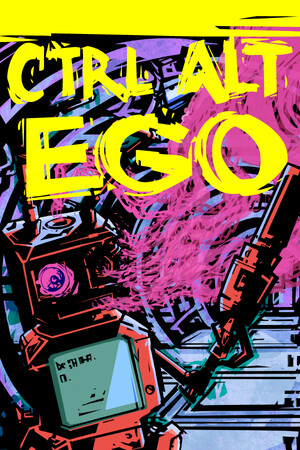
I kept seeing Ctrl Alt Ego surface in the corners of immersive-sim discourse, always with the same incredulous tone: made by essentially two people, shaped like Prey but stranger, and somehow pulling it off. So I went in skeptical, and the opening hours rewarded that skepticism with a slow, deliberate tutorial that asks you to learn its language before it starts speaking. Patience here is not a bug. It is the entire premise. You play as a disembodied consciousness, a thing with no body and no fixed address, loose aboard a retro British sci-fi space station that feels like a BBC production from 1978 that somehow got a game engine. Your primary vessel is Bug 22, a small robot you can print at stations scattered across the levels. Bug 22 can be kitted out with eleven distinct skills, unlockable in any order you choose: you can arm one limb as a shotgun, turn the other into a drill for breaking enemy bots apart, gain a telekinetic Shift ability to reposition objects, add levitation for reaching passages that seem impossible, or convert nearby items into improvised explosives. The sequencing of those choices genuinely changes how you move through the world. Two players who both finish the game are likely to have experienced different stations. On top of Bug 22 you can spend a resource called Ego to take over other machines entirely: dog-like PUPs for crawling through tight spaces, hulking DADs for defensive muscle, and later in the game the fearsome MUMs. The environment itself functions as your inventory, which sounds like a design-speak abstraction until you realize that it means every room is a toolbox and you are the one who decides what counts as a tool. The systemic depth is genuine and the freedom of approach is the real selling point. Stealth runs are meaningfully distinct from aggressive ones. Pacifist playthroughs, where you try to pass through the station without harming any bot, reframe every room into something closer to a spatial puzzle. What impresses most is that wild, apparently game-breaking ideas have usually been anticipated and accounted for by the developers, which gives experimentation a particular satisfaction. The story, delivered through voice logs and conversations via CAT cabinets scattered around the station, carries a dry, deadpan British humor that surfaces in unexpected places, including the robots themselves, whose reactive dialogue made me genuinely laugh more than once. Sonically the game is careful and atmospheric: the hum of machinery, the ambient bleeps of the station, a sparse soundtrack that knows when silence is doing more work than music. Honesty requires flagging the rough edges. The visuals are functional rather than beautiful, and the first-person movement has a floaty quality that bothers some players enough to cause motion discomfort, though the game does offer settings to help with this. Traversal before you have unlocked enough abilities can feel labored. The enemy AI swings between passive and suddenly unforgiving, and a handful of players have noted that once you settle into Bug 22 as your primary solution for everything, the pressure on the possession system eases more than it probably should. There are edge cases where the systemic openness creates small breaks in the logic. For a game built by a tiny team over years, these feel honest rather than damning. What stays with me is how rare this kind of game is and how quietly confident it is about what it wants to be. It does not chase prettiness or mainstream legibility. It rewards the kind of player who reads the systems, experiments with combinations that seem absurd, and finds a particular pleasure in discovering that the absurd combination works. If you have ever finished Prey wishing the immersive-sim philosophy had been pushed further and filtered through something weirder and more handmade, Ctrl Alt Ego is exactly that something.

Indie & narrative
Tags
System Requirements
Minimum
- OS
- Windows 7+
- Memory
- 2 GB RAM
- DirectX
- Version 10
- Storage
- 18 GB available space
- Graphics
- 2016+
- Processor
- x86, x64
Recommended
- OS
- Windows 10+
- Memory
- 8 GB RAM
- DirectX
- Version 11
- Storage
- 18 GB available space
- Graphics
- Nvidia GTX 1070+
- Processor
- x86, x64
Keep exploring
Community Discussion
Be the first to comment on Ctrl Alt Ego.
Reviews & Ratings
No ratings available
Game Info
- Developer
- MindThunk
- Publisher
- MindThunk
- Release Date
- Jul 22, 2022