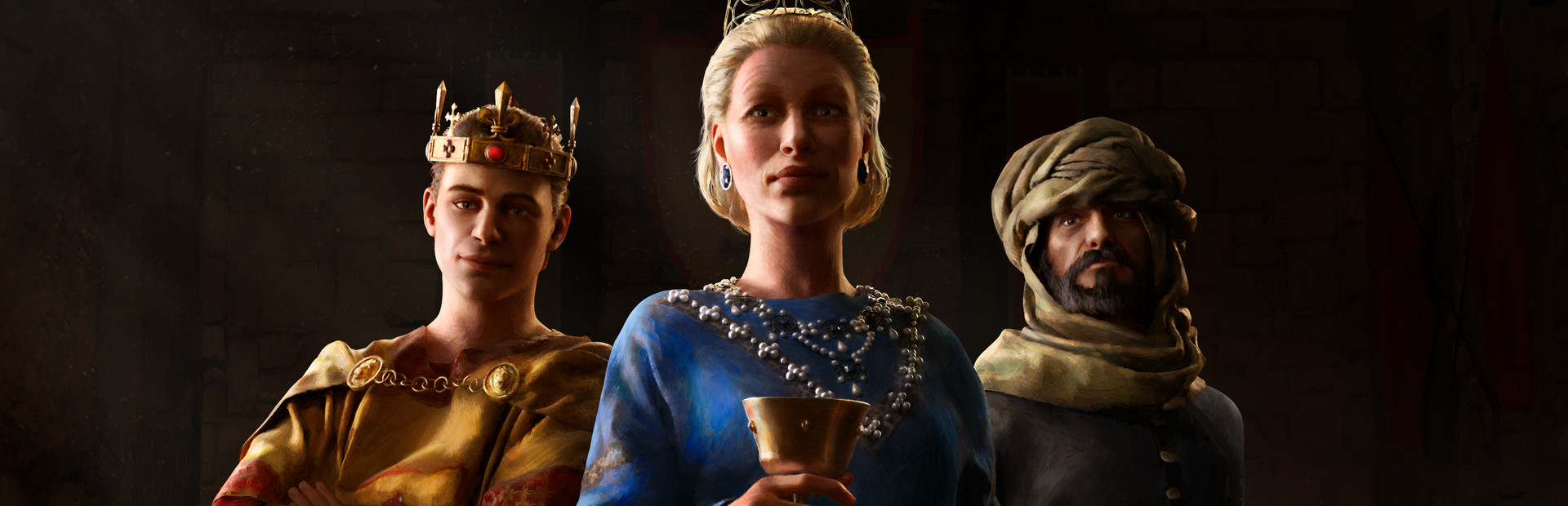

Crusader Kings III: Royal Court
Six hundred years of dynastic scheming with a throne room bolted on top. The culture rework is the real reason to play; the 3D court is set dressing you will stop looking at.
GamerScout Verdict
Best for patient roleplayers who want their culture, not their borders, to be the thing they built by 1300.
Compare Prices(4 stores)
Every store in this table quotes us in euros, so the EUR figure is the price the seller actually set, not our arithmetic — which is why EUR is also the currency we rank in. We only list an offer here when the store gives us its price in euros, so nothing in this table is a number we invented.
Pick USD, PLN, GBP, CAD or AUD in the header and we convert from EUR at the European Central Bank reference rate — converted amounts are prefixed with ~. Your bank or the store may apply a different rate at checkout. We never hide offers based on where you are: everyone sees this whole table.
We may earn a commission when you buy games through links on this page — at no extra cost to you. It never affects our rankings or verdicts.
Price History
Screenshots & Media
About Crusader Kings III: Royal Court
The first hour is a wall of tooltips, and the useful thing I can tell you is which parts of that wall you are allowed to ignore. You load in, pick a ruler, and get handed a character sheet with four skill trees, a stress meter, a succession law nobody explains properly, and a map where every county has a claim attached to it. With Royal Court running you also get a throne room glowing at you and a grandeur bar that starts complaining about your spending before you have any income worth spending. Most new players respond by trying to read all of it. Do not. This game asks you to learn roughly six systems across your first hundred hours, and hour one needs exactly two: who inherits when you die, and how to acquire more counties. Push through on that basis and the friction resolves inside about three sessions. Try to master your court on day one and you will bounce off it. Underneath the noise, this is a dynasty role-playing game that happens to own a map of Eurasia. You do not play a country, you play a specific greedy, gouty, ambitious person with traits, lovers, rivals and a lifespan. Armies are levies plus a small stack of men-at-arms you actually choose (pikemen to blunt cavalry charges, horse archers to shred them back), knights whose prowess decides more battles than raw numbers do, and a war score system that rewards sieging the correct holdings over doom-stacking. The other half is the scheme menu: seduce, murder, fabricate a claim, extract a hook on a bishop and blackmail him into voting your way. Royal Court layers a household onto that. Kings and emperors gain a physical court with grandeur expectations, hireable positions (a physician who keeps you breathing, an antiquarian who improves what your artisans produce, a bodyguard, a poet), commissioned artifacts, and a hold court screen where petitioners bring you their problems. The culture rework is the headline and genuinely the best structural change this game has had. Cultures are built from pillars now: an ethos, a language, a martial custom, an aesthetic, and a set of traditions you can swap at a cost in prestige and time. You can diverge from your parent culture to lock in something new, or hybridize with a neighbour you have conquered and thoroughly married into, producing a culture that did not exist in 867 and inherits innovations from both parents. Cultural acceptance turns conquest into a slow assimilation problem instead of a colour change on the map. For anyone who plays for the two-hundred-year arc, this is the system that finally makes the late game about something other than blob maintenance. My Norse-Andalusian hybrid, running coastal warfare traditions and a stone-and-plaster aesthetic, was mine in a way that a painted map never was. Artifacts feed the same loop, since funding an inspired craftsman gives your treasury a purpose once every building slot is full. Now the other side, because 42 percent positive is not a rounding error. The throne room is a diorama. You decorate it, you rotate the camera, and then you stop opening it, because nothing in that room is a decision with a real cost attached. Holding court degenerates into an event queue you clear with the first option, and grandeur functions mostly as a standing tax on your income with a red icon when you underpay. The rank gate stings too: you need to be a king or emperor to have a court at all, so a standard count start means dozens of hours before the content switches on. Meanwhile the part that actually changed the game, the culture system, shipped free in the accompanying patch for everyone, which left the paid half looking thin next to it. The war AI is still poor at operational movement, and the difficulty curve still inverts around your third generation once your income is real. So who should push through? Anyone who wants stories more than optimisation, and anyone willing to run a small count in Ireland in 867 with ironman switched off for the first two attempts. Learn partition succession, learn that stress kills, then start again as a king and let the court content come to you. Approached that way, the intimidating hour count stops being a barrier and becomes the point. If you want a tight tactical wargame, look elsewhere, because battles here resolve themselves while you are reading a marriage contract.

Strategy & simulation
Tags
System Requirements
Minimum
- Processor
- Intel® Core™ i3-2120 / AMD® FX 6350
- Memory
- 6 GB RAM
- Graphics
- Nvidia® GeForce™ GTX 660 (2GB)…
Recommended
- OS
- Windows® 10 Home 64 bit
- Processor
- Intel® Core™ i5-4670K / AMD® Ryzen™ 5 2400G
- Memory
- 8 GB RAM
- Graphics
- Nvidia® GeForce™ GTX 1650 (4GB) / AMD® Rade…
Keep exploring
Community Discussion
Be the first to comment on Crusader Kings III: Royal Court.
Reviews & Ratings
Game Info
- Developer
- Paradox Development Studio, Paradox Thalassic
- Publisher
- Paradox Interactive
- Release Date
- Feb 8, 2022