
Cities: Skylines - On Air Radio
A city builder forgiving enough that you can be wrong for two hours straight, then ruthless enough to show you exactly which intersection caused it. Bring 200 hours.
GamerScout Verdict
Best for tinkerers who want a forgiving mod-fed sandbox, not for anyone chasing a strict economic simulation.
Compare Prices(4 stores)
Every store in this table quotes us in euros, so the EUR figure is the price the seller actually set, not our arithmetic — which is why EUR is also the currency we rank in. We only list an offer here when the store gives us its price in euros, so nothing in this table is a number we invented.
Pick USD, PLN, GBP, CAD or AUD in the header and we convert from EUR at the European Central Bank reference rate — converted amounts are prefixed with ~. Your bank or the store may apply a different rate at checkout. We never hide offers based on where you are: everyone sees this whole table.
We may earn a commission when you buy games through links on this page — at no extra cost to you. It never affects our rankings or verdicts.
Price History
Screenshots & Media
About Cities: Skylines - On Air Radio
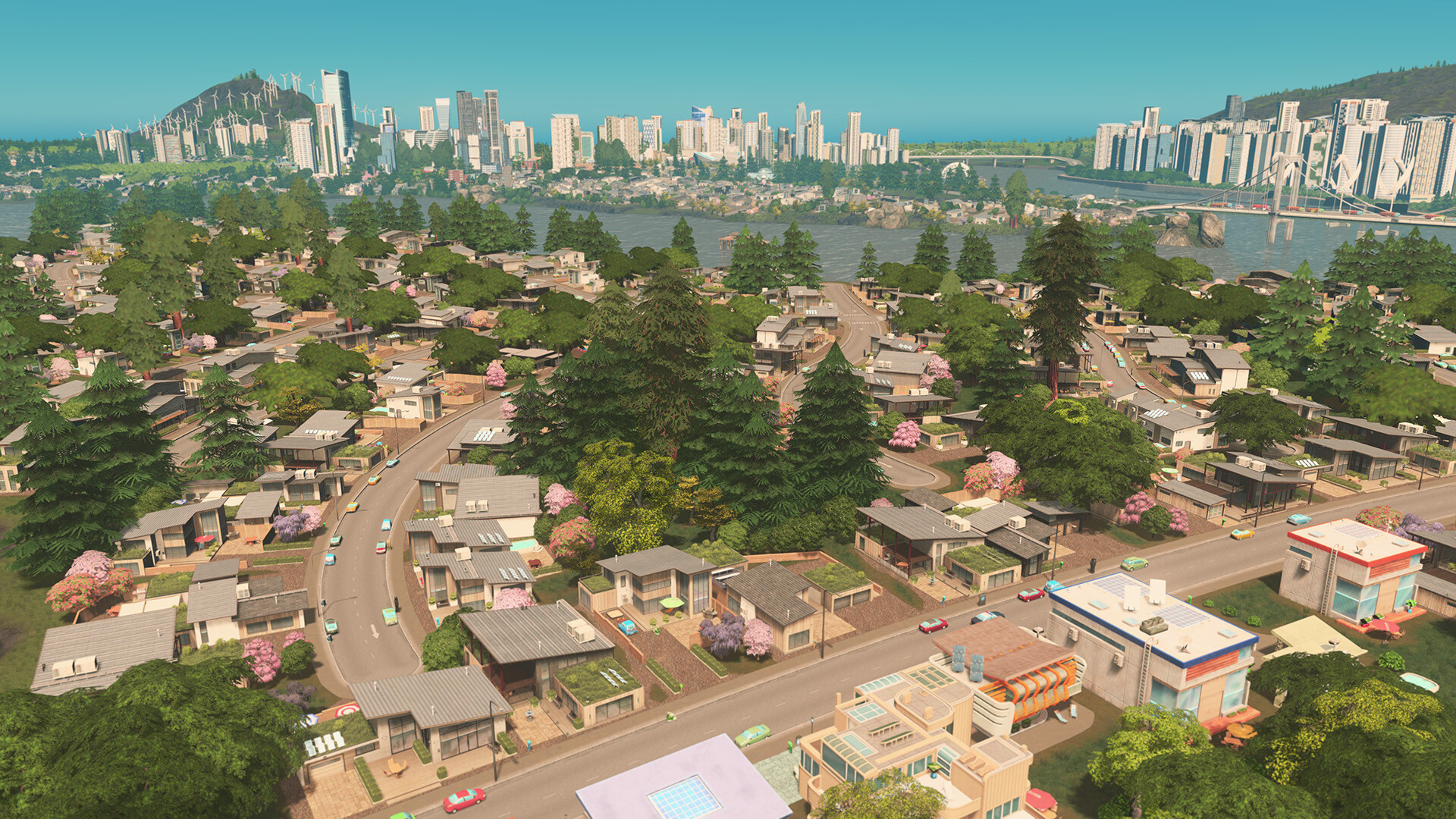
My first city died over a river. I put the water pumps downstream of the sewage outflow, ignored the little icons quietly turning grey, and by the time I looked up, a third of my population was sick, broke, or packing. Nothing warned me. The simulation just kept running, honestly and without comment, until the consequences arrived all at once. That is the appeal in miniature: a sandbox that lets you make a bad call, live inside it for a while, and then hands you the overlays to work out precisely where you went wrong. What you are managing is four or five interlocking grids. Zoning is the familiar residential, commercial and industrial split with density tiers, and demand for each is steered indirectly through land value, education level, pollution, and how far a citizen has to travel to reach a job. Under that sit the utility layers: water and sewage pipes, power lines and their coverage radii, garbage collection, healthcare, deathcare, each with a budget slider you can push to 150 percent to buy yourself breathing room during a crunch. The layer that actually decides whether your city functions is traffic. Every vehicle is an individual agent pathfinding to a real destination, so one badly connected highway ramp propagates backwards through half the map over about ten in-game minutes. Districts let you paint areas and apply local policies (recycling, high-tech industry only, heavy traffic bans), and public transport spans buses, metro, trains, ships and planes with routes and stops you place by hand. Add the map and asset editors plus Workshop support and the content ceiling effectively disappears. Now the part I always end up arguing: this is a genuinely good first sim, despite the hour counts you see attached to it. Progression is gated behind population milestones, and that gating works as a tutorial the game is too polite to label as one. You get a handful of services at a few hundred residents, and by the time districts, metro lines and the higher-density zones unlock, you have already learned budget management and coverage radii on a city small enough to fix. Money is forgiving too. Loans are cheap, the bulldozer costs nothing, and a failing district can simply be flattened and rebuilt. The build order that saves newcomers the most pain is boring and effective: never zone directly onto the highway connection, run one collector road inland first, keep blocks small so buildings actually reach the road, and put a roundabout on your first off-ramp before you think you need it. Do that and your first 20 hours are pleasant rather than a slow strangulation. Do the opposite and you learn the same lesson anyway, just louder. The weaknesses are real and worth pricing in. Traffic AI is the loudest one: agents pick lanes badly, queue in one lane while another sits empty, and will despawn when the jam gets bad enough, which papers over problems you would rather see. The economy is shallow once you are past roughly 50,000 residents, because taxes scale faster than costs and money stops being a constraint, leaving aesthetics and throughput as the only real goals. Late-game performance sags hard as agent counts climb, and a sprawling city will drag your framerate down regardless of your GPU. There is also the Paradox DLC situation, which is sprawling to the point of comedy (this very listing is a radio pack), and the honest truth that several fixes the base game needs, better lane control, free object placement, more buildable tiles, arrive through mods rather than patches. The sequel launched in 2023 and stumbled badly on performance, which is a large part of why this one is still the default recommendation years later. So: not a hard economic simulation, and anyone arriving from the tighter supply-chain sims will find the numbers underneath thinner than they want. What it is instead is the most approachable deep city builder on PC, with a mod ecosystem that has been maturing for a decade and a failure mode that teaches rather than punishes. Go in expecting a tinkering toy with a traffic puzzle bolted to it, budget a weekend for your first serious city, and install a traffic mod the moment your first intersection embarrasses you.

Strategy & simulation
Tags
System Requirements
Minimum
- Processor
- Intel® Core™ I7 930 | AMD® FX 6350
- Memory
- 8 GB RAM
- Graphics
- Nvidia…
Recommended
- OS
- Windows® 10 Home 64 bit
- Processor
- Intel® Core™ I7 2700K | AMD® Ryzen 7 2700X
- Memory
- 16 GB RAM
- Graphics
- Nvidia® GeForce™ GTX 580 (1.5 GB) | A…
Keep exploring
Community Discussion
Be the first to comment on Cities: Skylines - On Air Radio.
Reviews & Ratings
Game Info
- Developer
- Colossal Order
- Publisher
- Paradox Interactive
- Release Date
- Mar 10, 2015