
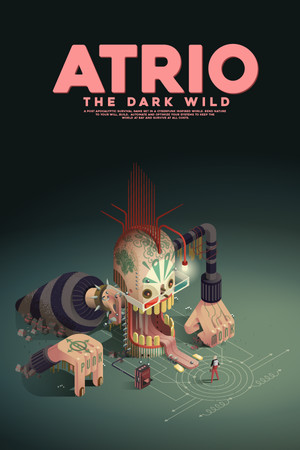
Atrio: The Dark Wild
If Factorio and a cyberpunk survival game had a small, weird indie baby, this is roughly what you'd get - a 20-25 hour automation campaign with creature-powered assembly lines and a surprisingly earnest story.
GamerScout Verdict
Best for automation newcomers and factory fans wanting a story-driven campaign with a creature-mechanics twist, not an infinite sandbox.
Compare Prices(3 stores)
Every store in this table quotes us in euros, so the EUR figure is the price the seller actually set, not our arithmetic — which is why EUR is also the currency we rank in. We only list an offer here when the store gives us its price in euros, so nothing in this table is a number we invented.
Pick USD, PLN, GBP, CAD or AUD in the header and we convert from EUR at the European Central Bank reference rate — converted amounts are prefixed with ~. Your bank or the store may apply a different rate at checkout. We never hide offers based on where you are: everyone sees this whole table.
We may earn a commission when you buy games through links on this page — at no extra cost to you. It never affects our rankings or verdicts.
Price History
Screenshots & Media
About Atrio: The Dark Wild
I went into Atrio: The Dark Wild expecting a budget Factorio clone and came out the other side genuinely surprised by how much personality a solo-dev automation game can pack into a hand-crafted open world. You play as a disposable android whose body literally dies without a constant power supply, which means every decision - where to drop a lamp, how to route your grav-pipe network, which creatures to capture first - carries real stakes from minute one. That survival pressure is what separates Atrio from the more relaxed factory-builder crowd, and it works. The production-line loop is built around farming, foraging, crafting, and capturing, and the creature mechanic is where the game earns its originality. Tornatoads act as automated crop harvesters, vacuuming fully grown shrooms and vegetables from planters from up to six blocks away. Pushback Splitters - which are effectively mechanical dogs you catch in the wild - handle item distribution across grav-pipe networks in the same role a splitter plays in Factorio or Satisfactory. Mini Deer can be slotted into paste-crafting stations to produce fuel and batteries. Every captured creature slots into a specific node in your assembly line, and routing them correctly is the satisfying core of mid-game play. Veterans of Factorio will recognise the logic immediately; newcomers will find the creature framing genuinely helps explain why each component exists. For automation newcomers, this is actually a well-paced entry point. The campaign's roughly 25-hour runtime forces you to build incrementally - stone tools and basic conveyors before you're dealing with Shroom Fuel and multi-stage crafting chains. The pacing respects the genre's learning curve better than most. What it does not do well is communicate its own interface conventions. Keybindings ignore standard factory-game shortcuts, building rotation on structures like the planter is limited to two orientations instead of four, and the isometric camera angle can make conveyor placement genuinely ambiguous. These are friction points that experienced builders will find more irritating than beginners, because the expectation gap is wider. The atmosphere deserves a mention. Neon light cutting through total darkness is a strong visual hook, and the world's quiet question of "where did all the humans go" gives the campaign a low-key narrative pull that most factory games skip entirely. The writing aims for dry comedy and lands it occasionally - the player community fondly references a running gag about watermelons - though the combat encounters scattered through exploration feel underbaked and annoying rather than tense. The community has raised concerns about the pace of post-launch updates, with some players flagging possible development slowdown, so manage expectations on long-term content support. Bottom line for strategy and sim players: Atrio is not trying to out-depth Factorio, and the critics who called it lacking in complexity are not wrong. What it is, is a focused, atmospheric, mechanically inventive 25-hour campaign that does something genuinely fresh with the creature-as-factory-component idea. If you want a complete, story-driven automation experience rather than an infinite sandbox, that trade-off is absolutely worth it. If you need belt-laying complexity at Factorio scale, look elsewhere.

Strategy & simulation
Tags
System Requirements
Minimum
- OS
- Windows 10
- Processor
- Intel Core i5-8250U
- Memory
- 2 GB RAM
- Graphics
- Intel HD
- Storage
- 4 GB available space
Recommended
Requires a 64-bit processor and operating system
Keep exploring
Community Discussion
Be the first to comment on Atrio: The Dark Wild.
Reviews & Ratings
Game Info
- Developer
- Isto Inc.
- Publisher
- Isto Inc.
- Release Date
- Jan 10, 2023