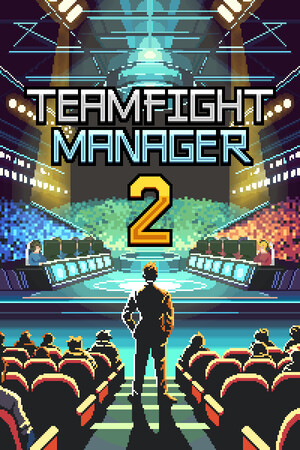
Teamfight Manager 2
If you ever yelled at a pro player's draft from your couch, this is your game. Sit in the manager's chair of a fictional MOBA org and find out how hard roster-building and ban-pick actually are.
GamerScout Verdict
Best for MOBA-literate players who want to theorize about draft and roster depth and can stomach Early Access AI rough edges.
Compare Prices(4 stores)
Every store in this table quotes us in euros, so the EUR figure is the price the seller actually set, not our arithmetic — which is why EUR is also the currency we rank in. We only list an offer here when the store gives us its price in euros, so nothing in this table is a number we invented.
Pick USD, PLN, GBP, CAD or AUD in the header and we convert from EUR at the European Central Bank reference rate — converted amounts are prefixed with ~. Your bank or the store may apply a different rate at checkout. We never hide offers based on where you are: everyone sees this whole table.
We may earn a commission when you buy games through links on this page — at no extra cost to you. It never affects our rankings or verdicts.
Price History
Screenshots & Media
About Teamfight Manager 2
I spent the first hour of Teamfight Manager 2 convinced I was smarter than every coach in the league. By hour three the transfer market had humiliated me, my jungler had blown Serpen for the fourth match in a row, and I was frantically rewriting my tactics presets at halftime like a man who absolutely does not have it together. That feedback loop, frustrating and gripping in equal measure, is exactly what this game is selling. The core structure is a Football Manager-style esports sim wrapped around a fictional MOBA. You do not touch the mouse during matches. The AI-driven players handle laning, farming, objective control, and teamfighting autonomously across a full five-role map with Top, Jungle, Mid, Bottom, and Support. Your levers are the draft, pre-match tactics, per-player item loadouts, training schedules, scouting, and contracts. The champion pool ships at 60 at Early Access launch, split across Melee, Ranged, Mage, Support, and Assassin classes, with three abilities and an ultimate that unlocks at level five. Two map objectives drive the macro rhythm: Serpen on the bottom side, which stacks permanent team-wide stat buffs per kill, and Morgard late, a siege-minion empowerment that functions more like a closing tool than a raw numbers spike. Knowing when to contest or concede each one is where most of the draft depth actually lives. The management layer goes deeper than the original. Each player carries 14 trainable stats including last-hitting, skill dodging, map awareness, and mental toughness. Behavior stats like judgment outperform raw mechanical numbers in longer matches, which flips the obvious "recruit the highest-rated player" instinct on its head. Players age out in their late twenties, stress spikes tank in-game performance, and a language mismatch between a player and the rest of the roster creates real communication penalties until it is trained away. The Auto Patch System is the standout systemic idea: the engine collects per-champion win-rate data each season and auto-balances the pool internally, independent of developer patches, so your pocket picks and ban priorities shift organically across a long save. Now for the honest part. Steam reviews are sitting at Mixed, and the complaints are real. The match AI makes decisions that range from questionable to actively infuriating, particularly in jungle pathing and objective priority. Player stat weighting feels opaque early on, with some reviewers noting a low-stat player performing comparably to a high-stat one in early divisions, which makes scouting feel arbitrary until the systems click. The transfer market is the other sore spot: AI teams refuse offers with broken logic, the contract negotiation UI is undercooked, and the short transfer windows punish you for the market's own dysfunction. Team Samoyed shipped six patches in the first launch week and has maintained a near-daily cadence since, directly addressing AI roster behavior, transfer distribution, pick-ban performance drops, and memory issues. The velocity is encouraging. The roughness is still visible. Steam Workshop launched alongside the game, and within 24 hours the community had uploaded real-world rosters covering major leagues. If the fictional setting was the only thing keeping you out, that barrier is already gone. The online league mode is functional at launch, cross-platform multiplayer is supported, and the modding infrastructure is genuinely well-built for a small indie studio this early in EA. This is not a finished product and Team Samoyed is not pretending it is. The 1-to-2-year EA window they have projected is realistic given the scope. If you need polished AI and a tight management UI right now, sit this one out and check back after a few major updates. If you are the kind of person who has strong opinions about lane assignments and ban priority, and you want a sim that takes those opinions seriously, the foundation here is solid enough to get lost in.

Shooters
Tags
System Requirements
Minimum
- OS
- Windows 10
- Memory
- 8 GB RAM
- DirectX
- Version 10
- Storage
- 10 GB available space
- Graphics
- 3D Accelerated Card (Not Integrated)
- Processor
- 2.8 Ghz
- Sound Card
- Yes.
Recommended
- OS
- Windows 10
- Memory
- 16 GB RAM
- DirectX
- Version 10
- Storage
- 20 GB available space
- Graphics
- 3D Accelerated Card (Not Integrated)
- Processor
- 3 Ghz+
- Sound Card
- Yes.
Keep exploring
Community Discussion
Be the first to comment on Teamfight Manager 2.
Reviews & Ratings
No ratings available
Game Info
- Developer
- Team Samoyed
- Publisher
- Team Samoyed
- Release Date
- May 25, 2026