
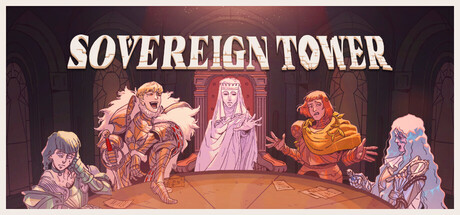
Sovereign Tower
A knight-wrangling management RPG where the hard part is scheduling: read every grievance, watch your best plan collapse, then rewind and do the month over with better information.
GamerScout Verdict
For story-first players who like spreadsheets with feelings and will happily rerun a doomed timeline to fix one conversation.
Compare Prices(6 stores)
Every store in this table quotes us in euros, so the EUR figure is the price the seller actually set, not our arithmetic — which is why EUR is also the currency we rank in. We only list an offer here when the store gives us its price in euros, so nothing in this table is a number we invented.
Pick USD, PLN, GBP, CAD or AUD in the header and we convert from EUR at the European Central Bank reference rate — converted amounts are prefixed with ~. Your bank or the store may apply a different rate at checkout. We never hide offers based on where you are: everyone sees this whole table.
We may earn a commission when you buy games through links on this page — at no extra cost to you. It never affects our rankings or verdicts.
Price History
Screenshots & Media
About Sovereign Tower
The first thing Sovereign Tower asks of you is patience with paperwork, and I say that as someone who reads every tooltip twice. There is no reflex test here, no timing window, nothing that punishes you for putting the controller down mid-sentence. What it wants instead is attention: the willingness to read a knight's grievance, remember who insulted whom three quests ago, and accept that your carefully assigned roster is going to fail in ways you did not see coming. Give it that, and it starts paying out in the currency I actually care about, which is characters who change shape depending on what you asked of them. You play the Sovereign of a magical tower, which in practice means you sit at the head of a Round Table and decide who goes where. Knights get recruited, quests get assigned, outcomes come back, and the kingdom's fortunes move accordingly. The wrinkle is that the knights are people rather than stat blocks in hats. They have egos, opinions about each other, and strong feelings about being handed the errand nobody wanted. Sending your most capable knight on every important job is the obvious play and also the fastest way to poison the table. When a run collapses, and it will, you turn back time. What you learned carries over even when the calendar does not, so the second pass through a disaster is less about grinding numbers and more about knowing which door to open earlier. The loop is where the writing earns its keep. Rewinding does real narrative work: it is the retrieval mechanism for everything the game deliberately withholds on a first pass. You pry a secret loose in one timeline and spend the next one leveraging it, and the dialogue is written to notice. That is the test I apply to any game built on repetition. Does the second read reward you, or does it just charge you the same twenty minutes again. Sovereign Tower mostly passes. The knights are written as genuine eccentrics instead of quirk-dispensers, and their arcs land differently depending on whether you treated them as a resource or a person. The strongly positive reception since its August 2026 launch tracks with what I felt around the point where a knight I had been quietly overworking finally said something about it. It is not friction-free. The middle stretch is where the seams show. Once you have internalized the assignment logic, a chunk of the quest flow turns administrative, and you are confirming outcomes you can already predict just to reach the next story beat. Repeated timelines make that worse before they make it better, because a rewind resets the busywork along with the mysteries, and there is no skip button for a Sovereign who already knows how this month goes. The ego management is also more legible than it first appears. After a while you can feel the thresholds sitting under the personalities, and the drama flattens into a meter you top up. This is a single-player PC release with no real combat layer either, so if you were hoping for tactical encounters to break up the admin, that itch stays unscratched. Who should play it: anyone who liked the idea of a kingdom sim but wanted the people inside it to talk back, and anyone who has ever restarted an RPG purely to see how one conversation goes the other way. The accessibility side helps, with save-anytime, no timed inputs, Steam Cloud and full controller support including DualSense, so it works as a slow evening game in forty-minute pieces without punishing you for stepping away. If you need loot, builds and a skill tree to optimize, look elsewhere, because the only thing you are optimizing here is a group of proud people who do not want to be optimized. If you want a campaign that ends with you realizing your favorite knight had you pegged from the first meeting, the tower has a chair waiting.

RPGs
Tags
System Requirements
Minimum
- OS
- 10
- Processor
- Intel Core i5-7600K
- Memory
- 8 GB RAM
- Graphics
- GTX 970, 4GB VRAM
- Storage
- 3 GB available space
Recommended
- OS
- 11
- Processor
- Intel Core i5-9600K
- Memory
- 8 GB RAM
- Graphics
- GTX 1060, 6GB VRAM
- DirectX
- Version 12
- Storage
- 3 GB available space
Keep exploring
Community Discussion
Be the first to comment on Sovereign Tower.
Reviews & Ratings
Game Info
- Developer
- WILD WITS GAMES
- Publisher
- Curve Games
- Release Date
- Aug 6, 2026
