
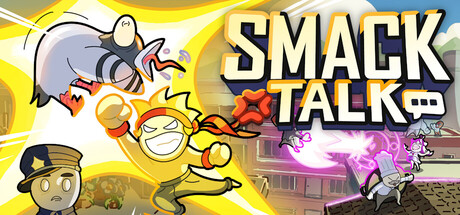
Compare Smack Talk prices across trusted key stores and find the best deal. Developed by Monchii Studio. Published by Monchii Studio. Released on 8/27/2026. Available on PC, Mac, Linux. Genres: Action, Casual, Indie.

A voice-controlled platform fighter that costs you an hour of mic wrangling and whatever dignity you had left, then pays it back in eight-player lobbies where listening is your best defense.

My first hour was less fighting game and more audio troubleshooting, and I say that as someone who keeps a spare headset on the desk for exactly this reason. Voice is the input layer here, so the usual ritual of remapping keys and dialling in sensitivity gets replaced by mic gain, push-to-talk placement, and learning to say a move name the same way twice. There is a genuine wall in there. You will call something, get nothing, call it louder, get the wrong thing, and briefly wonder whether the entire premise is a bit. Push through it. Once your mic is set and your brain stops treating spoken commands as a party trick, the input starts behaving like an input, and the game sitting underneath is sharper than the pitch makes it sound. What you are actually buying is a 1 to 8 player online PvP platform fighter where your voice fires the attacks. Movement and positioning stay on the stick or the keyboard (controller support is in and works fine), while everything offensive routes through what you say out loud. Call a move, land it, stack pressure, and eventually shout your way into an ultimate that ends the round in a way the lobby will bring up later. The one-liners are structural rather than decorative. Trash talk is a mechanic in the literal sense that talking is how you fight, which means a silent lobby feels broken in a way no other multiplayer game manages. The eight-player ceiling is the smart call. Platform fighters usually get unreadable past four, but the voice layer turns a crowded stage into something you can parse, because you hear what is coming roughly a half second before it lands. That is the real competitive texture, and it took me a couple of nights to notice: listening is defense. Someone calls a big commitment from across the stage and you get an honest window to punish, so the skill curve ends up being about voice discipline as much as spacing. Strong players get quiet, short and clipped. Weak players narrate everything they are about to do. On gear, a boom mic beats a desk condenser here, not for tone but for consistency, and anything that picks up your flatmate is going to cost you a stock. The problems are the ones you would predict from the concept. Voice is a slower, noisier input than a button, so the execution ceiling sits well below a traditional platform fighter and the top of the skill tree is reads and timing rather than mechanical precision. If you want frame-perfect strings, this is not that, and no patch is going to make it that. Recognition is also unforgiving of heavy accents, background noise, and anyone playing at 1am in a shared flat, which quietly excludes a slice of the audience that the store page will never mention. It is worth being blunt about the shelf-life question too. It arrived to an overwhelmingly positive reception across roughly a thousand reviews, which is a strong opening, but a game this dependent on group energy lives or dies on whether lobbies stay populated and whether Monchii keeps feeding it. If you came looking for a ranked ladder to grind past plat, temper that expectation now and treat this as a games-night fixture instead of a main. So who is it for. Anyone with three to seven friends, a voice channel that is already open most evenings, and enough tolerance to sound ridiculous in front of them. It is one of very few multiplayer games where the people who normally sit muted in comms are structurally forced to participate, and that alone changes the temperature of a lobby within about five minutes. Solo queue is a much thinner proposition, because half the appeal is knowing the person you just deleted. Play it with people you can embarrass, on a headset with a boom, in a room where you can raise your voice without apologising. Skip it if your setup means whispering, or if your idea of a good fighting game is lab time and combo notation. I came for a novelty and stayed because the eight-player rounds are the funniest thirty seconds I have had in a PvP game this year. Fred, Scout Team

Smack Talk

Smack Talk

Aug 27, 2026Monchii Studio
GamerScout Says

A voice-controlled platform fighter that costs you an hour of mic wrangling and whatever dignity you had left, then pays it back in eight-player lobbies where listening is your best defense.

PCMacLinux
Best Price Available
€3.99-35%
at Steam
Lowest tracked: €3.99
Track this price

GamerScout Verdict

Worth it with a full voice channel and no shame; skip it if you need frame-perfect execution or quiet late-night sessions.

Compare Prices(1 stores)

SteamBest price
StandardEurope (EU)Steam KeyKey
€3.99-35%
Priced in EUR by the store
Buy

Every store in this table quotes us in euros, so the EUR figure is the price the seller actually set, not our arithmetic — which is why EUR is also the currency we rank in. We only list an offer here when the store gives us its price in euros, so nothing in this table is a number we invented.

Pick USD, PLN, GBP, CAD or AUD in the header and we convert from EUR at the European Central Bank reference rate — converted amounts are prefixed with ~. Your bank or the store may apply a different rate at checkout. We never hide offers based on where you are: everyone sees this whole table.

We may earn a commission when you buy games through links on this page — at no extra cost to you. It never affects our rankings or verdicts.

Price History

Lowest tracked
€3.9929 Aug 2026
Current best
€3.99
Lowest since we started tracking
Official stores
€3.67€3.88€4.10€4.3129 Aug30 Aug31 Aug
Tracking prices since 29 Aug 2026
Create alert

Screenshots & Media

About Smack Talk

My first hour was less fighting game and more audio troubleshooting, and I say that as someone who keeps a spare headset on the desk for exactly this reason. Voice is the input layer here, so the usual ritual of remapping keys and dialling in sensitivity gets replaced by mic gain, push-to-talk placement, and learning to say a move name the same way twice. There is a genuine wall in there. You will call something, get nothing, call it louder, get the wrong thing, and briefly wonder whether the entire premise is a bit. Push through it. Once your mic is set and your brain stops treating spoken commands as a party trick, the input starts behaving like an input, and the game sitting underneath is sharper than the pitch makes it sound. What you are actually buying is a 1 to 8 player online PvP platform fighter where your voice fires the attacks. Movement and positioning stay on the stick or the keyboard (controller support is in and works fine), while everything offensive routes through what you say out loud. Call a move, land it, stack pressure, and eventually shout your way into an ultimate that ends the round in a way the lobby will bring up later. The one-liners are structural rather than decorative. Trash talk is a mechanic in the literal sense that talking is how you fight, which means a silent lobby feels broken in a way no other multiplayer game manages. The eight-player ceiling is the smart call. Platform fighters usually get unreadable past four, but the voice layer turns a crowded stage into something you can parse, because you hear what is coming roughly a half second before it lands. That is the real competitive texture, and it took me a couple of nights to notice: listening is defense. Someone calls a big commitment from across the stage and you get an honest window to punish, so the skill curve ends up being about voice discipline as much as spacing. Strong players get quiet, short and clipped. Weak players narrate everything they are about to do. On gear, a boom mic beats a desk condenser here, not for tone but for consistency, and anything that picks up your flatmate is going to cost you a stock. The problems are the ones you would predict from the concept. Voice is a slower, noisier input than a button, so the execution ceiling sits well below a traditional platform fighter and the top of the skill tree is reads and timing rather than mechanical precision. If you want frame-perfect strings, this is not that, and no patch is going to make it that. Recognition is also unforgiving of heavy accents, background noise, and anyone playing at 1am in a shared flat, which quietly excludes a slice of the audience that the store page will never mention. It is worth being blunt about the shelf-life question too. It arrived to an overwhelmingly positive reception across roughly a thousand reviews, which is a strong opening, but a game this dependent on group energy lives or dies on whether lobbies stay populated and whether Monchii keeps feeding it. If you came looking for a ranked ladder to grind past plat, temper that expectation now and treat this as a games-night fixture instead of a main. So who is it for. Anyone with three to seven friends, a voice channel that is already open most evenings, and enough tolerance to sound ridiculous in front of them. It is one of very few multiplayer games where the people who normally sit muted in comms are structurally forced to participate, and that alone changes the temperature of a lobby within about five minutes. Solo queue is a much thinner proposition, because half the appeal is knowing the person you just deleted. Play it with people you can embarrass, on a headset with a boom, in a room where you can raise your voice without apologising. Skip it if your setup means whispering, or if your idea of a good fighting game is lab time and combo notation. I came for a novelty and stayed because the eight-player rounds are the funniest thirty seconds I have had in a PvP game this year.
Fred
Fred · Scout Team

Shooters

Tags

multiplayerpvponline-pvpachievementscontroller-supportVoice ControlledPlatform FighterParty Brawler8-Player LobbiesFriend Group GameComedyLow Execution BarrierMic Required

System Requirements

Minimum

OS
10
Memory
8 GB RAM
Storage
2 GB available space
Graphics
not potato
Processor
not potato
VR Support
no

Recommended

OS
10
Memory
16 GB RAM
Storage
2 GB available space
Graphics
not potato
Processor
not potato
VR Support
no

Keep exploring

Community Discussion

Be the first to comment on Smack Talk.

Reviews & Ratings

Steam
96%(959)

Game Info

Developer
Monchii Studio
Publisher
Monchii Studio
Release Date
Aug 27, 2026

Price Alert

Get notified when the price drops below your target!

Create Alert
Best price€3.99
See offer

Across the 24,049 games we track, a verified key was cheaper than the official store 90% of the time. See the method and the full numbers in our game price report.

No card? Pay another way

Top up your Steam Wallet or buy crypto with any card — instant delivery, no bank account needed.

Buy smarter: helpful guides

Looking for more? See games like Smack Talk →

Frequently asked questions about Smack Talk

How much does Smack Talk cost?

As of 31 August 2026, the cheapest in-stock offer for Smack Talk is €3.99 at Steam, out of 1 live offers we track across verified key stores. Prices change daily — the table on this page is refreshed continuously.

Where can I buy Smack Talk cheapest?

The lowest in-stock price we track for Smack Talk is €3.99 at Steam (31 August 2026). We compare 1 live offers from verified key stores — the full table with every store and its trust score is on this page.

What platforms is Smack Talk available on?

Smack Talk is available on PC, Mac, Linux.

When was Smack Talk released?

Smack Talk was released on 27 August 2026.

Who developed Smack Talk?

Smack Talk was developed by Monchii Studio.