
Compare Polyball prices across trusted key stores and find the best deal. Developed by Studio Monolith. Published by Studio Monolith. Released on 12/1/2017. Available on PC. Genres: Action, Casual, Indie, Racing, Simulation.

Restart-until-perfect ball rolling that lives or dies on a gamepad. Brilliant in five-minute solo bursts, gloriously stupid with three friends crammed onto one couch.

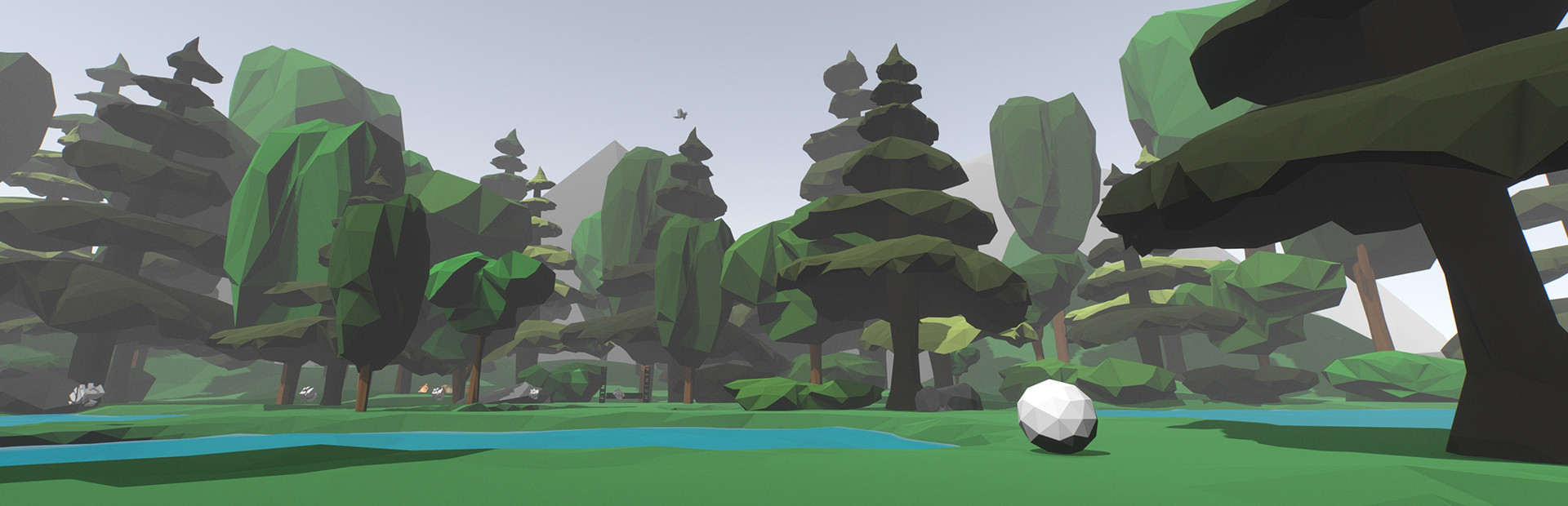
Fourth run at the same banked corner, and I stabbed the stick instead of feathering it. The ball drifted a hair wide, clipped the lip of the track, and dropped into open space while the timer kept counting like it was laughing at me. Restart was instant, no loading, no menu. Attempt five I eased into the same corner, carried the momentum through the exit, and knocked a second and a half off my own best. Then I did it eleven more times because I was convinced there was another half second hiding in the second half of the course. That compulsive one-more-go rhythm is the whole pitch here, and when it clicks it is genuinely hard to put the pad down. What you are actually playing is a time attack built around momentum rather than jumping. You steer a rolling ball through obstacle courses full of ramps, narrow ledges, boost strips and gaps, and the skill is entirely in how you manage speed you already have. Braking is usually the wrong answer. Learning where to let the ball run wide and where to pinch the line is the right one. Studio Monolith clearly took notes from Trackmania's restart loop and from the old Monkey Ball school of punishment, where one greedy input undoes ninety seconds of clean driving. Steam Leaderboards give the whole thing a spine, because a course you thought you had beaten suddenly looks sloppy next to someone two seconds ahead of you. Add the level editor and Workshop support and the course list keeps growing well past what shipped in the box back in December 2017. On the couch it turns into something else entirely. Split screen supports competitive and co-op play, there is online PvP and online co-op for people who are not in the same room, and Remote Play Together covers the friends who are technically in the same room but live four hours away. Four players on one screen is the mode I keep coming back to. Nobody needs a tutorial, everybody understands "do not fall off", and the failure state is funny rather than humiliating. It reads the room well at a party, and the short course lengths mean losers are back in the next round within seconds instead of watching someone else finish. That said, playing this on a keyboard is a genuinely bad time. Fine stick control is the entire game, and digital inputs give you full lock or nothing. A controller is not a nice-to-have, it is the price of entry. The rough edges are real and the mixed Steam reception is fair. The camera is the biggest offender, especially on tight vertical sections and around loops, where it swings just enough to cost you a run you did not deserve to lose. Difficulty scaling is spiky rather than smooth, so you can cruise through a stretch of courses and then hit a wall that expects near-frame-perfect commitment. Physics can occasionally feel inconsistent on collisions, which is poison in a genre where you need to trust that the same input produces the same result every single time. And the online side is thin. Matchmaking depends entirely on other people being there, and this is not a game with a bustling lobby list, so treat online PvP as a bonus for a pre-arranged group rather than a reliable feature. Solo players who want structure and progression rather than raw leaderboard chasing will probably run out of motivation before the course list runs out of content. So, who is this for. If you have a pad, a competitive streak, and a taste for shaving hundredths off a run you already technically completed, you will get plenty out of this. If you host game nights and need something with a thirty second learning curve that four people can pick up half-attentively, it is a strong addition to that rotation. If you want a polished single-player campaign with a clean difficulty curve and a camera that never betrays you, look elsewhere, because this one asks you to forgive some jank in exchange for a very satisfying skill loop. I would happily leave it installed for party nights and dip back in solo whenever a friend beats one of my times, which, annoyingly, keeps happening. Riley, Scout Team

Polyball

Polyball

Dec 1, 2017Studio Monolith
GamerScout Says

Restart-until-perfect ball rolling that lives or dies on a gamepad. Brilliant in five-minute solo bursts, gloriously stupid with three friends crammed onto one couch.

PC
Best Price Available
€3.99
at Steam
Lowest tracked: €3.99
Track this price

GamerScout Verdict

Worth it for pad-owning leaderboard chasers and four-player couch nights; skip if you play on keyboard or need busy online lobbies.

Compare Prices(3 stores)

SteamBest price
StandardEurope (EU)Steam KeyKey
€3.99
Priced in EUR by the store
Buy
StandardGlobalSteam KeyKey
€8.42
Priced in EUR by the store
Buy
StandardGlobalSteam KeyKey
€14.99
Priced in EUR by the store
Buy

Every store in this table quotes us in euros, so the EUR figure is the price the seller actually set, not our arithmetic — which is why EUR is also the currency we rank in. We only list an offer here when the store gives us its price in euros, so nothing in this table is a number we invented.

Pick USD, PLN, GBP, CAD or AUD in the header and we convert from EUR at the European Central Bank reference rate — converted amounts are prefixed with ~. Your bank or the store may apply a different rate at checkout. We never hide offers based on where you are: everyone sees this whole table.

We may earn a commission when you buy games through links on this page — at no extra cost to you. It never affects our rankings or verdicts.

Price History

Lowest tracked
€3.993 Sept 2026
Current best
€3.99
Lowest since we started tracking
Official stores
€3.67€3.88€4.10€4.313 Sept4 Sept5 Sept6 Sept
Tracking prices since 3 Sept 2026
Create alert

Screenshots & Media

About Polyball

Fourth run at the same banked corner, and I stabbed the stick instead of feathering it. The ball drifted a hair wide, clipped the lip of the track, and dropped into open space while the timer kept counting like it was laughing at me. Restart was instant, no loading, no menu. Attempt five I eased into the same corner, carried the momentum through the exit, and knocked a second and a half off my own best. Then I did it eleven more times because I was convinced there was another half second hiding in the second half of the course. That compulsive one-more-go rhythm is the whole pitch here, and when it clicks it is genuinely hard to put the pad down. What you are actually playing is a time attack built around momentum rather than jumping. You steer a rolling ball through obstacle courses full of ramps, narrow ledges, boost strips and gaps, and the skill is entirely in how you manage speed you already have. Braking is usually the wrong answer. Learning where to let the ball run wide and where to pinch the line is the right one. Studio Monolith clearly took notes from Trackmania's restart loop and from the old Monkey Ball school of punishment, where one greedy input undoes ninety seconds of clean driving. Steam Leaderboards give the whole thing a spine, because a course you thought you had beaten suddenly looks sloppy next to someone two seconds ahead of you. Add the level editor and Workshop support and the course list keeps growing well past what shipped in the box back in December 2017. On the couch it turns into something else entirely. Split screen supports competitive and co-op play, there is online PvP and online co-op for people who are not in the same room, and Remote Play Together covers the friends who are technically in the same room but live four hours away. Four players on one screen is the mode I keep coming back to. Nobody needs a tutorial, everybody understands "do not fall off", and the failure state is funny rather than humiliating. It reads the room well at a party, and the short course lengths mean losers are back in the next round within seconds instead of watching someone else finish. That said, playing this on a keyboard is a genuinely bad time. Fine stick control is the entire game, and digital inputs give you full lock or nothing. A controller is not a nice-to-have, it is the price of entry. The rough edges are real and the mixed Steam reception is fair. The camera is the biggest offender, especially on tight vertical sections and around loops, where it swings just enough to cost you a run you did not deserve to lose. Difficulty scaling is spiky rather than smooth, so you can cruise through a stretch of courses and then hit a wall that expects near-frame-perfect commitment. Physics can occasionally feel inconsistent on collisions, which is poison in a genre where you need to trust that the same input produces the same result every single time. And the online side is thin. Matchmaking depends entirely on other people being there, and this is not a game with a bustling lobby list, so treat online PvP as a bonus for a pre-arranged group rather than a reliable feature. Solo players who want structure and progression rather than raw leaderboard chasing will probably run out of motivation before the course list runs out of content. So, who is this for. If you have a pad, a competitive streak, and a taste for shaving hundredths off a run you already technically completed, you will get plenty out of this. If you host game nights and need something with a thirty second learning curve that four people can pick up half-attentively, it is a strong addition to that rotation. If you want a polished single-player campaign with a clean difficulty curve and a camera that never betrays you, look elsewhere, because this one asks you to forgive some jank in exchange for a very satisfying skill loop. I would happily leave it installed for party nights and dip back in solo whenever a friend beats one of my times, which, annoyingly, keeps happening.

Riley
Riley · Scout Team

Sports & racing

Tags

auto-admittedBall RollingTime AttackPhysics PlatformerMomentum ControlLocal Split-ScreenCouch CompetitiveWorkshop LevelsGamepad FirstLeaderboard ChasingRemote Play TogetherPrecision PlatformingTrial And ErrorShort Session FriendlyParty Night MultiplayerSpeedrun FriendlyHigh Skill CeilingController EssentialRestart Spam

System Requirements

Minimum

Processor
Intel Core2 Duo 2.0 GHz (or AMD equivalent)
Memory
4 GB RAM
Graphics
NVIDIA GeForce 8800GT / ATI Radeon HD 3870 / Intel HD Graphics 4000
Storage
8 GB available space

Recommended

Processor
Intel Quad Core i5 @ 2.5 GHz (or AMD equivalent)
Memory
6 GB RAM
Graphics
NVIDIA GeForce GTX 460 / AMD Radeon HD 7800 series
Storage
8 GB available space

Keep exploring

Community Discussion

Be the first to comment on Polyball.

Reviews & Ratings

Steam
69%(1,224)

Game Info

Developer
Studio Monolith
Publisher
Studio Monolith
Release Date
Dec 1, 2017

Features

Single-playerMultiplayerPvPOnline PvPShared/Split Screen PvPCo-opOnline Co OpShared/Split Screen Co Op+12 more

Price Alert

Get notified when the price drops below your target!

Create Alert
Best price€3.99
See offer

Across the 24,305 games we track, a verified key was cheaper than the official store 90% of the time. See the method and the full numbers in our game price report.

No card? Pay another way

Top up your Steam Wallet or buy crypto with any card — instant delivery, no bank account needed.

Buy smarter: helpful guides

Looking for more? See games like Polyball →

Frequently asked questions about Polyball

How much does Polyball cost?

As of 6 September 2026, the cheapest in-stock offer for Polyball is €3.99 at Steam, out of 3 live offers we track across verified key stores. Prices change daily — the table on this page is refreshed continuously.

Where can I buy Polyball cheapest?

The lowest in-stock price we track for Polyball is €3.99 at Steam (6 September 2026). We compare 3 live offers from verified key stores — the full table with every store and its trust score is on this page.

What platforms is Polyball available on?

Polyball is available on PC.

When was Polyball released?

Polyball was released on 1 December 2017.

Who developed Polyball?

Polyball was developed by Studio Monolith.