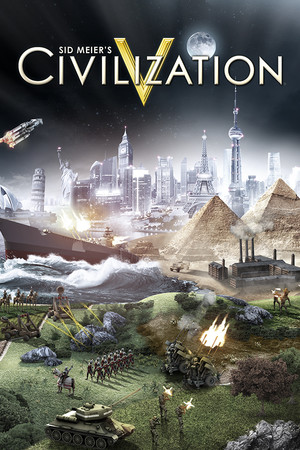
Sid Meier's Civilization® V
Few strategy games have the staying power to sit at 96% positive after 200,000 Steam reviews and still pull newcomers in. With both expansions, Civ V is the most complete the series ever felt before Firaxis moved on.
GamerScout Verdict
9/10Best for strategy fans who want a complete, mod-friendly 4X experience and are willing to grab both expansions to unlock the full game.
Compare Prices(5 stores)
Every store in this table quotes us in euros, so the EUR figure is the price the seller actually set, not our arithmetic — which is why EUR is also the currency we rank in. We only list an offer here when the store gives us its price in euros, so nothing in this table is a number we invented.
Pick USD, PLN, GBP, CAD or AUD in the header and we convert from EUR at the European Central Bank reference rate — converted amounts are prefixed with ~. Your bank or the store may apply a different rate at checkout. We never hide offers based on where you are: everyone sees this whole table.
We may earn a commission when you buy games through links on this page — at no extra cost to you. It never affects our rankings or verdicts.
Price History
Screenshots & Media
About Sid Meier's Civilization® V
I have a spreadsheet that logs my Civ V win rates by leader and victory type across difficulty settings, so take this review as what it is: the opinion of someone who has spent an embarrassing number of hours staring at hex tiles. Released in 2010, Civilization V is a 4X turn-based strategy where you guide a historical civilization from a single city in 4000 BC through to a modern-era victory condition of your choosing. The headline mechanical changes from its predecessor were the shift to a hex grid and, more consequentially, the removal of unit stacking. Where previous entries let you blob dozens of units onto one tile and march them across the map, Civ V forces you to position every archer, swordsman, and catapult individually. Artillery goes behind frontline units, ranged units need line of sight, and a badly positioned army can lose a siege it should have won. Combat stopped being a numbers-overflow and started being a positional puzzle. The base game is decent but incomplete. The two major expansions, Gods and Kings and Brave New World, are where the real depth lives. Gods and Kings reintroduced religion as an active strategic layer with roughly eleven different faiths to customize, brought back espionage, overhauled the combat health system from a 10-point to a 100-point scale so units actually survive long enough to promote, and added naval melee. Brave New World then transformed the late game entirely. Before that expansion, the post-Renaissance stretch was widely acknowledged as a slog. Brave New World answered that with the World Congress, active Trade Routes via Caravans and Cargo Ships, an Ideology system that forces you to pick between Order, Freedom, or Autocracy once you hit the Modern era, and a completely rebuilt Cultural Victory that now requires you to generate Tourism and dominate the cultural output of every rival civilization. The result is a game where the endgame is as contested and decision-dense as the opening dozen turns. City-states deserve a paragraph of their own because they are the mechanic most new players underestimate. These single-city minor nations scatter the map and offer alliance bonuses ranging from free military units to culture boosts to diplomatic votes in the World Congress. Managing them is a second economy running in parallel to your main expansion, and civilizations like the Siamese get unique leader bonuses built specifically around city-state diplomacy. Choosing which city-states to court and which to absorb is a genuine strategic decision that ripples into the late game, especially once World Congress votes are on the table. Each of the civilizations and their leaders also plays meaningfully differently. England leans naval, Poland gets bonus social policies, Venice cannot found new cities at all and must expand entirely through trade and annexing city-states, which is basically a full alternative win condition baked into a single civ choice. Honest weaknesses exist and should not be glossed over. The AI at higher difficulties compensates with production and gold bonuses rather than genuinely smarter play, which means experienced players will find Immortal and Deity feel more like resource handicap management than sharp tactical opposition. The global happiness mechanic that is supposed to limit aggressive expansion is unevenly balanced and tends to push optimal play toward running a smaller, tall empire rather than the wide sprawling civilization you might expect. The mod ecosystem on Steam Workshop is enormous, however, and community mods have addressed balance issues, added leaders, and even built full conversion scenarios, which extends the shelf life considerably. For newcomers worried about the complexity ceiling, the advisors system and the in-game Civilopedia provide enough scaffolding that you can start on Prince difficulty, play reactively, and still have a complete experience. The tutorials are functional rather than excellent, but a single YouTube overview of social policies and city placement will get any beginner up to speed faster than the tooltip system alone. Played with both expansions, this is one of the most replayable strategy games ever released on PC. Procedural maps mean no two starts are identical, 19-plus civilizations at base with expansions push that number much higher, and five distinct victory conditions across domination, science, culture, diplomacy, and score mean you can impose a new challenge on yourself every run. It is not Civ VI with its district system, and it is not Civ VII, but for a very significant portion of the strategy community it remains the version they return to, and Steam's review count after fifteen years supports that preference loudly.

Strategy & simulation
Tags
System Requirements
Minimum
- Processor
- Intel Core 2 Duo 1.8 GHz or AMD Athlon X2 64 2.0 GHz
- Memory
- 2GB RAM
- Graphics
- 256 MB ATI HD2600 XT or better, 256 MB nVidia 7900 GS or better, or Core i3…
Recommended
- Processor
- 1.8 GHz Quad Core CPU
- Memory
- 4 GB RAM
- Graphics
- 512 MB ATI 4800 series or better, 512 MB nVidia 9800 series or better DirectX®: DirectX® version 11…
DLC & Add-ons for Sid Meier's Civilization® V21
Expansions, DLC packs and add-on content for this game. Click any item to see store offers.
Keep exploring
Community Discussion
Be the first to comment on Sid Meier's Civilization® V.
Reviews & Ratings
Game Info
- Developer
- Firaxis Games
- Publisher
- 2K
- Release Date
- Sep 23, 2010