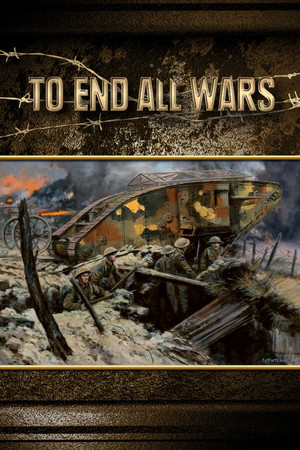
To End All Wars
One of the few grand-strategy titles that takes WWI seriously as a subject - rewarding for wargame veterans, a genuine wall for everyone else.
GamerScout Verdict
Essential for hardcore operational wargamers prepared to read the manual; too opaque and slow-paced for anyone expecting a Paradox-style entry point.
Compare Prices(7 stores)
Every store in this table quotes us in euros, so the EUR figure is the price the seller actually set, not our arithmetic — which is why EUR is also the currency we rank in. We only list an offer here when the store gives us its price in euros, so nothing in this table is a number we invented.
Pick USD, PLN, GBP, CAD or AUD in the header and we convert from EUR at the European Central Bank reference rate — converted amounts are prefixed with ~. Your bank or the store may apply a different rate at checkout. We never hide offers based on where you are: everyone sees this whole table.
We may earn a commission when you buy games through links on this page — at no extra cost to you. It never affects our rankings or verdicts.
Price History
Screenshots & Media
About To End All Wars
I keep a short list of strategy games that actually model logistics as a load-bearing mechanic rather than a footnote, and To End All Wars earned a spot on it. The AGEOD engine runs on a WEGO simultaneous-order system where both sides commit their moves, then watch 15-day turns resolve at the same time - meaning you are always reasoning under uncertainty, which is exactly right for a war defined by fog, attrition, and catastrophic miscommunication. The map spans over 3,000 regions covering everything from the Western Front to the Middle East, with off-map boxes representing colonial theaters so that the global scope of the conflict is at least acknowledged even if not fully simulated. The depth of the military model is the game's strongest argument for itself. You organize units from brigades up through divisions, corps, and full armies, then assign historical leaders whose individual ratings genuinely shape combat outcomes. Over 1,600 named commanders are in the database alongside more than 900 unit types, from standard infantry and cavalry through artillery, aircraft, and capital ships. Air reconnaissance is modeled - and planes are scarce, so deploying them carelessly costs you the intelligence advantage for several turns. Supply lines run along actual railway capacity, which means rebuilding destroyed rail infrastructure is not optional busywork, it is a core part of your operational tempo. The regional decision card system lets you trigger events like surprise attacks, tactical breakthroughs, or trench-warfare specializations, adding a layer of asymmetric choice that keeps repeated playthroughs from feeling identical. Two main scenarios cover the full 1914-1918 arc: one with a historical August 1914 setup, and a second open-start mode where you select your own war plans before the first shot - choosing to invade France through Switzerland, for instance, or keeping Germany on the defensive east-first. Here is where I will be honest about the entry cost, because the critical reception is split cleanly along familiarity lines. Reviewers who came in as AGEOD veterans praised the historical fidelity and the satisfying crunch of the WEGO system. Reviewers without that background frequently described the interface as cluttered and the tutorial as only partially useful - it walks you through basic unit movement but leaves you largely unprepared for the cascade of decisions that arrive in the first real campaign turn. Key commands are buried in small buttons and nested menus, and the diplomacy system - a drag-and-drop box in the upper map corner where you assign ambassadors and wait for dice-roll resolution - is functional but thin compared to the military layer it supports. AI turn processing can run slow given the volume of calculations involved, though post-launch patches addressed this considerably. The Steam user score sits at a mixed 60 percent, which reflects that gap between the audience the game was built for and the wider pool of players who approached it expecting something closer to a Paradox title. For someone willing to invest the reading time, the payoff is real. The engine correctly models the asymmetry between the static, attritional grind of the Western Front and the more mobile, space-heavy warfare in the East and Middle East. Victory conditions run on two tracks simultaneously - national morale representing the home front's will to fight, and victory points tied to unit destruction and territorial control - which means a strategically clever opponent can win without ever achieving a clean breakthrough. The expansion Breaking the Deadlock added further scenarios, and the AGEOD forum community has kept a modding subforum active for years, so the content ceiling is higher than the base box suggests. If you are the kind of player who reads the manual before the first turn and considers supply-chain management a feature rather than a chore, this is one of the most serious WWI simulations available on PC.

Strategy & simulation
Tags
System Requirements
Minimum
- OS
- Vista/7/8/10
- Memory
- 2 GB RAM
- Storage
- 3 GB available space
- Graphics
- VIDEO: 1024Mb video card
- Processor
- Pentium 4 or higher
Keep exploring
Community Discussion
Be the first to comment on To End All Wars.
Reviews & Ratings
Game Info
- Developer
- Ageod
- Publisher
- Slitherine Ltd.
- Release Date
- Aug 29, 2014