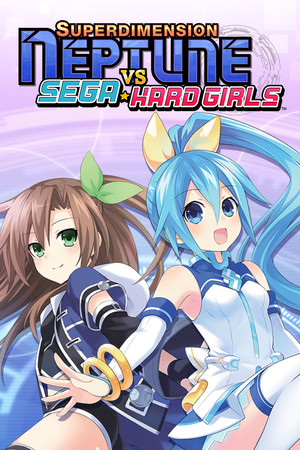
Superdimension Neptune VS Sega Hard Girls
If you grew up watching Sega consoles lose the console war and want to process that grief via time-travel JRPG, this crossover is oddly the right therapy. Niche as a laser disc, but smarter than it looks.
GamerScout Verdict
A surprisingly structured Neptunia spin-off worth the runtime for series fans and Sega nostalgists, but a hard sell to anyone outside that overlap.
Compare Prices(7 stores)
Every store in this table quotes us in euros, so the EUR figure is the price the seller actually set, not our arithmetic — which is why EUR is also the currency we rank in. We only list an offer here when the store gives us its price in euros, so nothing in this table is a number we invented.
Pick USD, PLN, GBP, CAD or AUD in the header and we convert from EUR at the European Central Bank reference rate — converted amounts are prefixed with ~. Your bank or the store may apply a different rate at checkout. We never hide offers based on where you are: everyone sees this whole table.
We may earn a commission when you buy games through links on this page — at no extra cost to you. It never affects our rankings or verdicts.
Price History
Screenshots & Media
About Superdimension Neptune VS Sega Hard Girls
I went into this one skeptical. A crossover between the Hyperdimension Neptunia universe and anthropomorphized Sega hardware sounds like the kind of premise a marketing team invented on a dare. But after spending time with it, I came out genuinely charmed, and mildly surprised at how much structural work sits underneath the pastel aesthetic. The story puts IF (Idea Factory personified, pronounced eye-eff) and an amnesiac girl named Segami at the center of a time-travel adventure. History is being devoured by a creature called the Time Eater, and the two protagonists have to jump across four distinct eras, each themed around a Sega console: Mega Drive, Game Gear, Sega Saturn, and Dreamcast. What makes this more interesting than the usual Neptunia loop is that the structure is deliberately non-linear. You pick which era to tackle and in what order, accepting missions from the Grand Library hub at your own pace. There is even a mechanic borrowed from Chrono Trigger's playbook: the Time Eater is technically beatable early, and story progression functions more as a power gate than a rigid chapter wall. For a series historically accused of handholding its players down a corridor, that is a genuine design step forward. The writing is where the game earns its keep. The comedy is self-aware, fourth-wall-breaking, and frequently pokes fun at the absurdity of its own premise, including the logical holes in time travel stories. Neptune, Plutia, Nepgear, and Uzume all return, though their characterizations here are alternate-universe versions that sometimes feel slightly off from their mainline personalities. Segami, the enigmatic amnesiac, holds her own as a co-protagonist and gives IF a straight-man foil to bounce jokes off. The Sega Hard Girls themselves, Dreamcast, Sega Saturn, and Mega Drive among them, are likeable additions whose inter-era conflicts form the emotional core of each story arc. The comedy hits more often than it misses. That said, if you have no attachment to Sega console history, roughly half the references and emotional beats will land with a thud. Combat is turn-based with some welcome additions. Parties cap at four characters, and everyone earns full experience regardless of whether they fight, which means you can freely experiment with class assignments without fear of falling behind on XP. Classes, including Nomad, Noble Thief, and Scholar variants, level independently from the character themselves, which creates a thin but functional build layer. The Fever Time system is the combat highlight: fill the Fever Meter, grab a rainbow gem that appears on the battlefield, and time stops, letting your whole party unload EX Moves (super attacks) until the meter drains. It is satisfying when it fires. The dungeon traversal also got a platforming injection, with jumping, climbing, and crawling through gaps adding some kinetic texture to what would otherwise be pure hallway-to-encounter loop. Collectible medals and baseballs tucked into each area give completionists something to hunt. Three endings exist, the true ending requiring enough story investment to feel earned without demanding a spreadsheet. The weaknesses are familiar if you know the series. Sidequest design leans hard on fetch-and-defeat loops, and the drop-rate grinding on certain mission items will test your patience. The class-change system, while present, is shallow for most of the cast, and a couple of reviewers noted that Fever Mode can trivialize combat once you understand how to chain it. The Steam port runs acceptably but carries the DNA of a handheld game, and some dungeon visual designs recycle assets aggressively. The tutorial is also bafflingly lopsided, explaining obvious jump mechanics at length while leaving genuinely useful stat interactions like the TEC attribute largely unexplained. For players already in the Neptunia orbit, this is one of the tighter spin-offs in the catalogue, with a protagonist (IF) who gets a rare moment to carry a full story, and a crossover that makes more thematic sense than it has any right to. For complete newcomers, the Sega nostalgia hook only works if you lived through that era, and the broader Neptunia in-jokes will feel like static. It runs about 15 hours to the true ending without heavy side content, which is a reasonable ask for what it delivers.

RPGs
Tags
System Requirements
Minimum
- OS
- Windows 7 (64-bit)
- Memory
- 4 GB RAM
- DirectX
- Version 10
- Storage
- 12 GB available space
- Graphics
- DirectX 10.x or OpenGL 3.3 or better graphics card with 1 GB RAM and support for v4 shaders
- Processor
- 3 GHz Intel i3 or equivalent
- Sound Card
- DirectX 10.x compatible sound card
Recommended
- OS
- Windows 10 Home (64-bit)
- Memory
- 8 GB RAM
- Storage
- 12 GB available space
- Graphics
- NVIDIA GeForce GTX 960 or comparable
- Processor
- Intel(R) Core(TM) i5-4460 CPU @ 3.20GHz
- Sound Card
- DirectX 10.x compatible sound card
DLC & Add-ons for Superdimension Neptune VS Sega Hard Girls1
Expansions, DLC packs and add-on content for this game. Click any item to see store offers.
Keep exploring
Community Discussion
Be the first to comment on Superdimension Neptune VS Sega Hard Girls.
Reviews & Ratings
Game Info
- Developer
- IDEA FACTORY
- Publisher
- Idea Factory International
- Release Date
- Jun 12, 2017