
Stellaris
Put 50 hours in before you see the cracks, and 500 before you stop caring about them. Stellaris is the deepest space grand strategy on PC, but the DLC wall and a shaky 4.0 patch make the entry point complicated right now.
Veredicto de GamerScout
7.8/10Best for strategy players who want a 500-hour sandbox, provided you check the current patch state before committing to a build.
Comparar precios(8 tiendas)
Todas las tiendas de esta tabla nos dan el precio en euros, así que la cifra en EUR es el precio que fijó el vendedor, no un cálculo nuestro, y por eso EUR es también la moneda en la que calculamos el ranking. Solo incluimos aquí una oferta cuando la tienda nos da su precio en euros, de modo que ninguna cifra de esta tabla es inventada por nosotros.
Elige USD, PLN, GBP, CAD o AUD en la cabecera y convertimos desde EUR con el tipo de cambio de referencia del Banco Central Europeo — los importes convertidos llevan el prefijo ~. Tu banco o la tienda pueden aplicar un tipo distinto al pagar. Nunca ocultamos ofertas según dónde estés: todo el mundo ve esta tabla completa.
We may earn a commission when you buy games through links on this page — at no extra cost to you. It never affects our rankings or verdicts.
Historial de precios
Capturas y multimedia
Acerca de Stellaris
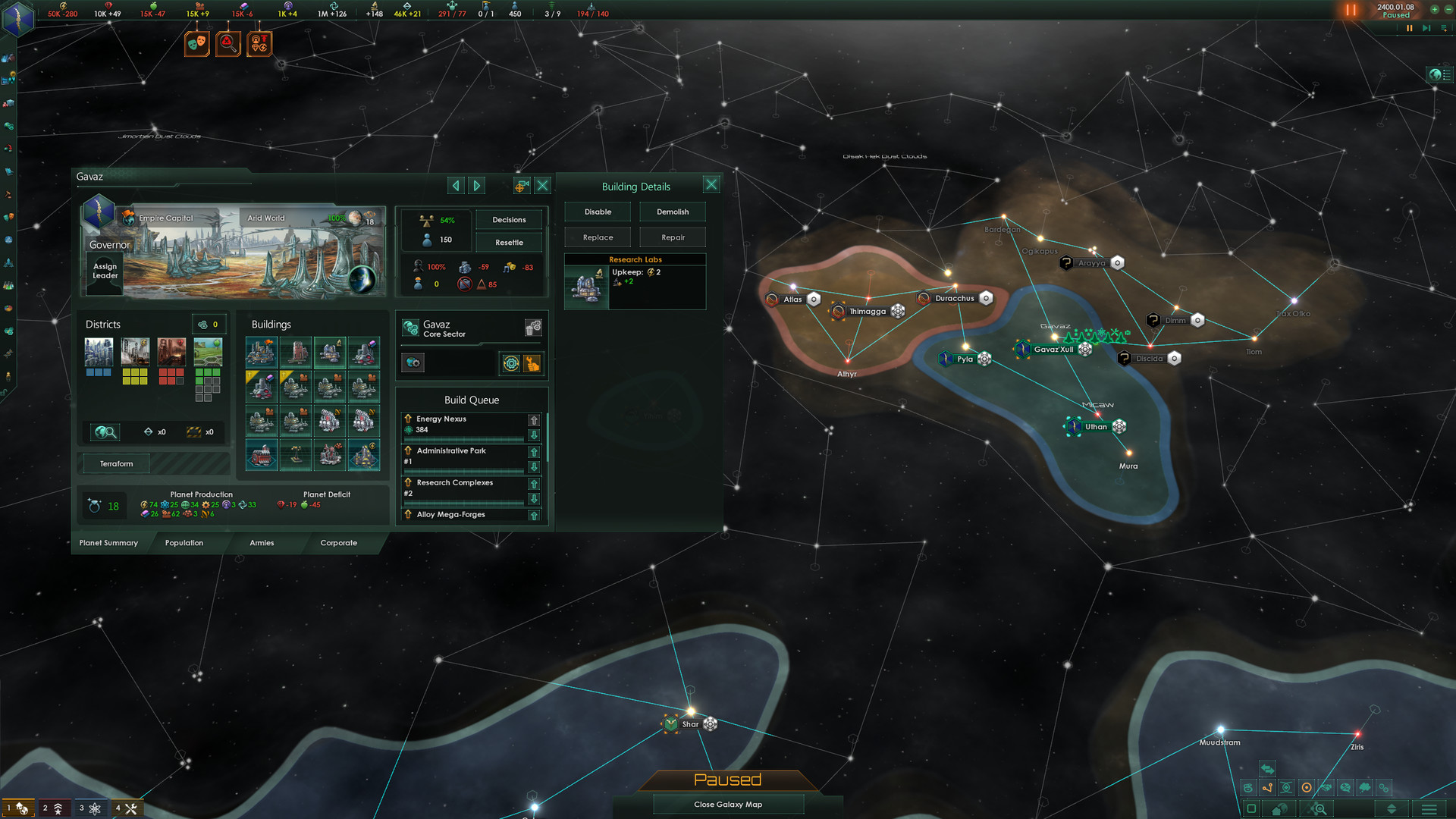
I have lost entire weekends to Stellaris, and I say that as someone who colour-codes patch notes for fun. The loop starts deceptively small: design a species (humanoid, fungoid, reptilian, lithoid, and a dozen more), pick an ethics set that shapes your government, choose an origin, and launch into a procedurally generated galaxy with a survey ship and a dream. Within twenty in-game years the complexity multiplies fast. You are juggling pop growth, planetary district specialisation, research queues, fleet power ratios, and diplomatic posturing against AI empires that range from passable to frustratingly random depending on the situation. The early game rewards exploration; the mid-game is where wars, economics, and federation politics collide; and the late game pivots hard into Endgame Crisis territory, where the entire galaxy unites (or fractures) against a threat that can reshape star systems. That three-act structure is what keeps veterans logging another run. For newcomers, the honest news is that the tutorial does an acceptable job but not a great one. There is simply too much thrown at you in the first two hours, and discovering that you can fully redesign your fleet loadout is the kind of thing that happens eight hours in by accident. My advice: pick a militarist authoritarian empire, set the galaxy to small, and treat the first run as a learning campaign. The mechanics reward patience, and the species customisation and empire builder depth mean no two starting positions feel identical. Every trait point, every civic pick in the government editor, and every ascension perk slot you fill matters by year 2350. This is a game that genuinely respects your decision-making if you put the hours in to understand the systems. The mod ecosystem through Steam Workshop is a serious selling point. UI Overhaul Dynamic alone makes the interface dramatically more manageable, and total conversion mods push the sandbox in directions the base game never imagined. The base game has also been maintained well through free Custodian patch updates that improve existing systems without requiring DLC purchases. That said, the DLC situation is the elephant in the hangar bay. Expansions like Utopia and Apocalypse feel close to essential for a full-featured experience, and the catalogue has grown to a point where new players face a real cost-of-entry calculation. A Paradox subscription exists now, which is probably the pragmatic answer for anyone starting fresh in 2025. There is also a current wrinkle worth flagging. The 4.0 "Phoenix" update, which launched alongside the Biogenesis expansion, overhauled how populations behave, removed trade routes, and restructured district specialisations. The DLC itself has been praised as one of the strongest additions in the game's history, with an overhauled Genetic ascension path and new ship origins. But the 4.0 patch shipped with bugs that made certain empires unstable or outright unplayable for some users. Paradox has been patching actively, and the base game's long-term track record on post-launch support is solid, but it is worth checking the current patch status before diving into a machine intelligence run. At its ceiling, Stellaris is the most replayable grand strategy game in the 4X space. The procedural galaxy, the species and government builder, the branching ascension paths (biological, synthetic, psionic), and a Workshop scene that never stops producing content mean the hours stack up without repetition setting in hard. The AI diplomacy is the weakest link in the chain, and the performance in large galaxies with many empires is a known, long-standing issue that no patch has fully solved. But for players who want a sandbox where every run tells a different story and every build order has a downstream consequence, there is nothing else at this scale.

Strategy & simulation
Etiquetas
Requisitos del sistema
Mínimos
- Processor
- AMD Athlon II X4 640 @ 3.0 Ghz / or Intel Core 2 Quad 9400 @ 2.66 Ghz
- Memory
- 2 GB RAM
- Graphics
- AMD HD 5770 / or Nvidia GTX 460, with 1024MB VRAM. Latest available WHQL drivers from bo…
Recomendados
- OS
- Windows® 10 Home 64 Bit
- Processor
- Intel® iCore™ i5-3570K or AMD® Ryzen™ 5 2400G
- Memory
- 4 GB RAM
- Graphics
- Nvidia® GeForce™ GTX 560 Ti (1GB VRAM) or AMD® Radeon™ R7 370 (2 GB VRAM)
- DirectX
- Versio…
DLC y complementos de Stellaris33
Expansiones, packs de DLC y contenido adicional de este juego. Haz clic en cualquier elemento para ver las ofertas de las tiendas.
Sigue explorando
Community Discussion
Be the first to comment on Stellaris.
Reseñas y valoraciones
Información del juego
- Desarrolladora
- Paradox Development Studio
- Distribuidora
- Paradox Interactive
- Fecha de lanzamiento
- 9 may 2016